Describe your breathing

There is a lot to be learned about how you, and the people around you breath. As a trainer and 1st aider, I try and observe carefully how people breath.

A normal breathing pattern consists of between 12-16 (some argue 12-20) breaths a minute aka your respiratory rate. From a first aid and general fitness perspective breathing patterns out of this range should be investigated.

Respiratory rate has been described as the neglected vital sign, for instance a respiratory rate higher than 27 breaths/minute is one of the most important predictors of cardiac arrest in hospital wards

Changes in respiratory rate seem to be much greater than changes in heart rate or systolic blood pressure meaning that respiratory rate is likely to be a better means of discriminating between stable patients and patients at risk.

21% of ward patients with a respiratory rate of 25–29 breaths/minute assessed by a critical care outreach service, died in hospital. However, its not just the rate of breathing that indicates your current state. How you breath can be critical.

So, can you describe how you are breathing?

Here are some useful descriptive words that will help you categorise and explain to others what you see.

breathless: breathing very fast and hard, for example after exercising

choke  the action or sound of choking

deep breathing a lot of air into or out of your body

deeply if you breathe or sigh deeply, you breathe a lot of air into or out of your body

fighting/struggling for breath : almost unable to breathe

heavily if you breathe heavily, you breathe slowly and loudly

indrawn  An indrawn breath is one that is suddenly breathed in

laboured If someone’s breathing is laboured, they breathe with difficulty, for example because they are ill or extremely tired from physical activity

Out of breath breathing fast and with difficulty, for example because you have been running

puffed breathing very quickly because you have been running, jumping etc

shallow taking in only a little air

sharp a sharp breath is taken suddenly, often because you are surprised

short of breath finding it difficult to breathe

winded unable to breathe because you have been running or have been hit in the stomach.

Obviously you need to put these observations in context. If someone has just sprinted 400m, they will be breathing heavily and be out of breath. But you can see why. If someone has been sitting down for the last hour and they have a breathing rate of 27, you really ought to be getting some help. Apart from breath counting, it’ as well to notice how people are holding themselves, or their posture.

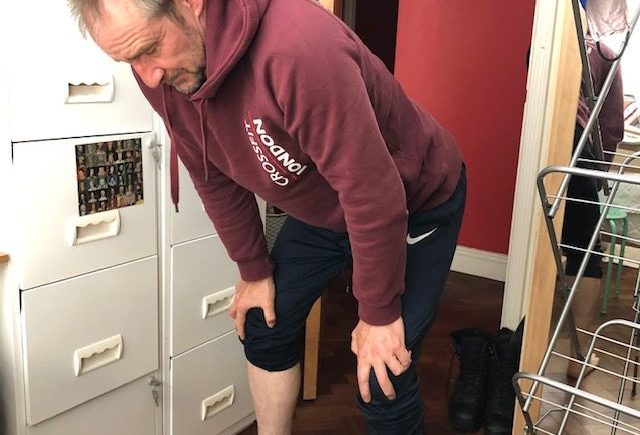
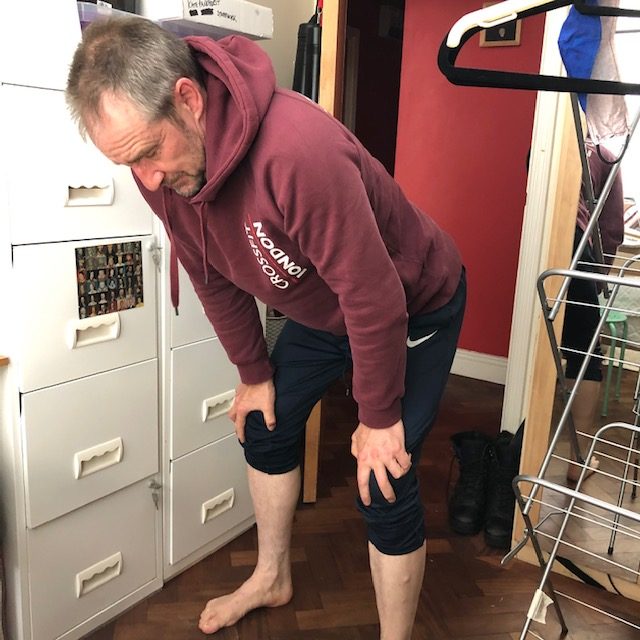
People with breathing issues often adopt a tripod position which is a “Physical stance often assumed by people experiencing respiratory distress or who are simply out of breath. In this position, a person sits or stands leaning forward and supports the upper body with hands on knees or other surface”(source)
Bicep stretch

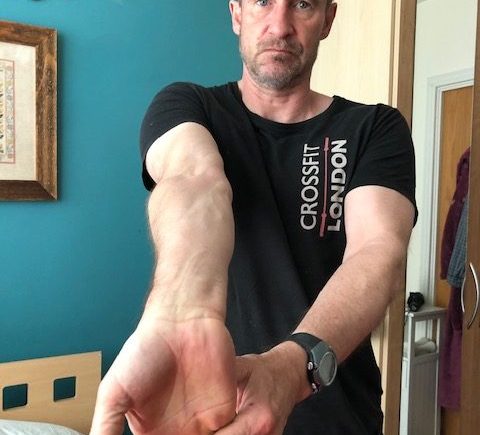
its actually quite a tricky muscle to stretch. Interestingly it inserts into the shoulder and then skips over to the forearm. Speaking with my therapist hat on, I’d say 85 % of shoulder problems have a “poor relationship” with the bicep. Getting some sort of stretch in, is therefore, good.

Stretch No 1

The “just straighten your arm” stretch. Do what it says on the tin. It’s better than nothing

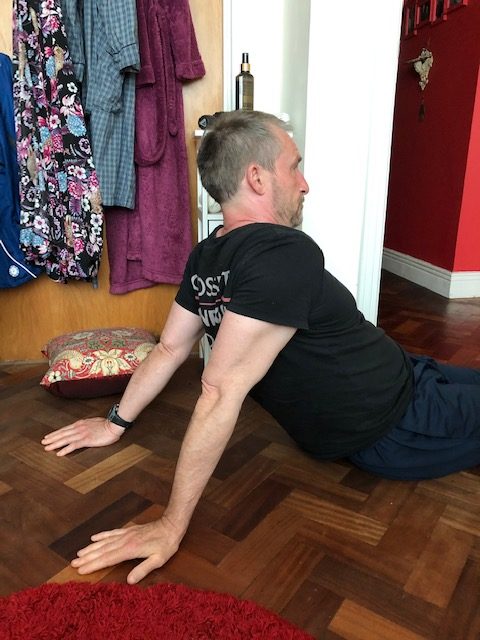
Stretch 2 is more fun. Sit down with your arms behind you and start sliding your bum forward. You’ll either feel the stretch in the elbow, the shoulder or in the belly of the muscle. Over the weeks, focus on getting your hips further forward to increase the stretch. Build to 2-3 minutes

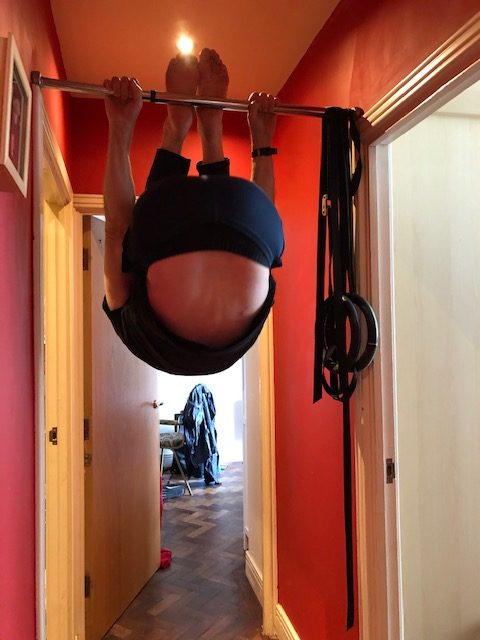
Number 3 is a disgusting stretch, so make sure you have built some stretch capacity by pushing Stretch 2 along for a few weeks. This hanging stretch is stolen from gymnastics and is called the German Hang. Find a low bar, hang off it. Pull your knees through your arms then keep on turning. Lower your legs to the floor and hang in your shoulders. Do start this with a low bar, as you may need to drop straight off even as you get into something resembling the position. Its very intense!

It also helps you understand the meaning of the word “intense”

1 mile running task

If you can run 1 mile in sub 8 minutes: run 1 mile (1.6k) to equal or beat your last 1 mile time. Rest that amount of time, then  run 1 mile (1.6k) . Attempt to keep the same pace ( or faster). ( this amounts to 2 miles (3.2k) in total.

If it takes you  longer than 8 minutes to run a mile,  run  1K   as fast as you can; rest the amount of time it took you to do the 1st  1k. Then run 1 k again. ( 2k in total, not miles)

If your 1 mile (1.6k) time is between 8 and 9 minutes you can choose  which task  you feel will benefit you more. But we are looking at pace and speed if possible.

(new runners feel free to pick 400, 600, 800m as your distance)

Stretching for Plantar Fasciitis.

Whilst I talk about the various therapies and stretches for Plantar Fasciitis here, its worth tuning into the “length of stretch” debate.

If you look at Porter D, Barrill E, Oneacre K, May BD. The effects of duration and frequency of Achilles tendon stretching on dorsiflexion and outcome in painful heel syndrome: a randomized, blinded, control study. Foot Ankle Int 2002;23(7):619-624.

You’ll find two protocols coming neck and neck:

3 minutes of stretching 3 x a day (ie hold the stretch for 3 minutes) , or five sets, 20 seconds each, two times daily.

Either way, the take-home message that a quick reluctant 10-second stretch when you can be bothered, isn’t enough. The study also determined that both sustained and intermittent Achilles tendon stretching exercises increase Achilles tendon flexibility. This increase in flexibility correlated with a decrease in pain!

This is an idea that features heavily in my fix your plantar fasciitis course. It’s only £27 and has the most effective science-backed drills. Never waste money on physical therapy again!!

if you’d like other stuff sent to you free of charge, do join the mailing list

Stretching your quads

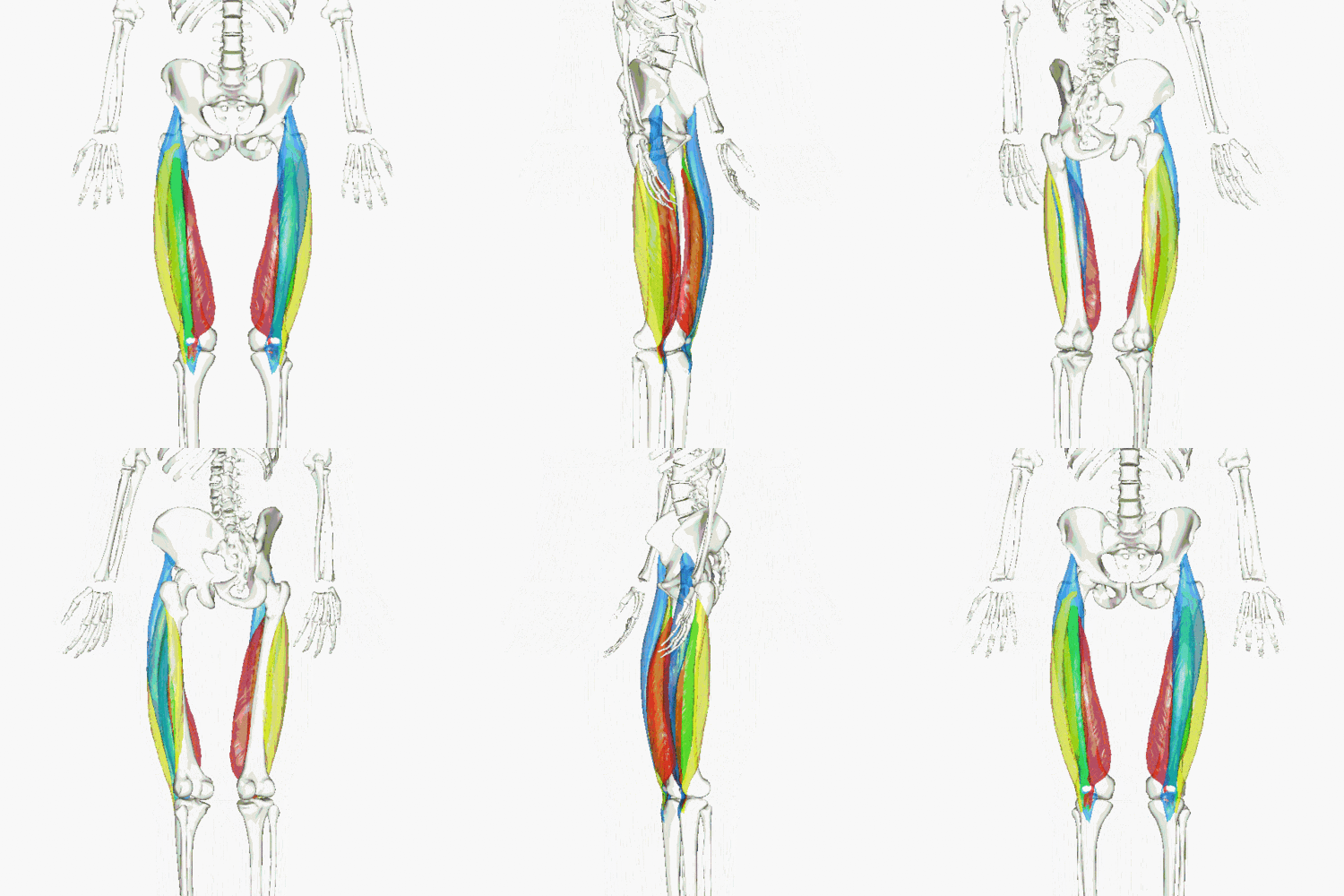
It’s impossible to get fit without someone reminding you to “stretch your quads”. The quads, or quadriceps ( quad for four) run up the top of the front of your leg. Three of them go from the knee cap to below your hip. One goes across the knee and then across the hip. Here is a useful graphic from wikipedia

Stretching these muscles is important as they are the ones most likely to become short if you sit too much. We all sit too much.

Here is the standing quad stretch that I think everyone must have seen at some stage

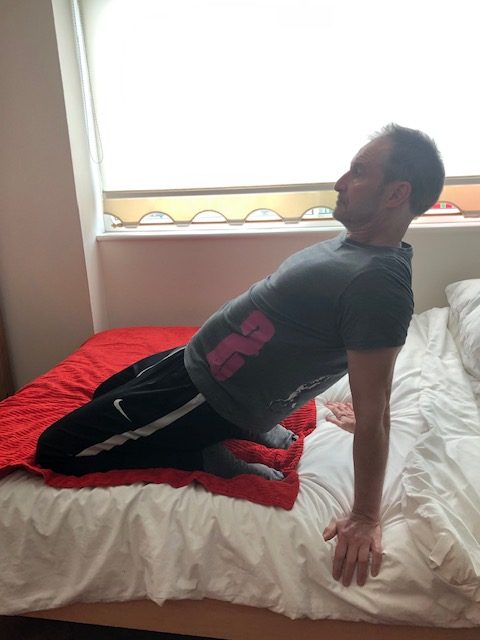
But this is just the start of your quad journey. Get on a bed (or anything comfy) and kneel down

Put your hands behind you and lean back. Some may find this hard. Don’t worry, just keep on getting used to it. Just incase you get stuck, it maybe as well to have someone around to pull you back up again if you cannot get back up again.

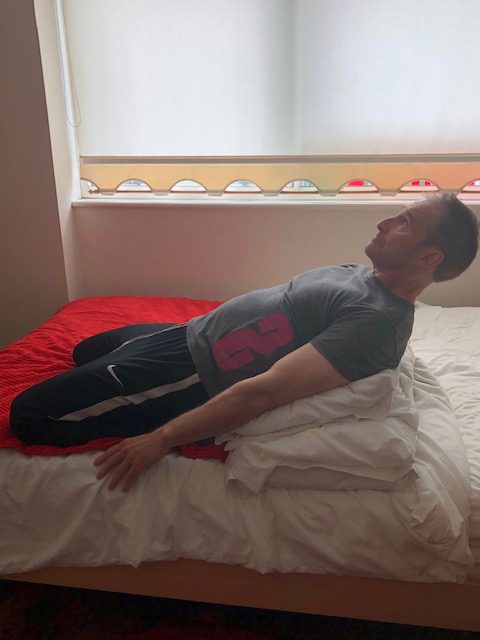
Once you build your confidence, get a cushion pile and slowly take a cushion away each time you try

Eventually you’ll simply lie down. you’ll notice my hips are fairly high, so to be a quad stretching master, eventually you need to pull your hips down.

Unfortunately, you probably need to build this up to 3 minutes. If your ankles are very tight you may need a small roll (a towel) under them, as the initial stretch can be quite intense! Enjoy. Slowly build up your time and tolerance. In the early stages, it’s just about getting used to it.