Do at least 10,000 steps a day

“10000 steps a day. Yep, that’s 10 thousand steps every day . Go and buy a cheap pedometer or look up if its already on your phone,, and record how many steps you take each day. This is your baseline of daily activity. Any gym work or running around is training and is extra . This is the minimum amount of movement you do to keep ticking over.

Frequently I see people work quite hard in the gym for an hour, but are totally sedentary for the rest of the time. The gym session barely compensates for their lack of day today movement.

I also see many sports people, who apart from the weekly football match, are to all intents and purposes, sedentary.  So,  put that pedometer on, check your phone and review your daily count.

Lifestyle IndexSedentaryLow ActiveSomewhat ActiveHighly Active
Steps/day*<50005000 – 75007500 – 10,000>10,000

But don’t worry! slowly build up your activity level if you find yourself in the sedentary box! Get active at work

for some science, look at

Effects of a 10,000 steps per day goal in overweight adults” by Schneider et al (Am J Health Promot. 2006 Nov-Dec;21(2):85-9.)

Some points need to be made

1) the 10,000 steps is a fantastic way to assess basic activity. Ive helped people who could  only manage 3000 steps in a day and the effect was remarkable.

2) 10,000 steps a day is the very least you should be doing.

However,  if you present 10,000 step Versus almost anything else, anything else is probably better: Brisk walking is better, a  fast 400m  run or a Crossfit Workout is better, indeed a  life and death brawl at your local pub really gets the blood pumping. The issue is this: you have to really be sedentary to do less than 10,000 steps a day, so its  a great baseline and target and you should always do more.

3) the message is “do both”.

So, its 10,000 steps each day, plus a workout

[mc4wp_form id=”832″]
Check Your Oxygen saturations

Lon Kilgore wrote in ‘The Paradox of the Aerobic Fitness Prescription” (Crossfit journal) that improvements in oxygen management could be driven by dropping Oxygen saturation during/after exercise. The logic of the General Adaption Syndrome (Seyle) requires an alarm phase to provoke adaptations.

“In the intermediate trainee and beyond, it is the depression of oxygen saturation as a result of interval training that forces the muscle to adapt to improve its ability to extract and consume oxygen to power exercise. Oxygen saturation is a marker of the specific driving force of VO2max gain*. If a beginner does long-slow-distance work and blood oxygen saturations drop 1% or less to 97%, this is enough to drive adaptation. But intermediate, advanced, and elite trainees need more. They need a drop in oxygen saturation to as low as 91%, maybe even lower for an elite athlete”

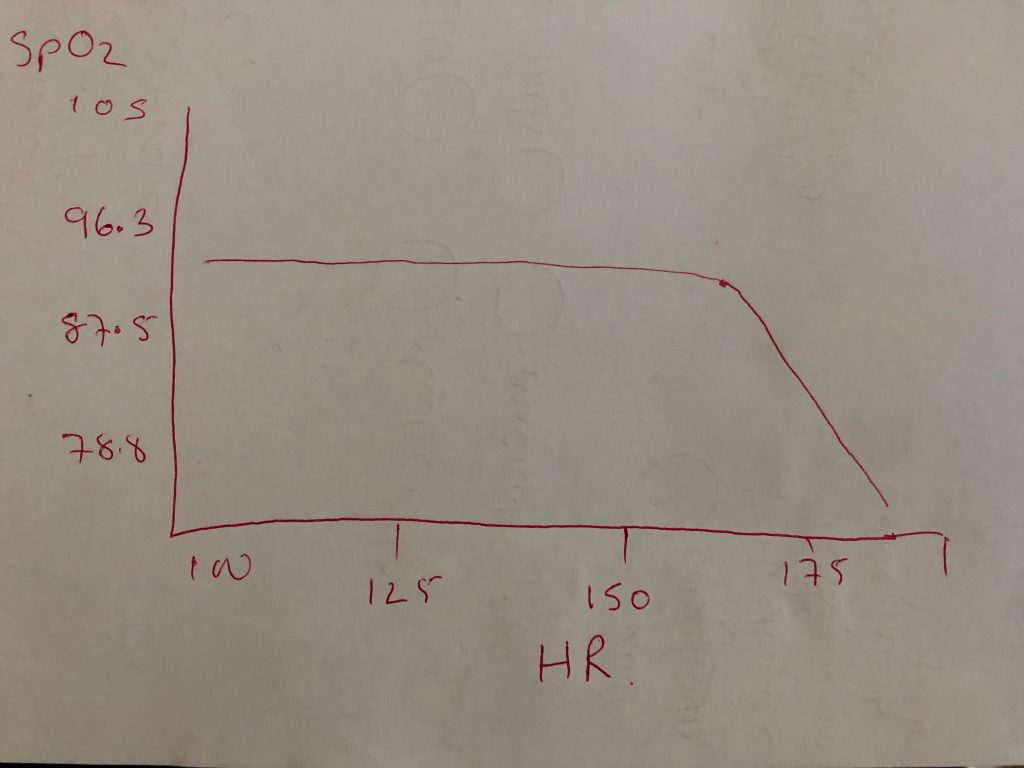
This observation was supported by David Lin et al who wrote “Oxygen saturations and heart rate during exercise performance” There is a fascinating write up here This basically showed that at a certain level of work, you can see a  drop in O2 saturations

i

“SpO2% desaturations during maximal performance levels with power bursts into the clusters as revealed in this test could lead to measures of intense interval training providing an important augmentation to sports conditioning. “

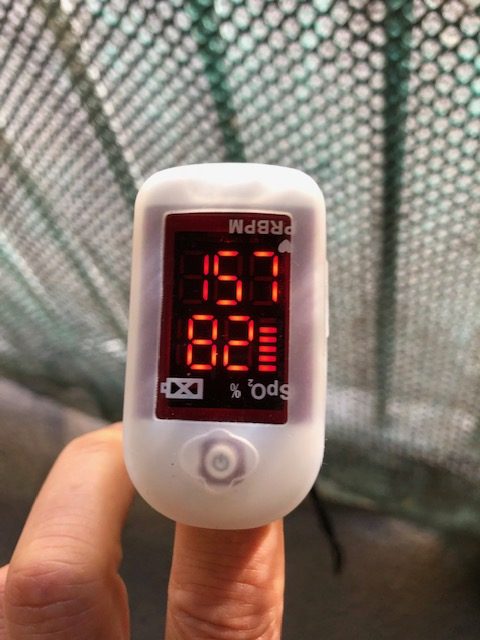
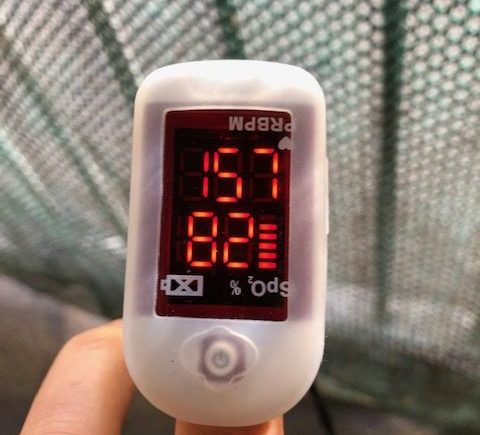
This mornings workout was a 15 minute AMRAP of 20 kettlebell swings, 15 double unders 150m sprint . I decided today, I’d take my pulse oximeter down. About half way through, straight after my double unders and during the run I managed to get my pulse ox on and this reading came up.

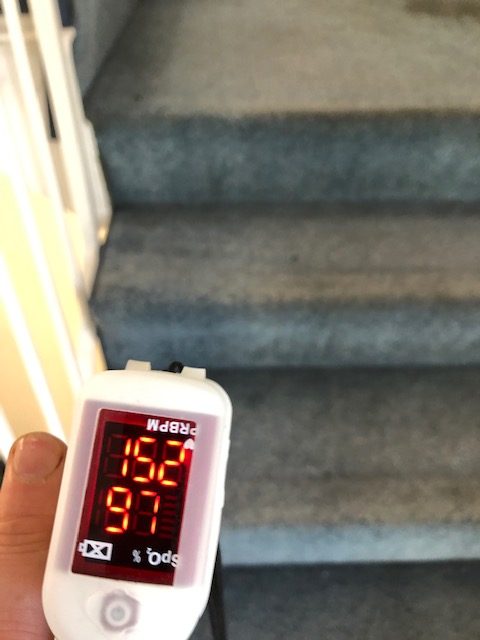
After a quick  recovery our workouts always end with a disgusting stair climb to our flat ( to get home and haul the kettlebells back up) At the top it always feels as if you are going to die. As I reached the top I managed to get my pulse ox back on and whilst my heart rate was 160, my O2 saturations were 97. It took me a while to get my phone out so I only got a photo after my heart rate had dropped to 152

My take home conclusion  is that the variation in a workout combined with power (in his case jumping in the double unders) really stresses the oxygen system. The requirement to rapidly change from one exercise to another  takes the body by surprise and has it scrabbling around for oxygen like a pandemic government trying to buy PPE. BY comparison the rhythmic stair climb. which felt disgusting, and produced a highish heart rate, didn’t disturb my normal reading of 97%.

Obviously this is an old Pulse oxmimeter (new one here), this wasn’t a clinical environment ( no lab rats, no one had a clip board), but it was an in treating bit of citizen science!)

If you have never heard of it *According to wikipedia “Oxygen saturation is the fraction of oxygen-saturated hemoglobin relative to total hemoglobin (unsaturated + saturated) in the blood. The human body requires and regulates a very precise and specific balance of oxygen in the blood. Normal arterial blood oxygen saturation levels in humans are 95–100 percent”

For the normal person, you want to check that your O2 saturations are around 97 say, once every week or 2 weeks. When you get diagnosed with a breathing condition, your doctor will suggest to you that readings of 88-94 are acceptable. If you doctor has not told you, and you get O2 sats at rest of, say, below 90, its time to report that reading to your doctor and get them to run some more tests.

Amazon have a nice range of Pulse oximeters, and this one for £19.98 caught my eye ( as did Its qualification under the EU medical device scheme

To get more home monitoring and health ideas, do sign up for my newsletter!