actually, this is my 3rd go.
What I have done is to add a lot of ancillary conditioning that I do on my own. More of that later
actually, this is my 3rd go.
What I have done is to add a lot of ancillary conditioning that I do on my own. More of that later
I don’t know where to put my foot in the lunge for the round off.
This drill helps me think about where it should go. Notice the wobbling knee,and the physical uncertainty. No wonder I cannot drive power into this position. But still, its a drill I can work on
Damn. This has been added to my target list.
For my new routine, I need this. Its called an Upstart.
Just so you can get on board with the injustice of it all, in April 2013 I did my 1st ever unspotted back flick at the age of 52. It was clunky, legs bent etc, but it was a back flick. Throughout the rest of the year, while working on my Tucks and P bars and round off and muscle up and up rises ( the list is endless), and in between back injuries, Elbow tendonitis and adductor tear ( in both adductors at different times). My back flick slowly improved it, but became dependent on an emotional spot. I had to have my coach by me, to lightly touch my back before I “went”. There was no actual spotting, but my mental dependence grew and grew.
We started solving this last week: ie my coach started stepping back.
Boom!!
My form collapsed totally and my back flick, when I can pluck up courage to throw one, is now heavily twisted to one side or the other and is “dangerous”.
In catastrophe theory, I hit my bifurcation point. This is that teeny change that collapses the whole structure and from which there is no going back: imagine counting from 1 to 5. And you do it well.
“1.2.3.4.5”
Now your teacher say, ok this time count to 6… you go
“7, 2, sob, london , kitty cat”
So your teacher goes, ok, ignore the 6, lets stay with the 1-5. You go, great!
“ paris, 4, hiccup, moon beam”.
Hitting a bifurcation point, destroys everything you have built up, its not a question of taking one step back to where you were: everything gets demolished.
You can try charging at the back flick ( go to a pit and throw your self in, time and time again) but , bearing in mind that a back flick involves jumping backward upside down and landing on your hands and is 100% technique based, a temper based solution isn’t the way.
This brings me to some observations which is based on the Crossft London teaching method, some of Grigori Raiport’s work and gym bunny rumour.
An interesting bit of advice is to “keep your mind tight”. Everyone talks about abs and glutes: maybe you need to keep your mind focused too. Just throwing yourself backwards doesn’t work.
That said, what does that mean. I know many gym goers who pronounce the value of special thinking and of special mind techniques, but frankly they normally deal in simple moves.
I offer several approaches to solve and maybe avoid blocks
1) Practice the basics
Where possible, base your skill training on proven progressions, build these progression into your warm up. You never know when you will injure yourself or have a brain malfunction and need to retrace your steps
The moment you hit a (new) problem your brain goes into an emotional overdrive. Many solutions are quite basic, but in my opinion, panic, combined with laziness and a wish for drama makes finding the solution difficult.
I once (back in 1979) had a friend who was really nasty ( and abusive and violent) to his girlfriend. She eventually kicked him out. He decided to win her back. His strategies, as I recall, ranged from expensive romantic dinners, to getting a violinist to play while he begged under her bedroom window, I think he even thought of (a mock) sucide. “then she’ll be sorry…..”
Never did it occur to him to be truthful, loyal, loving, sober ,patient and kind.Basics!!!
2) Get your mind to control your body.
Its a bit of a negative view, but there are streams of thought that say, left to its own devises, you will be lazy. In short the body will get away with whatever it can if the mind lets it. If the mind gives up, or goes soft, the body wlll auto pilot for a while, then it will do what the hell it likes.
You must have been in one of those classes where you mucked around. You could sense the teacher wasn’t in control, and off you went.
So with these models in mind I re-looked at what happened running up to my failure.
I tore my left adductor about 12 weeks ago then, screwed my back in a deadlift workout, and then we had a lovely time in Madrid. I had planned a lull to write a bit more and over the last few weeks was able to stay in bed longer, ( certainly later) and stay up late. I was able to lounge around on a soft sofa. In short a long way away from my normal regime. In short I let everything go. My routine went, my focus and drive went with it.
My mind surrendered authority, my body lost strength.
So why the hell would any animal throw itself backwards ( upside down…onto its hoof presumably) for a lazy master.
Here then is the value of underpinning conditioning. No matter how good you do the big skills, do the progressions and your under pinning conditioning often and well because, not only are they useful rehearsal , but its is a message to your body that you, not it, is in charge.
3) that said, it takes a while to re establish control, so there’s nothing much wrong with laying off a hard skill for a short time, while you re-establish control
If its10 push ups, a run, or a WOD drive yourself to do it regularly,
Allegedly, repetition works
But, please stay in control
Its as well to add some basic parallel bar work into your gymnastic training. Begin by conditioning the chicken wing dip, which means you can support your body weight on your upper arms.
There is a danger in learning only the strength elements of gymnastics: Sure levers, muscle ups are cool, but so much of the lessons of gymnastic rely on you understanding how to efficiently use gravity, angles and lean the achieve movement.

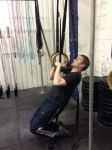
To learn the muscle up, you must at some stage use the kneeling muscle up drill: but there are 2 set ups. A crude, arm strength builder, is with the knees under the rings where the pull is straight up. This is a great starting point as it improves arm strength, although the ideal movement pattern isn’t trained. Another variation of this exercise moves the toes under the rings and brings in a larger lean back. Here the pull is, in theory. to the hips, meaning the shoulders have the space to be swooped over the rings by a drop of the feet. This drill requires no break at the hips. Ill try and do a video later.
in the meantime, think about what a lean in certain circumstances can achieve

The lean, can direct energy
a useful extra drill
Legs straight!!!!
More shoulder flexibility
More lean….ish
Still “ugly” I want to be graceful….
2 Major problems (there are more) in the back flick
1) failing to lean back to approx 45 degrees as you drive
2) failing to co-ordinate arms and legs
3) sort of , failing to think about the arms leading the way and reaching for the floor behind
 Andrew Stemler