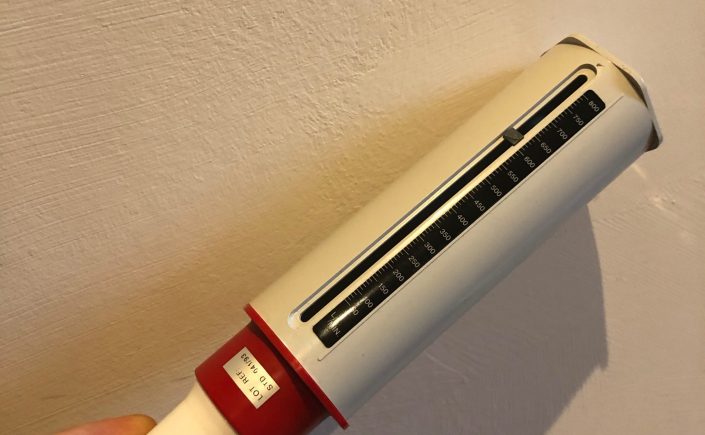
Before anyone starts criticising your breathing and setting you weird breathing exercises, make sure they have at the least taken a peak flow reading. This is where you puff down a tube and compare the reading with your height, so you can monitor your lung function. There are too many trainers hanging around who attended an online course and are now taping peoples mouths up while exercising with very little assessment of the science behind it.
Make sure they do some basic assessments first. The peak flow meter is one of those basic tests! You may need breathing drills.
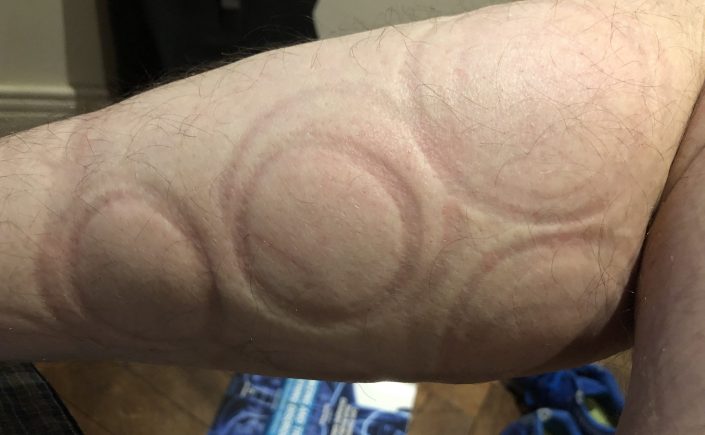
It’s such a shame. After that olympian guy strutted out with cupping bruises over his body, many people wondered and hoped that cupping could be the new secret cure for injury and pain.
I now publish regular breathing drills and give the occassional zoom seminar . However, breathing has been one of those ongoing issues where people have been able to misrepresent, twist and ignore the science.
This goes for exercise professionals, miracle healers and straight up loonies.
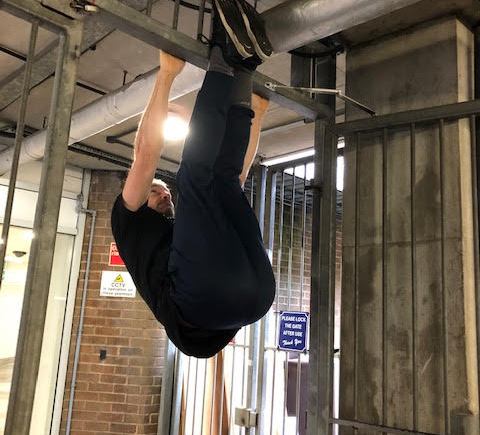
A cute little workout: 10 dumbbell snatches left, 10 right, 1 turkish get up L, 1 turkish get up R, 10 toes to bar. Amrap 12 minutes. I discovered I could use the door frame of the security gate. which added a few interesting challenges. The square shape gave my fingers and hand a “novel grip experience” and because there are bars coming off it, you have to control where your fingers go, otherwise you can smash them up.
Most days I’ll post a workout you can do with minimal equipment and no gym access. It be will be on a 3 day on, 1 days off rota
The “gym-less” workouts only assume you has access to 1) some dumbbells 2) a kettlebell 3) a skipping rope 4) a car park and some benches.
Obviously a full Crossfit or exercise regime requires more stuff and more variation, and ill encourage you to practice and train in weightlifting and gymnastics and other forms of cardio, but doing these workouts as bits of intensity (hard and fast) should help most people
So todays workout is
With a running clock set for 15 minutes as many rounds as possible of
20 lunges, 20 double under’s, 100m run.
Feel free to tweak everything: 10 lunges, 10 single skips, walk 50m for 7 minutes 10, or 12 minutes. If there is an exercise you cannot do or tweak, feel free to switch it with one you can do, or just leave it out and practice it later if you can.
If you are in chronic pain take it easy, feel free to limit the range of motion, feel free to rest if you must, but it’s simply about pushing you on a bit or a lot, depending on where you are
For food, ill be recommending the Zone diet . For now this is a TWO BLOCK snack, or “brunch” if you prefer.
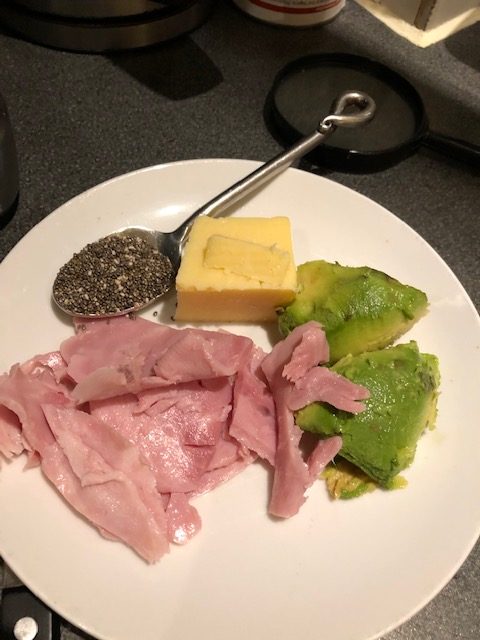
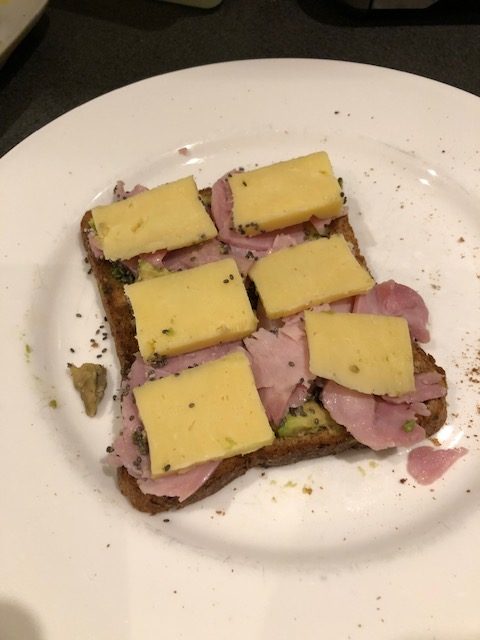
This snack had 2 blocks of carb in the form of a slice of bread, 2 blocks of avocado (In the form of 2 (overly generous) teaspoons ) 42g of ham (as one block of protein) and 28g of cheese (as another block of protein).
I sneaked in a tea spoonful of chia seeds for extra fibre and a mini scrap of butter as an old habit
and ended up on toast like this
I’ll be explaining in great details how the zone block system works, but its intention is to ensure that each meal or snack has a balance of the main 3 macro nutrients: carbs protein and fat.
Ill be a launching a free ” how to zone course” some time in the next few months so do join my mailing list and ill tell you when you can get it
Underpinning every psychological approach to back pain is education.
It’s seen as crucial that you understand the mechanisms of pain within your body. So here is a super simple introduction to the basics of pain. I started teaching in our kitchen:
We have that basic banana approach. We can now build up to a bit more of a technical overview. You’ll see, I got kicked out of the kitchen, into the bathroom!
now, its up into the brain! We were relocated to the bedroom
Its back to the bathroom to remind ourselves about what switches nociceptive neurons on and off
back into the bedroom to look at “inhibitory interneurons” and “enkephalins”
Helping you understand how pain works is certainly the approach used by Dr Sarno in his TMS (Tension Myositis Syndrome)programme and Dr Schubiner in his MBS ( Mind Body Syndrome) programme. I just think our educational process is a bit funnier!
The Backaholic course should be ready in late August/early September, so if you want to fix your back pain, do sign up for our newsletter so you know when its available! Obviously we will send out lots of handy hints and tips between then and now.
[mc4wp_form id=”345″]
The big warning. Some back pain is really serious: check your RED FLAGS by clicking here
No modern discussion of flexibility, trigger points or pain is complete without talking about fascia.
I was introduced to fascia by Julian Baker of the Bowen technique during some guided dissection sessions back in 2012 ( which means I have dissected corpses as part of my studies).
Its the “sort of fatty stuff directly under your skin See here
Years ago this “stuff was simply cut away by laboratory assistants so you could see the actual muscles.
It’s only now that people see this as a new communication highway for our endocrine, circulatory, or nervous systems.
Today much “tightness” is attributed to dysfunction in the fascia. Although this is far from proven it’s useful working hypothesis that makes us focus on trigger points. They are “a hyper irritable locus with a taut band of skeletal muscle, located in the muscular tissue and/or its associated fascia.”
Sometimes called knots, trigger points can be quite painful, will cause stiffness and weakness of the affected muscle, and restrict the muscle’s full range of motion.
Fascia can also stick to muscles in what Gill calls “fuzz” ( if you cannot pick the skin off your muscle, its arguably adhered and interrupting muscle function, reducing range of motion
When poking around your body, you can often find what needs attention if 1. You press on the skin, and its super painful with pressure 2. you cannot pick the skin away from the muscle. This should glide, not stick 3. You feel special tension in an area when you stretch
This is sorted by, being bothered enough to do something about it. Practically that means a mix, but consistent mix , of gentle (and not so gentle) massage, skin rolling and pressure applied by your fingers, objects, cupping, or better still someone else.
This stuff goes under the heading of Myofascial Release.
It’s uncomfortable which is why few people use it or do it. Sort of like flexibility. You have to get used to that weird discomfort.
The problem is that medically, no one wants to be a muscle doctor. So it’s the orphan organ.
If you have enough flexibility to squat, why do you need more. Crucially, if you cannot squat well because of flexibility who cares. Most lift the weight anyway, and if they screw their back who cares!
Stretching is uncomfortable, boring, the evidence is very conflicted and many charlatans insist that flexibility is a “star gate” to spiritual well being and enlightenment. This obviously puts any right mind individual off stretching.




 Andrew Stemler