DWF: a curry and a cute workout.

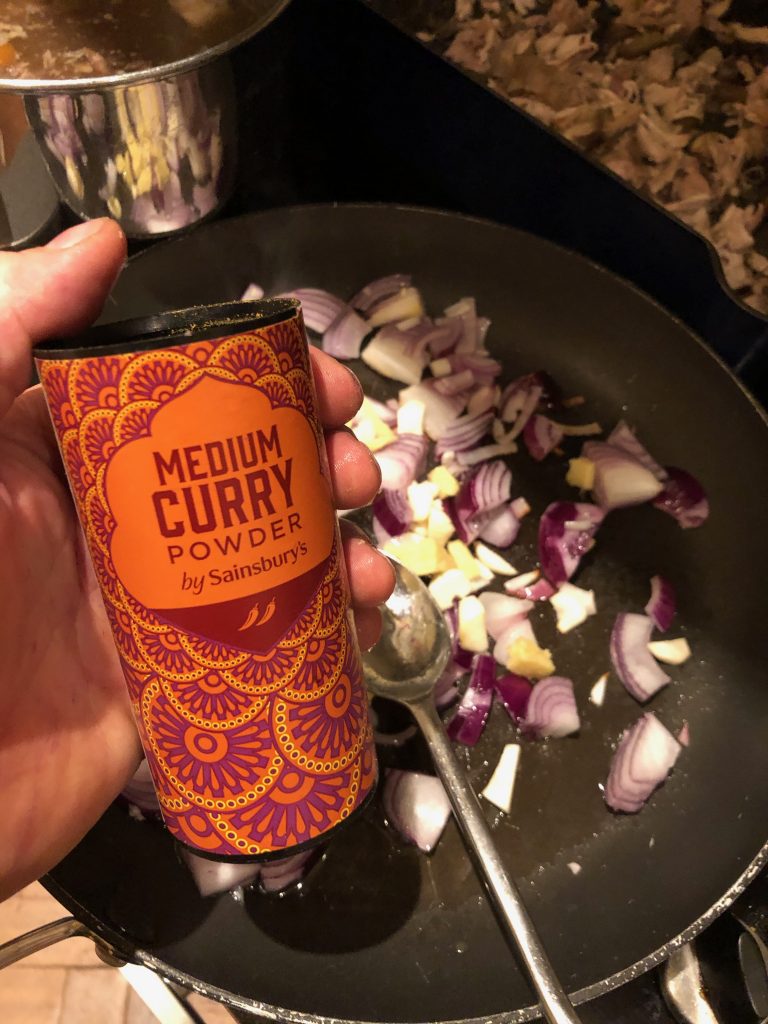
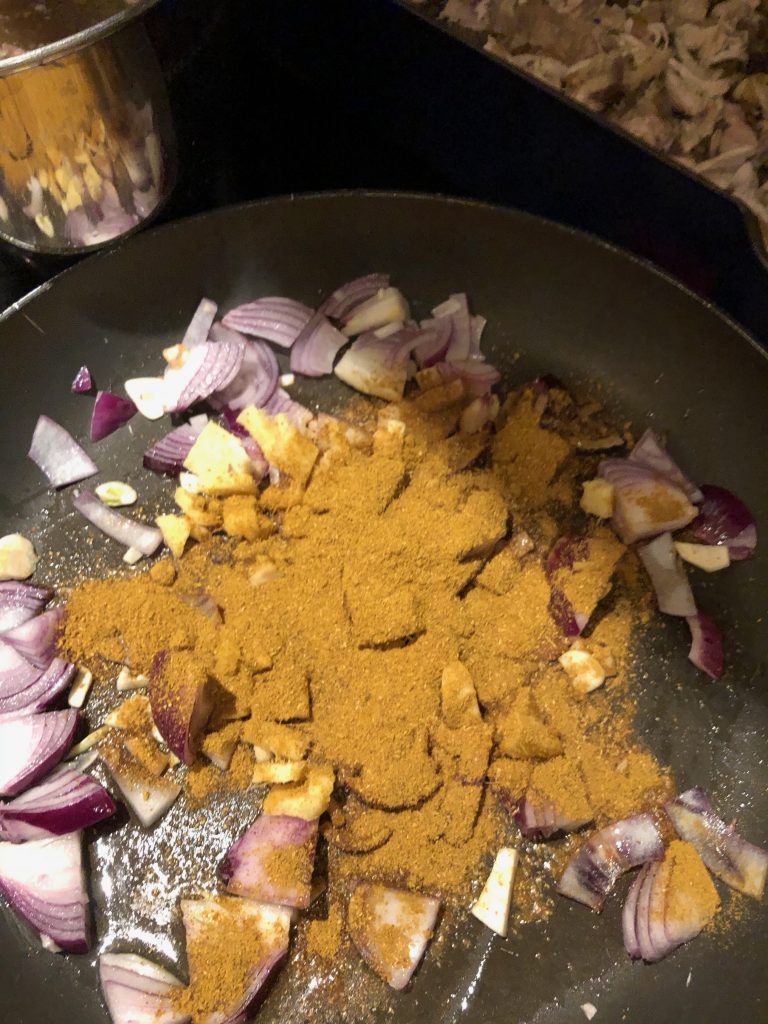
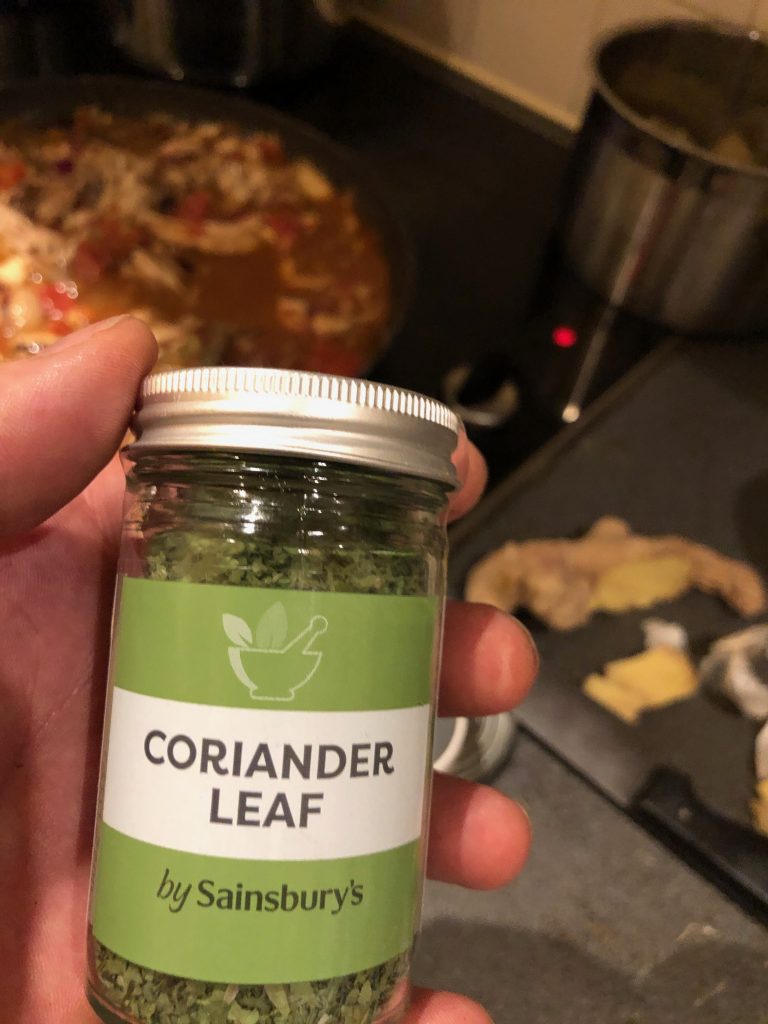
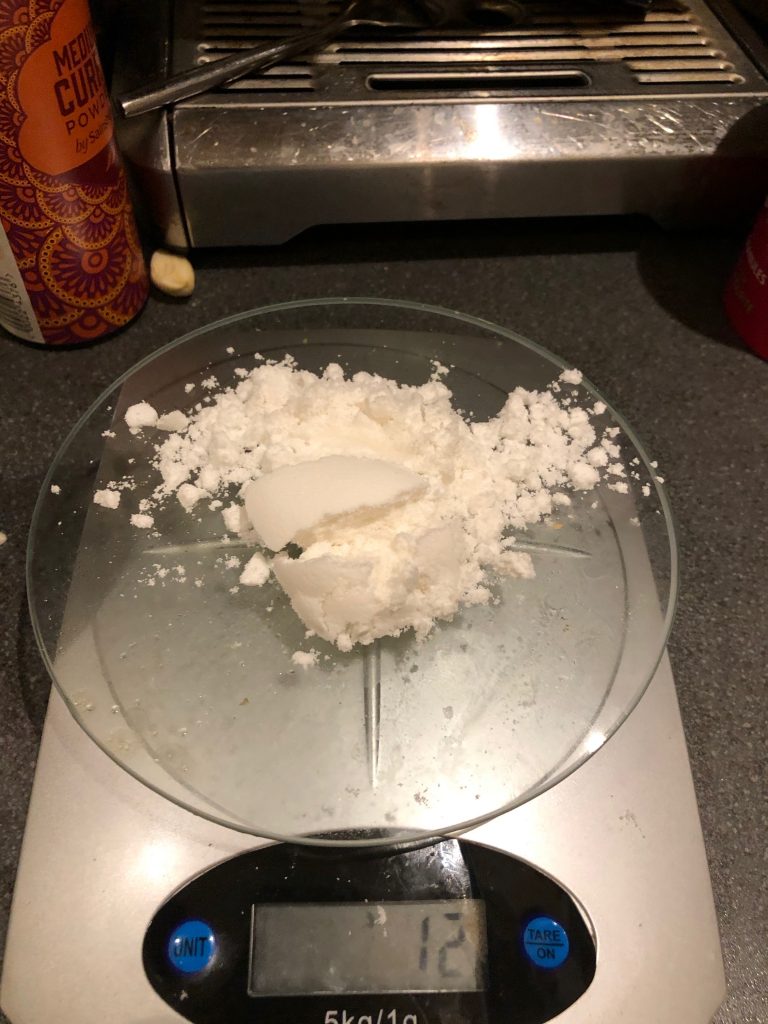
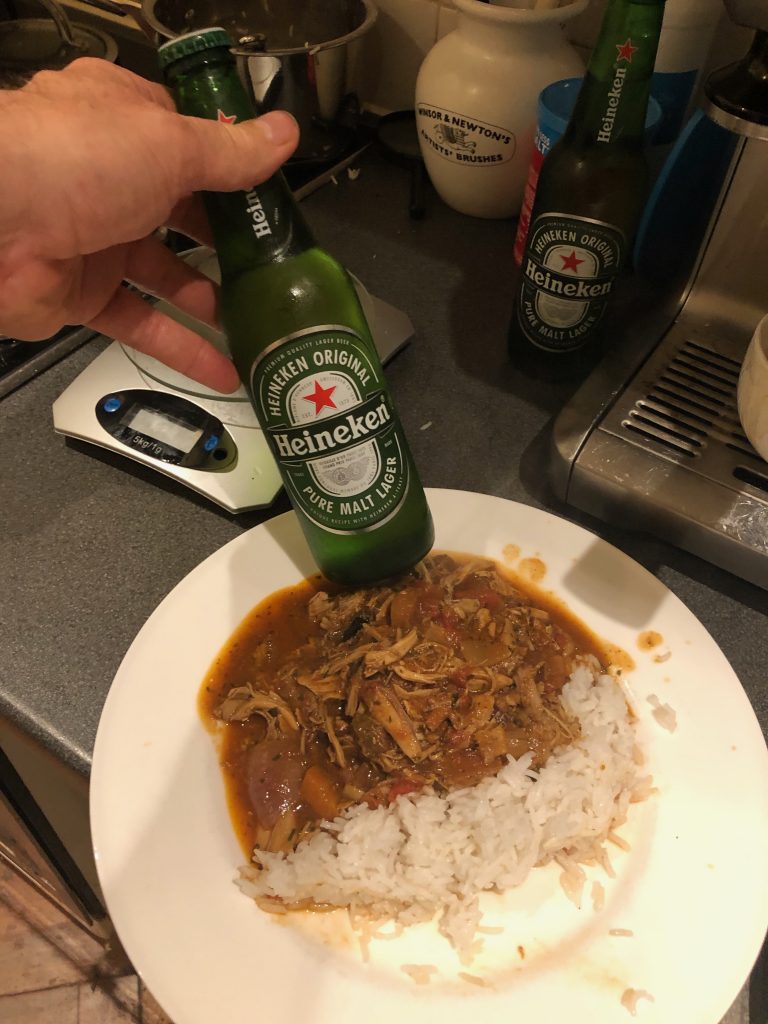
Here are some action picks from todays curry task. Everything you need to make a 4 block curry meal, with a bottle of beer.

Using yesterdays pulled chicken and some stock made from the bones, it was chicken curry time. 93g of rice (3 blocks) 120 g of chicken (4 blocks) buried in a sauce of stock and tomatoes, plus tomato puree with onions, ginger, toasted and crushed cloves, coriander, garlic, curry powder and a bit of coconut milk powder.

This sort of meant there was room for an extra 9g carb block (1 block). I sneaked in a beer at 12g of carb, so 3 g over But I knew I was going to do this so I slightly cut back a previous meal.

Nice, but I should have put a bit of chilli in. For me the ginger and clove is enough of a bit, but today it would have been better with a bit of chilli.

THE WORKOUT

An escalating ladder of 1 D/B snatch L&R, 1 push up, 5/10 V sit ups. Then 2 D/B snatch left/right, 2 push ups, 5/10 V sit ups ( 5 for kate, 10 for me.) The V sit up work stays the same each round) ( next round is 3 D/B 3 push ups)

As high up the ladder as you can as you can get in 13 minutes. Depending on the stimulus, you may want a light, medium or heavy dumbbell.

It was surprisingly disgusting .

This is day 3, so tomorrow is a rest day!

[mc4wp_form id=”832″]

DWF: chicken dinner and a strength day.

THE FOOD . A zone Chicken dinner.

Here we have 112g of roast chicken, (4 blocks) 150g of boiled potato (3 blocks) . I rubbed 2 blocks of butter onto the chicken ( kate loves her crispy skin) and put about 2 blocks of butter onto the vegetables. I boiled up a “mess” of courgettes, broccoli and cabbage, served with an ” as much as you can eat” mentality. Any diet that restricts non starchy carb should be avoided. As many veggies as you can get down I say!!

Use the veggie stock to make gravy (with the juice from the chicken)

The sneaky “bad” things I did were: 1) slung a glass of wine into the baking pan, to support the juice from the chicken and the trivet ( thats the bed of onion, celery and carrot) hoping that most of the alcohol had boiled away ( check if I”m delusional, by following this thread) and 2) stirred in 2 tea spoons of gravy powder which had a bit of carb in. I’ve ignored that as it minor and life is too short.

Delicious and filling!

Straight after diner, when the chicken is cold, rip it off the bone, with your hands. Put the trivet and the bones and any remainder gravy/juice into a pot to make a stock ( you’ll need this for tomorrows curry)

THE WORKOUT

Today, kate and I are off to the gym ( at the amazing Crossfit London) to do a strength workout 3 sets of 5’s of deadlift, squat and press.

If you are stuck at home can I suggest 3 sets of 10 kettlebell deadlift (holding whatever weight kettlebell you have), 3 sets of 10 goblet squats, ( with a weight you can cope with) and 3 sets of 10 dumbbell press. Do these with rest periods as a strength session, not a mad workout!

Not every workout should be a near death intense workout, you need to sprinkle in strength ( and you’ll see the odd run now and then)

If you want more hints and tips do join the mailing list. Ill be launching a free Zone course and I’ll email when it’s ready.

[mc4wp_form id=”832″]

To see if I have time to help you personally in an around the city and the East End of london, do drop me an email Andrew@andrewstemler.com

Introducing the Daily Food and Workout:DFW

Most days I’ll post a workout you can do with minimal equipment and no gym access. It be will be on a 3 day on, 1 days off rota

The “gym-less” workouts only assume you has access to 1) some dumbbells 2) a kettlebell 3) a skipping rope 4) a car park and some benches.

Obviously a full Crossfit or exercise regime requires more stuff and more variation, and ill encourage you to practice and train in weightlifting and gymnastics and other forms of cardio, but doing these workouts as bits of intensity (hard and fast) should help most people

So todays workout is

With a running clock set for 15 minutes as many rounds as possible of

20 lunges, 20 double under’s, 100m run.

Feel free to tweak everything: 10 lunges, 10 single skips, walk 50m for 7 minutes 10, or 12 minutes. If there is an exercise you cannot do or tweak, feel free to switch it with one you can do, or just leave it out and practice it later if you can.

If you are in chronic pain take it easy, feel free to limit the range of motion, feel free to rest if you must, but it’s simply about pushing you on a bit or a lot, depending on where you are

For food, ill be recommending the Zone diet . For now this is a TWO BLOCK snack, or “brunch” if you prefer.

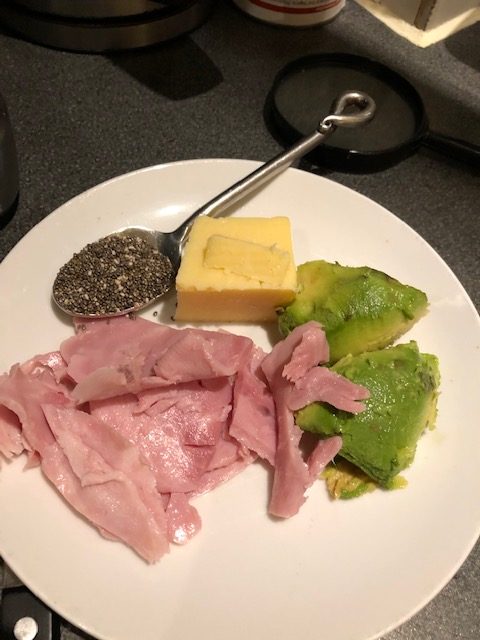
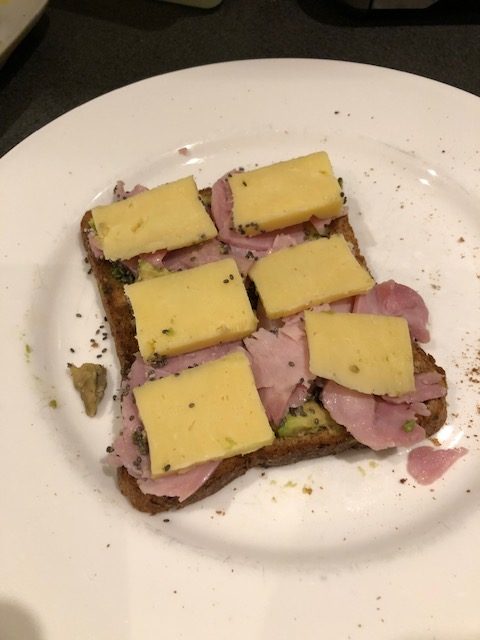
This snack had 2 blocks of carb in the form of a slice of bread, 2 blocks of avocado (In the form of 2 (overly generous) teaspoons ) 42g of ham (as one block of protein) and 28g of cheese (as another block of protein).

I sneaked in a tea spoonful of chia seeds for extra fibre and a mini scrap of butter as an old habit

and ended up on toast like this

I’ll be explaining in great details how the zone block system works, but its intention is to ensure that each meal or snack has a balance of the main 3 macro nutrients: carbs protein and fat.

Ill be a launching a free ” how to zone course” some time in the next few months so do join my mailing list and ill tell you when you can get it

[mc4wp_form id=”832″]

Muted Hip Function

Effective exercise can generate powerful  huge forces  if they are initiated controlled and dominated by the hip.

Many untrained athletes  have a muted hip which  creates postures and mechanics that reduce power output, promotes postures and mechanics that are considered by  many  to be unsound.

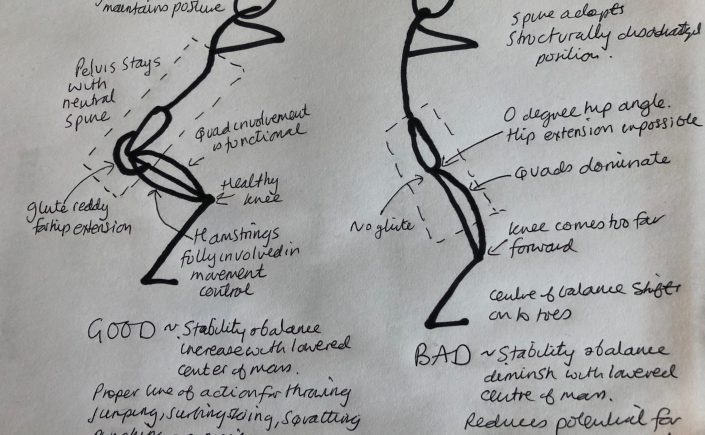
In simple terms the Muted Hip Function (MHF) results from the legs  compensating for the failed of the hip, in effect using leg extension  to compensate for non existent hip extension.

According to the Crossfit Journal the causes and consequences of MHF include but are not limited to:

• structurally disadvantaged spinal posture

• low glute recruitment

• low hamstring recruitment

• pelvis abandoning the spine and chasing the legs

• centre of gravity shifting dramatically backward

• centre of balance shifting toward toes

• knee experiencing unsound shear force

• leg extension being the only productive effort

• hip extension not being possible with low hip angle

• pelvis rotating the wrong way

The cure is deliberate and focused training. Thats why you probably need a trainer like me. Why not join the mailing list a get useful information

[mc4wp_form id=”832″]

Do at least 10,000 steps a day

“10000 steps a day. Yep, that’s 10 thousand steps every day . Go and buy a cheap pedometer or look up if its already on your phone,, and record how many steps you take each day. This is your baseline of daily activity. Any gym work or running around is training and is extra . This is the minimum amount of movement you do to keep ticking over.

Frequently I see people work quite hard in the gym for an hour, but are totally sedentary for the rest of the time. The gym session barely compensates for their lack of day today movement.

I also see many sports people, who apart from the weekly football match, are to all intents and purposes, sedentary.  So,  put that pedometer on, check your phone and review your daily count.

Lifestyle IndexSedentaryLow ActiveSomewhat ActiveHighly Active
Steps/day*<50005000 – 75007500 – 10,000>10,000

But don’t worry! slowly build up your activity level if you find yourself in the sedentary box! Get active at work

for some science, look at

Effects of a 10,000 steps per day goal in overweight adults” by Schneider et al (Am J Health Promot. 2006 Nov-Dec;21(2):85-9.)

Some points need to be made

1) the 10,000 steps is a fantastic way to assess basic activity. Ive helped people who could  only manage 3000 steps in a day and the effect was remarkable.

2) 10,000 steps a day is the very least you should be doing.

However,  if you present 10,000 step Versus almost anything else, anything else is probably better: Brisk walking is better, a  fast 400m  run or a Crossfit Workout is better, indeed a  life and death brawl at your local pub really gets the blood pumping. The issue is this: you have to really be sedentary to do less than 10,000 steps a day, so its  a great baseline and target and you should always do more.

3) the message is “do both”.

So, its 10,000 steps each day, plus a workout

[mc4wp_form id=”832″]

Check Your Oxygen saturations

Lon Kilgore wrote in ‘The Paradox of the Aerobic Fitness Prescription” (Crossfit journal) that improvements in oxygen management could be driven by dropping Oxygen saturation during/after exercise. The logic of the General Adaption Syndrome (Seyle) requires an alarm phase to provoke adaptations.

“In the intermediate trainee and beyond, it is the depression of oxygen saturation as a result of interval training that forces the muscle to adapt to improve its ability to extract and consume oxygen to power exercise. Oxygen saturation is a marker of the specific driving force of VO2max gain*. If a beginner does long-slow-distance work and blood oxygen saturations drop 1% or less to 97%, this is enough to drive adaptation. But intermediate, advanced, and elite trainees need more. They need a drop in oxygen saturation to as low as 91%, maybe even lower for an elite athlete”

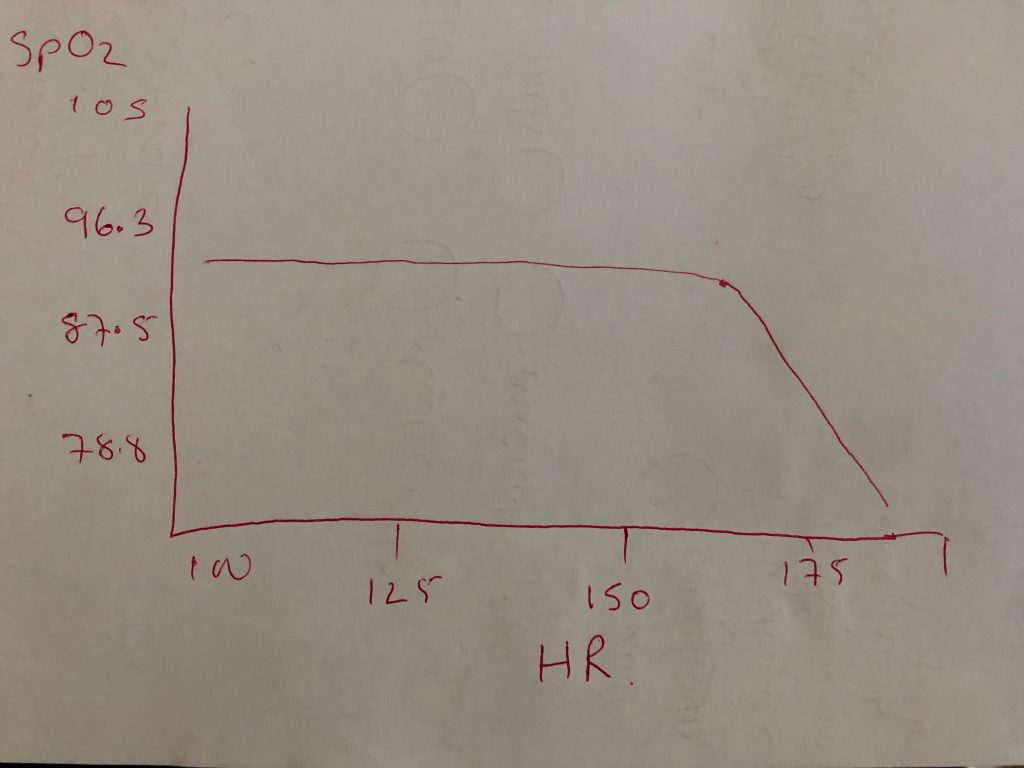
This observation was supported by David Lin et al who wrote “Oxygen saturations and heart rate during exercise performance” There is a fascinating write up here This basically showed that at a certain level of work, you can see a  drop in O2 saturations

i

“SpO2% desaturations during maximal performance levels with power bursts into the clusters as revealed in this test could lead to measures of intense interval training providing an important augmentation to sports conditioning. “

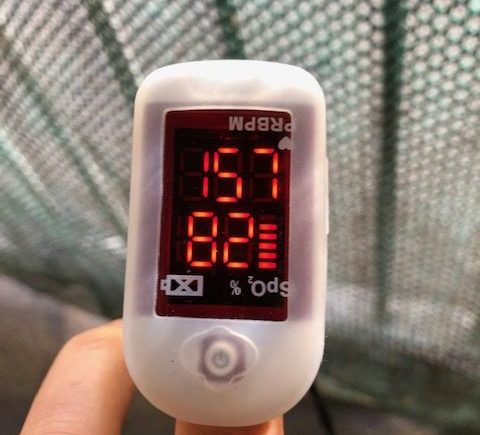
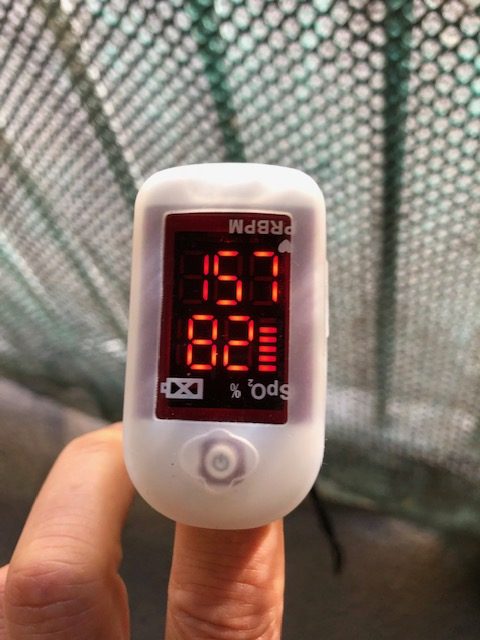
This mornings workout was a 15 minute AMRAP of 20 kettlebell swings, 15 double unders 150m sprint . I decided today, I’d take my pulse oximeter down. About half way through, straight after my double unders and during the run I managed to get my pulse ox on and this reading came up.

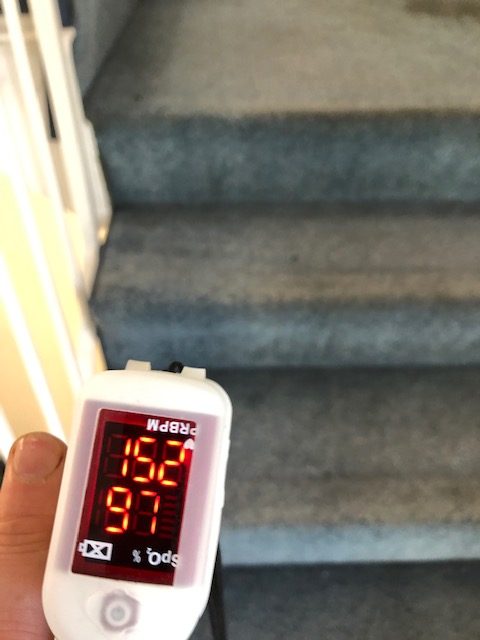
After a quick  recovery our workouts always end with a disgusting stair climb to our flat ( to get home and haul the kettlebells back up) At the top it always feels as if you are going to die. As I reached the top I managed to get my pulse ox back on and whilst my heart rate was 160, my O2 saturations were 97. It took me a while to get my phone out so I only got a photo after my heart rate had dropped to 152

My take home conclusion  is that the variation in a workout combined with power (in his case jumping in the double unders) really stresses the oxygen system. The requirement to rapidly change from one exercise to another  takes the body by surprise and has it scrabbling around for oxygen like a pandemic government trying to buy PPE. BY comparison the rhythmic stair climb. which felt disgusting, and produced a highish heart rate, didn’t disturb my normal reading of 97%.

Obviously this is an old Pulse oxmimeter (new one here), this wasn’t a clinical environment ( no lab rats, no one had a clip board), but it was an in treating bit of citizen science!)

If you have never heard of it *According to wikipedia “Oxygen saturation is the fraction of oxygen-saturated hemoglobin relative to total hemoglobin (unsaturated + saturated) in the blood. The human body requires and regulates a very precise and specific balance of oxygen in the blood. Normal arterial blood oxygen saturation levels in humans are 95–100 percent”

For the normal person, you want to check that your O2 saturations are around 97 say, once every week or 2 weeks. When you get diagnosed with a breathing condition, your doctor will suggest to you that readings of 88-94 are acceptable. If you doctor has not told you, and you get O2 sats at rest of, say, below 90, its time to report that reading to your doctor and get them to run some more tests.

Amazon have a nice range of Pulse oximeters, and this one for £19.98 caught my eye ( as did Its qualification under the EU medical device scheme

To get more home monitoring and health ideas, do sign up for my newsletter!

Before you start that diet: ask yourself some questions

I’m not really that into navel gazing. I came from a  religious family so I’ve had my fill of sitting quietly. On top of my christian praying and reflecting  experience, my mother and brother even  fell for that 1970’s transcendental meditation craze. So I had to put up with that too. Being 14 and being made to meditate wasn’t fun.

Never the less  there are some lessons to be learned from “sitting with yourself”  or  as Socrates said,  “the unexamined life is not worth living”. To sensibly ask yourself questions is actually a good idea. To actually listen to the answers is probably better!!

So you’ve decided, once again to lose weight. This time, rather than just jumping on the first weird diet you can think of, why not ask yourself some questions. Here are some useful ones.

Spend a bit of time thinking about the past ( both recent and longer term). Not too much, otherwise you can lose yourself in the mists of time. But get a handle of your history. 

Are you  overweight now?

Why are you overweight? (This is  a very stark, rude question, but was it illness, unhealthy eating, too much food, not enough exercise etc).

Have you ever lost weight before?

If so, what helped?

and what hindered?

Ok, so you have lost weight in the past! What made you put the weight back on?

Ok, thats your past, or as much as you realistically need to consider, what are your views and targets now?

Are you looking for a  short term  fix (a wedding in 2 weeks), or are you prepared to have a long term target

To be successful you need to change your approach to food, weigh and measure, change choices, record your eating habits, and exercise, and all this will no doubt make you feel uncomfortable. So, on a scale of 1 to 10 (10 is high)  answer these questions.

Be honest, as we can all want to lose weight but not have much motivation because we know it’s hard work?

How motivated are you to lose weight?

How motivated are you to change your eating habits?

How motivated are you to increase your physical activity?

Will you try new strategies/techniques for changing your eating, exercise, and other behaviours?

Are you prepared to spend time studying reading materials  about nutrition ?

Will you record your exercise  and everything you eat and drink,?

Will  you  change your eating habits?

 Will  you be able to work regular physical activity into your daily schedule?

Will  you be able to exercise  and be active most, if not everyday?.

If you make a mistake, have  a lazy day, or give into temptation, can you forgive yourself, and “get back on the programme”?

Do you have an emotional connection with food?

Do you eat more when you are upset, annoyed or miserable?

Do you eat to celebrate?

If you have  confrontation, do you seek comfort in food to calm down?

A SERIOUS BIT

Think about this question carefully?

Have you ever purged (used laxatives, diuretics, or  vomiting) to control your weight?

If yes,  is this “often” (About once a month  A few times a month  About once a week  About three times a week  Daily.)

If purging is part of your present weight loss strategy, and you feel unable to stop, you probably need to chat to your doctor who could get you some  one to one support to deal with this issue

Thats just the tip of the iceberg. If you’d like more help or thoughts on managing your weight, do join the mailing list of email me directly on Andrew@andrewstemer.com

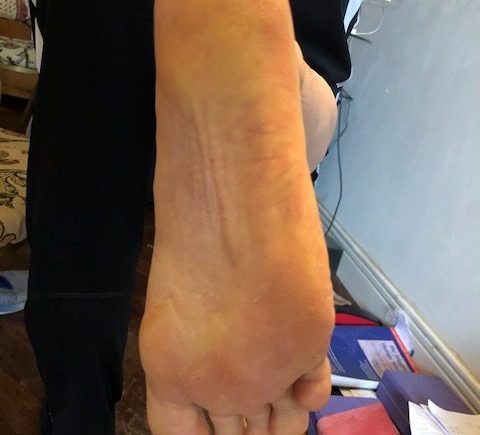
Foot exercises

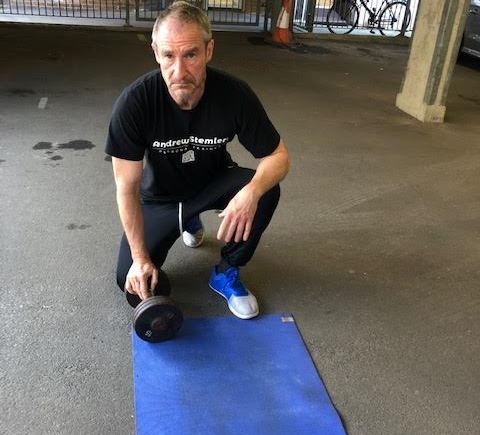
Try and do the foot exercises below. Your feet will love you, and you will also learn to love your feet. This type of activities are also helpful in your battle against plantar fasciitis.

Towel curls

Scrunch your toes, with or without a towel. Just think about the position you leave them in normally. Straight and  locked in your shoes like prisoners. To paraphrase Marie Antoinette “Let them scrunch air” or treat them to a  scrunch festival on a towel! Give them some manoeuvering room.

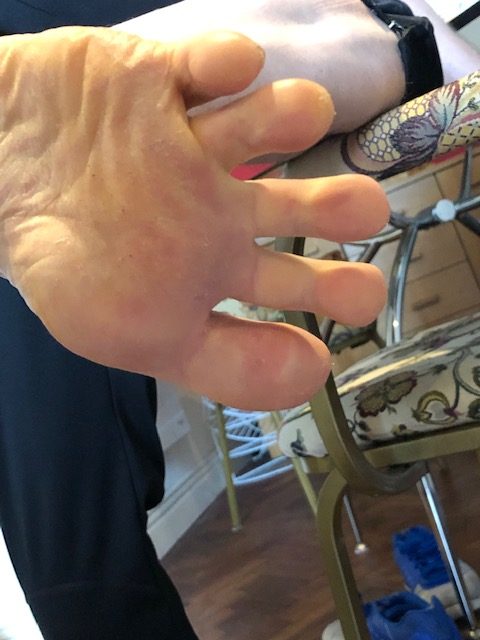
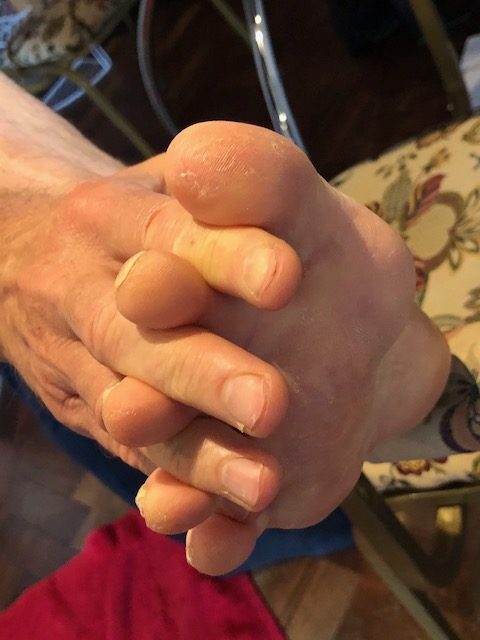
Toe splays

Splay your toes: see if you can  splay them.

It was a bit of a battle for me to learn how to do this ( as, like you I’ve locked my feet into shoes for the last  years, so I alternate the splay with using my fingers to pull them apart ( you can do it en-mass as shown here or individually )

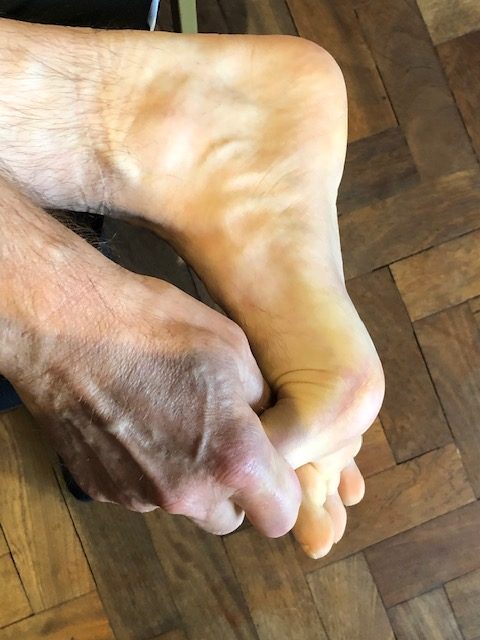
Big Toe stretch

Slowly stretch and pull the toe backward toward your shin. Go as far as is comfortable.

For more Physical therapy and fitness tips, join the mailing list

[mc4wp_form id=”832″]

What predicts your performance in the Crossfit open?

Among a batch of reports studying the Crossfit method, you’ll find “physiological Predictors of Competition Performance athletes” by Martinez-Gomez et al worth a read ( or a quick skim).

In reality any attempt to predict an athletes performance in a specific wod is always a bit speculative as different wod’s can have massively different outputs and can focus on specific “modal domains”that can bring specialists to their knees. Wod’s can be as wide ranging as “run 5k” or “deadlift 1,1,1,1,1,1,1”.

Nevertheless this study took the 5 wods of the Crossfit Open in 2019 and evaluated the performance of 15 athletes who were also assessed against various laboratory tests: incremental load test for deep full squat and bench press; squat, countermovement and drop jump tests; and incremental running and Wingate tests. It would be a fairly safe bet to say that the athlete who scores high on all of these tests would also score highly in the Wod’s.

In 2019 the “open” wods were

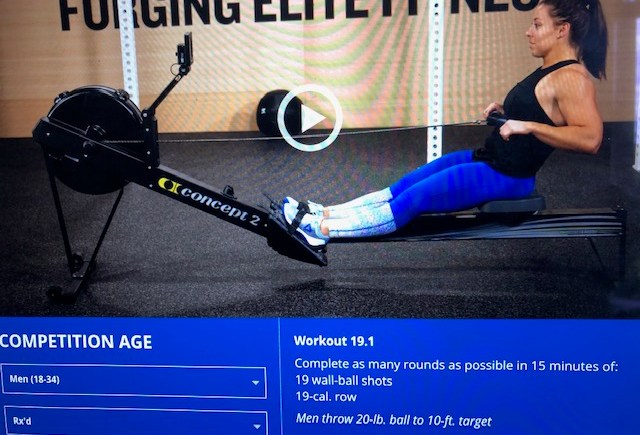
19.1 Complete as many rounds as possible in 15 minutes of

  • 19 wall-ball shots
  • 19-cal. row

19.2 Beginning on an 8-minute clock, complete as many reps as possible of:

  • 25 toes-to-bars
  • 50 double-unders
  • 15 squat cleans, 135 / 85 lb.
  • 25 toes-to-bars
  • 50 double-unders
  • 13 squat cleans, 185 / 115 lb.

If completed before 8 minutes, add 4 minutes to the clock and proceed to:

  • 25 toes-to-bars
  • 50 double-unders
  • 11 squat cleans, 225 / 145 lb.

If completed before 12 minutes, add 4 minutes to the clock and proceed to:

  • 25 toes-to-bars
  • 50 double-unders
  • 9 squat cleans, 275 / 175 lb.

If completed before 16 minutes, add 4 minutes to the clock and proceed to:

  • 25 toes-to-bars
  • 50 double-unders
  • 7 squat cleans, 315 / 205 lb.

19.3 For time:

  • 200-ft. dumbbell overhead lunge
  • 50 dumbbell box step-ups
  • 50 strict handstand push-ups
  • 200-ft. handstand walk

Men 50-lb. dumbbell / 24-in. box
Women 35-lb. dumbbell / 20-in. box

19.4

For total time:

3 rounds of:

  • 10 snatches
  • 12 bar-facing burpees

Rest 3 minutes

Then, 3 rounds of:

  • 10 bar muscle-ups
  • 12 bar-facing burpees

Men 95 lb.
Women 65 lb.

19.5

33-27-21-15-9 reps for time of:

  • Thrusters
  • Chest-to-bar pull-ups

Men 95 lb.
Women 65 lb.

“CrossFit performance (i.e., final ranking considering the sum of all WODs, as assessed by number of repetitions, time spent in exercises or weight lifted) was significantly related to jump ability, mean and peak power output during the Wingate test, relative maximum strength for the deep full squat and the bench press, and maximum oxygen uptake (VO2max) and speed during the incremental test”. However the relationship varied depending on the wod analysed. No surprise there.

However, the authors by using “multiple linear regression analysis” suggest that the two crucial factors were lower body muscular power (especially jump ability) and VO2 max.

You can do your own VO2 max here