Unlock Strength: Benefits of Gymnastics Ring Training

Adding gymnastics ring training to your fitness regime offers numerous benefits that enhance strength, mobility, and overall fitness. I got my introduction to them in my crossfit certification back in 2005 in Santa Cruz. Ibve iused them ever since. Here are soe oif the reasons why they are so useful

1. Builds Functional Strength

Gymnastic rings require you to stabilize your body, engaging multiple muscle groups simultaneously. This develops functional strength that translates to everyday movements and other sports.

2. Enhances Core Stability

Every ring exercise activates your core for balance and control. This constant engagement strengthens your core muscles more effectively than many traditional exercises.

3. Improves Joint Health and Mobility

Ring training allows natural movement patterns, reducing strain on joints compared to fixed machines or bars. It also promotes greater joint mobility, especially in the shoulders.

4. Boosts Grip Strength

Holding onto unstable rings challenges your grip, leading to significant improvements in forearm and hand strength.

5. Offers Scalable Progression

Whether you’re a beginner or an advanced athlete, ring exercises can be scaled to your skill level. For example, you can start with ring rows and progress to advanced moves like muscle-ups or planches.

6. Builds Coordination and Balance

The instability of the rings demands improved coordination and body awareness, enhancing neuromuscular control.

7. Portable and Versatile

Rings are lightweight and easy to carry. You can set them up almost anywhere, making them a versatile tool for at-home or outdoor workouts.

8. Promotes Lean Muscle Development

Because ring training engages multiple muscle groups at once, it promotes lean muscle growth, resulting in a toned and athletic physique.

9. Challenges Mental Focus

Mastering movements like dips, levers, and muscle-ups requires mental focus and discipline, making it as much a mental workout as a physical one.

10. Adds Variety to Workouts

Incorporating rings prevents workout monotony and keeps training fresh and exciting with endless exercise variations. Certainly this was one of the motivations behind their early adoption by the Crossfit regime

Whether you aim to build strength, improve mobility, or challenge yourself in new ways, gymnastic rings are an excellent addition to any fitness program.

I noticed that Amazon has a reasonable selection of rings for sale. You ought to have your own pair.

Gravity fitness rings (amazon) £37.95
Or “breaking limits” (£34.95)

Grip Strength: An Indispensable Biomarker For Older Adults

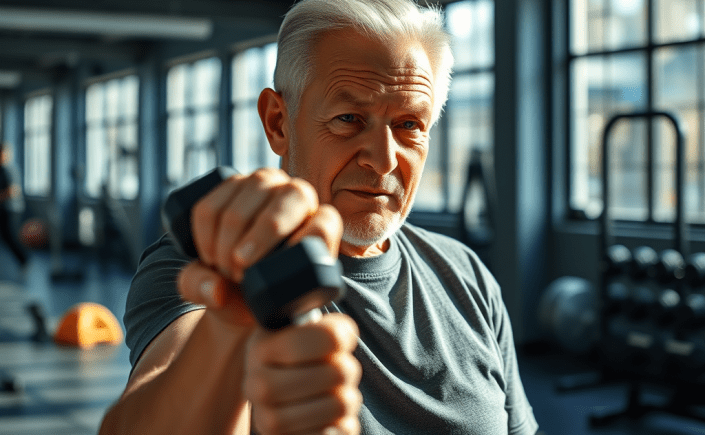
For those interested in fitness, training and Aging, looking up “Grip Strength: An Indispensable Biomarker For Older Adults” (PMCID: PMC6778477  PMID: 31631989) is time well spent.

Grip strength is closely asociated with “overall strength, upper limb function, bone mineral density, fractures, falls, malnutrition, cognitive impairment, depression, sleep problems, diabetes, multimorbidity, and quality of life.” There is aslo evidence “for a predictive link between grip strength and all-cause and disease-specific mortality, future function, bone mineral density, fractures, cognition and depression, and problems associated with hospitalization”

This suggests that the routine use of grip strength can be recommended as a” stand-alone measurement or as a component of a small battery of measurements for identifying older adults at risk of poor health status”

If you fancy building your grip, here are a few ideas

Build hanging time !

On an increasing basis you’ll see portable pull up bars being erected in public places with a ”can you hang for 90 seconds? ”challenge

Often there is a prize involved , but the task is made harder as the bar ( on the versions I’ve seen ) spins a bit making holding onto it rather hard .

Whilst I’ll talk about coping with the spin in another article , I thought it would be best to build up your hang ability on a normal bar .

Hopefully this 6 week training schedule will be helpful. It assumes you can hang for 45 seconds.

• Day 1: Hang for 45 seconds, rest for 1 minute, repeat 3 times. • Day 3: Hang for 50 seconds, rest for 1 minute, repeat 3 times. • Day 5: Hang for 55 seconds, rest for 1 minute, repeat 3 times. • Day 7: Rest

Week 3: Day 1: Hang for 60 seconds, rest for 1 minute, repeat 3 times. • Day 3: Hang for 65 seconds, rest for 1 minute, repeat 3 times. • Day 5: Hang for 70 seconds, rest for 1 minute, repeat 3 times. • Day 7: Rest.

Week 4:• Day 1: Hang for 75 seconds, rest for 1 minute, repeat 3 times. • Day 3: Hang for 80 seconds, rest for 1 minute, repeat 3 times. • Day 5: Hang for 85 seconds, rest for 1 minute, repeat 3 times. • Day 7: Rest.

Week 5:• Day 1: Hang for 85 seconds, rest for 1 minute, repeat 3 times. • Day 3: Hang for 88 seconds, rest for 1 minute, repeat 3 times. • Day 5: Hang for 90 seconds, rest for 1 minute, repeat 3 times. • Day 7: Rest.

Week 6:• Day 1: Hang for 90 seconds, rest for 1 minute, repeat 3 times. • Day 3: Hang for 92 seconds, rest for 1 minute, repeat 3 times. • Day 5: Hang for 94 seconds, rest for 1 minute, repeat 3 times. • Day 7: Rest.

This program gradually increases the time you hang from the pull-up bar each week, allowing your muscles to adapt and get stronger.

Even if you don’t make the 90 seconds , hanging from a bar is really , really good for your shoulders ( unless your doctor has told you that you have exploding shoulders and will die if you use them )

Pull ups and girls

I  love the pull up.

It is seen by many as a useful test for measuring the strength and endurance of the arm and shoulder girdle, and useful for those occupations where you need to manipulate your body weight: fire fighters, climbing into lovers’ bedrooms, showing off in front of kids, and getting out of holes when the zombie apocalypse strikes.
In Dec (2012) The media (papers and blogs) were all a-thither with the scientific proof that women cannot do pull ups. Even the Marines (“hoo-rah”) expect men to do 3, but women don’t have to do even one.

Zilch.

If you boil down the current research on women and pull ups, you will find two physiological reasons why most women cannot pull up.

They are fat and weak. (Don’t hate me, it’s science! )

It is generally accepted that women have a higher % of body fat (Heyward and Stolarczyk 1996) and according to an average of the research, women have upper body strength ½ of that of a man. (ranges from 35-79%: Laubach 1976).

But, as Kate said “It may be true, but God help you if you say that out loud to a girl!”

To be diplomatic and soften this up, it can easily be spun into the standard gym nonsense that women don’t have to do pull ups. Woo hoo, here comes your next Yoga class….after all strength is for smelly noisy boys.

We must accept that (Western) women have been sold a pernicious type of cultural weakness that blurs fitness with the spa. It palms off competence in Zumba as a substitute for the fitness that most women in the developing world need purely to survive the day. Elsewhere in the world women have to be tough, they have to plant food, haul goods, build stuff. A heroin-chic stick insect clinging to a partner’s arm isn’t available as a job option.

In fact, to be slightly political, the only reason Western women can prance around an aerobic studio and claim to be fit, is because their ancestors had the decency and foresight to be pirates, drug dealers and slavers who not only stole wealth, but saved it.
The poorest of us lives in comparative luxury based on this accumulated wealth, and it doesn’t matter if you have no physical competence
But what did this science experiment have to do, to validate the proposition that women don’t have to pull up?
“Three days a week for three months, the women focused on exercises that would strengthen the biceps and the latissimus dorsi — the large back muscle that is activated during the exercise. They lifted weights and used an incline to practice a modified pull-up, raising themselves up to a bar, over and over, in hopes of strengthening the muscles they would use to perform the real thing. They also focused on aerobic training to lower body fat”
And the result of this exciting “lat” challenging, bicep-strengthening routine was: “By the end of the training program, the women had increased their upper-body strength by 36 per cent and lowered their body fat by 2 per cent”
Wowee!
“But on test day, the researchers were stunned when only 4 of the 17 women succeeded in performing a single pull-up.”
“We honestly thought we could get everyone to do one,” said Paul Vanderburgh, a professor of exercise physiology”

A few interesting points.
1) This “hot news” (New York times dated 2012) was based on a report published in 2003 (“Training college-age women to perform the pull-up exercise.”) Shows how behind the times fitness media is.

2) It has been presented by much of the blogging world as justification for women having no pull ups, with the implication that they ought not to bother.

3) It shows that no one reads the small print. The researchers did not set out to produce a pull up specific routine
“We designed our training program with certain delimitations ..a whole body workout and not just a workout to improve pull ups”

4) It shows the impatience of “fitness regimes”. Why should the ability to achieve a certain goal in an arbitrary 12 weeks hold any sway? What’s wrong with spending 6 (+) months learning a skill?

5) The ineffectiveness of looking at movement in the simple terms of the strength of individual muscles.
All worthwhile “exercise” movements are analogues of human movement: they need to be learned, and they all, all combine numerous components of fitness: co-ordination, accuracy , agility, flexibility, strength, strength endurance, and to be frank some mental toughness and determination.

6) If you will permit me to sling a cat in among the pigeons, my final point is this : are pull ups a proper marker of fitness, or is “fit” a guesstimate of VO2 max.

If the girls we train can haul weight, including themselves, we begin to think “ tough chick” ( yes I know that’s a bit demeaning, but its meant nicely), but when flexible stick insects swoon into our gym with chocolate denial etched into their dulled eyes and the whiff of bulimia induced vomit around them, but a “really low resting heart rate”, we don’t think , “wow you’re fit”, we think “ Eat something and man up” .
Or to be more specific, get some steak and a pull up bar!