A limiting belief is a belief that constrains you in some way, often by creating self-imposed barriers or restrictions on what you can achieve.
In the context of exercise and weight loss, a limiting belief might be the belief that you’re not capable of losing weight or that you’ll never be able to stick to an exercise routine.
These beliefs can undermine your ability to exercise and lose weight by demotivating you, causing you to give up easily, or leading you to engage in self-sabotaging behaviors.
For example, if you believe that you’re destined to be overweight, you might not even bother trying to exercise or eat healthily because you don’t believe it will make a difference. Identifying and challenging these limiting beliefs is crucial for making progress towards your fitness and weight loss goals.
If you hate exercise, according to online Pt’s, you need to build a positive mindset !
Having chatted to a few (too many ) people, here are some strategies you will be sold to help you develop a positive exercise mindset:
1. Set realistic goals: Start with small, achievable goals that align with your fitness level and interests. Gradually increase the intensity and duration of your workouts as you progress.
2. Find enjoyable activities: Explore different types of exercises to find activities that you genuinely enjoy. It could be dancing, hiking, swimming, or any other physical activity that brings you pleasure.
3. Focus on the benefits: Remind yourself of the numerous benefits exercise offers, such as improved mood, increased energy levels, better sleep, and overall health. Concentrating on these positive outcomes can help motivate you.
4. Create a routine: Establish a consistent exercise routine that fits into your schedule. Consistency is key to developing a positive mindset and making exercise a habit.
5. Find a workout buddy or support system: Exercising with a friend or joining a fitness community can provide accountability, motivation, and make the experience more enjoyable.
6. Celebrate small victories: Acknowledge and celebrate your progress, no matter how small. Recognizing your achievements can boost your confidence and reinforce a positive mindset.
7. Practice self-compassion: Be kind to yourself and avoid self-criticism. Understand that everyone has different fitness levels and progress at their own pace. Focus on your own journey rather than comparing yourself to others.
Remember, building a positive mindset takes time and effort. By incorporating these strategies into your routine, you can gradually develop a more positive attitude towards exercise.
The problem with these totally worthy, helpful, handy hints, is they don’t really take into account the core of your objection.
You don’t like exercise.
So, if you don’t like exercise, why would you even embark on any of these things?
There is a massive and diverse list of things I don’t like. They have one thing in common. I don’t do them. Nor do I spend any time thinking about doing them.
To give a concrete example, I don’t want to eat poo. Guess how much time I spend creating a poo-eating routine.
Go on, I dare you. I double dare you Gosh. You are psychic. Zero!
I also don’t: set any sort of poo-eating goals, nor do I celebrate any poo-eating I may accidentally do, nor do I “forgive myself” for not liking poo-eating.
I do however have a big list of stuff that I know I should do and will have to do, but don’t really like or relish. My tax return is a good example.
So, to begin to build a positive mindset, to do the thing you don’t really want to, you need to know or believe that there is a compulsion to the activity. You must exercise “or else”
If you are struggling with the idea of exercise, your very 1st step is, not to make schedules, or think happy thoughts, it is to put exercise (or activity) on your agenda and accept it as something you ought to do, “or else”.
Without this stage, everything else you will do will probably fail!
Willpower: Unveiling its Muscle-like Nature In our pursuit of personal growth and success, willpower often plays a crucial role. It is commonly believed that willpower is a skill that can be honed through practice and discipline. However, recent research suggests that willpower is more akin to a muscle that can be strengthened and fatigued. This blog post aims to explore the concept of willpower as a muscle, supported by academic references.
Understanding Willpower as a Muscle: Willpower can be defined as the ability to resist short-term temptations in order to achieve long-term goals. Just like a muscle, it can be trained, depleted, and strengthened over time. This muscle analogy provides a useful framework for understanding the dynamics of willpower.
1. Baumeister and Heatherton (1996): Baumeister and Heatherton conducted a seminal study that compared willpower to a muscle. They found that individuals who exerted self-control in one task experienced a subsequent decrease in self-control in a subsequent task. This depletion effect suggests that willpower, like a muscle, can become fatigued with use.
2. Muraven, Baumeister, and Tice (1999): In another study, Muraven, Baumeister, and Tice explored the concept of willpower depletion further. They found that participants who resisted eating tempting chocolates performed worse on subsequent cognitive tasks compared to those who did not exert self-control. This study provides evidence that willpower depletion can extend beyond the specific domain of self-control.
3. Job, Dweck, and Walton (2010): Job, Dweck, and Walton investigated the malleability of willpower through a series of experiments. They found that individuals who believed willpower was a limited resource experienced more self-control failures compared to those who believed it was a flexible and trainable trait. This study highlights the importance of mindset in developing and maintaining willpower.
Building Willpower Muscle: Similar to building physical muscles, there are strategies to enhance and strengthen our willpower:
1. Gradual Progression: Start with small, manageable challenges and gradually increase the difficulty. This approach allows the willpower muscle to adapt and grow stronger over time.
2. Rest and Recovery: Just as muscles need rest to recover and grow, willpower also requires adequate rest. Engaging in activities that replenish mental energy, such as relaxation techniques or hobbies, can help restore willpower.
3. Mindfulness and Self-awareness: Developing mindfulness and self-awareness can help individuals recognize their triggers for self-control depletion. By identifying these triggers, individuals can proactively manage their willpower resources.
Conclusion: Willpower, often considered a skill, is better understood as a muscle that can be trained and strengthened. Academic research supports the notion that willpower can be depleted and restored, similar to the dynamics of a muscle. By adopting strategies to build and maintain this muscle, individuals can enhance their self-control and achieve their long-term goals.
References: 1. Baumeister, R. F., & Heatherton, T. F. (1996). Self-regulation failure: An overview. Psychological Inquiry, 7(1), 1-15. 2. Muraven, M., Baumeister, R. F., & Tice, D. M. (1999). Longitudinal improvement of self-regulation through practice: Building self-control strength through repeated exercise. Journal of Social Psychology, 139(4), 446-457. 3. Job, V., Dweck, C. S., & Walton, G. M. (2010). Ego depletion—Is it all in your head? Implicit theories about willpower affect self-regulation. Psychological Science, 21(11), 1686-1693.
The Tiny Habits process, developed by BJ Fogg, is a method for behavior change that focuses on making small, sustainable adjustments to our daily routines. It operates on the principle that by starting with tiny, easily achievable actions, we can create lasting habits.
However, the new habit has to be something you want to do, not something you are obliged to do and shockingly, you have to celebrate after each performance!!
The process consists of several steps:
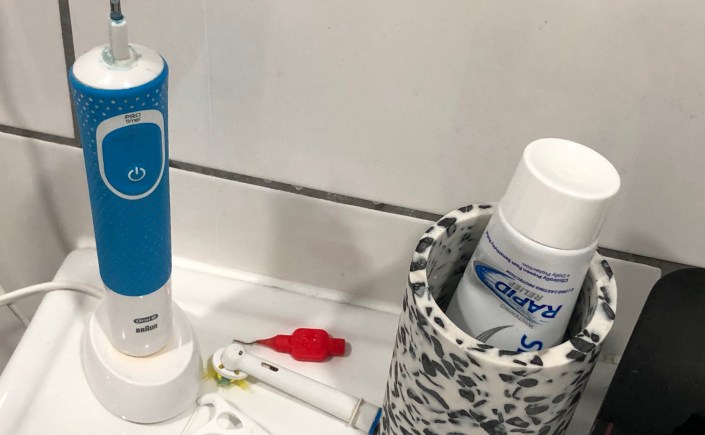
1. Identify the target behavior you want to do: often flossing your teeth is used as an example.
2. Define a tiny version of the behavior: Break down the behavior into a small, simple action that takes less than 30 seconds to complete. Using flossing your teeth, you would floss one tooth only.
3. Anchor the new behavior to an existing habit: Find an existing habit or routine that you already do consistently. Use this habit as a trigger or cue to remind yourself to perform the tiny behavior. thinking about flossing your teeth, its logical to anchor this to brushing your teeth
4. You need to look carefully at your anchor process and ask yourself what is the last part of brushing your teeth. This is called the trailing edge. Some spit then put their toothbrush down. It makes sense to have your floss right by where you put your toothbrush which is super easy to immediately pick up.
5. You now floss one tooth! You now celebrate! Maybe you punch the air, go “yaay”, or maybe you give yourself a pat!
6. To set up the habit you basically say, when I put my toothbrush down I’ll pick up my floss, floss one tooth, then celebrate.
7. Once you have flossed one tooth and celebrated, obviously you can go on to floss them all if you want to, BUT to develop the habit, all you NEED to do, and MUST do is the tiny habit.
Weirdly you’ll find this process can help you unlock many benefits beyond just the habit you have targeted. The mistakes you will make are: not identifying the trailing edge of your anchor habit, you’ll make the habit way too big, and because you are shy, you’ll think that celebrating is silly.
I recently wrote this outline of what I consider to be the most effective methods of helping people manage their weight.
The weight management industry is huge yet unregulated, and its advice is contradictory and confusing. I thought it ethical to clearly outline the strategy I will use to help you build the capacity in managing what you eat. You dont have to like all of this.
OBJECTIVE 1 Restore normal eating
The last 30 years have proven beyond doubt that simply manipulating food – be it by calorie counting, playing with macros, bingeing on a specific type of food, banning others and playing with time slots – has little lasting positive effect.Apart from not working, attempts to deploy starvation and deprivation methods merely result in disordered eating.Stop dieting and start eating normally. Basically, that means the plate method. A highly validated, effective nutritious method harking back to the “good old days” of “meat and two veg”
Objective 2 :Master your mind
Most people have no idea how to master their own minds. Our thinking is wrong, we do not recognise the influence our bad habits have, are often too inflexible in our approach to life, and have little to no idea as to how to change our behaviour.Our aim – using cutting-edge business, elite sport, and combat techniques – is to put you in control of your mindDon’t commit to goals, commit to processes.Treat goals with contempt. Goals are about the results you want to achieve. Systems are the processes that lead to those results.Goals are fine for the general direction of travel, but systems give you progress. Problems arise when you use your energy to focus on your goals rather than perfecting your system. Every sports person, and competitor wants to win. The winners are those who optimise their system.
Goals destroy your happiness. Your belief that joy and success appear only when your goal is achieved means you are never happy. Instead of tormenting yourself with goals, fall in love with the process.Goals are at odds with long-term processes. If you have a specific goal, what happens when you reach it? The purpose of setting goals is to win. The process of building systems is to continue playing the game.Setting up your system and processes is not a euphoria moment where you revel in positivity. Effective plans anticipate the barriers you may encounter and help you plan in advance about solving them. Otherwise, you can fall at the first fence. These barriers are known as inflection points. We help you imagine unpleasant situations in advance and write out a plan for responding. This strategy isn’t speculation, it’s taken from the Starbucks playbook. This is how willpower becomes a habit. By choosing a response to an issue in advance, that becomes the behaviour when that inflection point arises.
Objective 3 Build Better Habits.
We get you to understand habits. We guide you to identify the bad or unhelpful habits you’ve acquired, and how to transform them into better, more helpful habits. It’s certainly unhelpful to harangue people with generic exhortations to “meditate,” or “drink water”.Increasingly research has shown that those struggling with weight management often have certain habits in common. The more flexible you become in your daily life, the easier it is to manage what you eat.
Objective 4 Understand Will power
.For years people have been made to feel like failures when their willpower faded and their diet collapsed. It was thought that willpower was a skill to be learned, like riding a bike. This is a useful analogy. If you ride your bike on Monday, you don’t expect to be unable to ride it on Tuesday. So, if you have the skill to eat healthily on Monday, then Tuesday should be a breeze! We now view willpower as a muscle that needs both exercise and practice, but can equally end in failure. Willpower is a finite resource that needs to be managed. We will help you build your willpower.Some find the concept of willpower unhelpful, so we also explore the idea of “grit”. To make you more “gritty” we need to engage your interest, develop your ability to practice, discover your real (higher) purpose and build your hope. Researchers like Angela Duckworth have popularised and validated this approach.Little winsLittle wins have been shown to be crucial in redesigning how you think and feel about situations. By using simple daily tasks, we will get you some early successes.The underpinning theme is to help you find out how the mind works.We support you in studying powerful mind management models that can help you become a more happy, confident, healthier, and more successful person. We will help you understand the struggles that happen within your mind and know how to apply this insight to every area of your life. You have to changeTo manage your weight, you must change. At a fundamental level, you need to change your beliefs and values. This may sound drastic, but as the British cycling team found out, change is successful when made in 1% increments.
Objective 5. RECONNECT WITH YOUR EMOTIONS. Practicing healthy eating, building better habits, and understanding your mind is helpful. It’s also found that building your emotional resilience is equally important. However, secure within our relative wealth and comfort, much of our lives to date have ignored the need to attend to our emotional health. The overused phrase “How do you feel?” Is hackneyed, but the question remains essential. If you follow the work of Julie M Simon, you may quickly trace many issues as being created by a failure to manage your emotions. In its simplest form, people need to recognise, identify and accept their emotions.Once this is done, you can move forward to finding a solution.Emotions are too often either ignored or discounted. In other words, you are taught to ignore your emotional state. What can you do? You still have the emotions, you still feel them, fear sadness, and anger (more choice here!).How do you deal with them? You haven’t been taught how to cope with emotions so you need to soothe yourself. The number one choice of self-medication is food, although later on it could be drugs, booze, or pornography. Every time you feel joy, sadness, happiness, or failure, you go straight to food. Essentially, food becomes the only thing that means you can control your emotions. Where does this get you? If you cannot identify or control your emotions, then realistically you cannot control your food. It seems that food is the only thing that keeps you sane. For years you have used it to smother emotions, so it makes sense that you won’t allow it to be restricted or measured. If you do restrict, then it makes sense that you’ll binge later on during the day.Our program guides you through the emotional maze and helps you reconnect with your emotions, dealing with them in a better way than binging on cake
Objective 6 . Understand Trauma. One of the last pieces of the puzzle is trauma. Today this is an overused word. In this program, we use it to describe a “failed freeze” response.In simple terms, if you are attacked, most people think you have two options: fight or flight. Actually, you have four: fight, flight, a search for social support, or “the freeze” response. On a primal level, predators don’t like eating “dead meat”, so often creatures that freeze stand a higher chance of escaping. The mouse feigns death while the cat is staring, but when the cat loses interest the mouse runs like hell! The full freeze response is freeze THEN run.You may not have experienced a war zone or been mugged in the street; but what if your boss walks up and shouts at you, and you sit there and take it? Once your madcap boss wanders off, if you stay put, the chances are that you are accumulating micro traumas.. You froze, but you didn’t run. This leaves you feeling very unsafe. You do not need to be shot in a war zone to feel trauma (more here). Using drills developed for the military, our program gets to restore the safety you need and teaches you how to stop it from happening again.
Success is quite a difficult concept. It’s incredibly personal but whether you measure success by wealth, quality of service, or your relationships with other people, it seems that the ability to stick at a task is crucial. Some people call this grit. In assessing the success or failure of West Point graduates, researches identified “grit” as one of the required characteristics. Grit is about having what some researchers call an “ultimate concern”–a goal you care about so much that orders and structures almost everything you do. Grit is holding steadfast to that goal. Even when you fall down. Even when you screw up. Even when progress toward that goal is halting or slow.
I suppose an issue with this is you can be gritty in the pursuit of a goal or an idea, but be a lazy total toss pot in other areas.
Angela Duckworth is acknowledged as a leading grit researcher
This little test may help you consider how gritty you are. Im not sure if you should see this as an overall personality test, or consider a specific aspect of your life. Maybe try both.
I have some of my clients use this scale when assessing their commitment to fitness, olympic weight lifting, gymnastics, diet and first aid provision.
Short Grit Scale
Directions for taking the short Grit Scale:
Please respond to the following 8 items. Be honest – there are no right or wrong answers!
1. New ideas and projects sometimes distract me from previous ones.*
Very much like me
Mostly like me
Somewhat like me
Not much like me
Not like me at all
2. Setbacks don’t discourage me.
Very much like me
Mostly like me
Somewhat like me
Not much like me
Not like me at all
3. I have been obsessed with a certain idea or project for a short time but later lost interest.*
Very much like me
Mostly like me
Somewhat like me
Not much like me
Not like me at all
4. I am a hard worker.
Very much like me
Mostly like me
Somewhat like me
Not much like me
Not like me at all
5. I often set a goal but later choose to pursue a different one.*
Very much like me
Mostly like me
Somewhat like me
Not much like me
Not like me at all
6. I have difficulty maintaining my focus on projects that take more than a few months to complete.*
Very much like me
Mostly like me
Somewhat like me
Not much like me
Not like me at all
7. I finish whatever I begin.
Very much like me
Mostly like me
Somewhat like me
Not much like me
Not like me at all
8. I am diligent.
Very much like me
Mostly like me
Somewhat like me
Not much like me
Not like me at all
SCORING
For questions 2, 4, 7 and 8 assign the following points:
5 = Very much like me
4 = Mostly like me
3 = Somewhat like me
2 = Not much like me
1 = Not like me at all
For questions 1, 3, 5 and 6 assign the following points:
1 = Very much like me
2 = Mostly like me
3 = Somewhat like me
4 = Not much like me
5 = Not like me at all
Add up all the the points and divide by 8.
The maximum score on this scale is 5 (extremely gritty), and lowest score on this scale is 1 (not at all gritty)




 Andrew Stemler