We don’t assume that you have access to a pull up bar! But today we stayed in the flat because we have a pull up bar there (with rings on). We wanted to do a version of Cindy. The Crossfit workout of 5 pull ups, 10 push ups, 15 squats. AMRAP in 15 minutes (it should b 20 minutes, but Im 59, so I cut myself some slack now and then.)
Most days I’ll post a workout you can do with minimal equipment and no gym access. It be will be on a 3 day on, 1 days off rota
The “gym-less” workouts only assume you has access to 1) some dumbbells 2) a kettlebell 3) a skipping rope 4) a car park and some benches.
Obviously a full Crossfit or exercise regime requires more stuff and more variation, and ill encourage you to practice and train in weightlifting and gymnastics and other forms of cardio, but doing these workouts as bits of intensity (hard and fast) should help most people
So todays workout is
With a running clock set for 15 minutes as many rounds as possible of
20 lunges, 20 double under’s, 100m run.
Feel free to tweak everything: 10 lunges, 10 single skips, walk 50m for 7 minutes 10, or 12 minutes. If there is an exercise you cannot do or tweak, feel free to switch it with one you can do, or just leave it out and practice it later if you can.
If you are in chronic pain take it easy, feel free to limit the range of motion, feel free to rest if you must, but it’s simply about pushing you on a bit or a lot, depending on where you are
For food, ill be recommending the Zone diet . For now this is a TWO BLOCK snack, or “brunch” if you prefer.
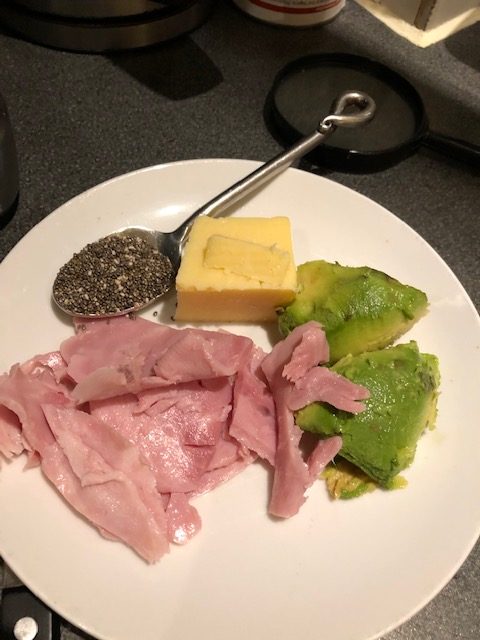
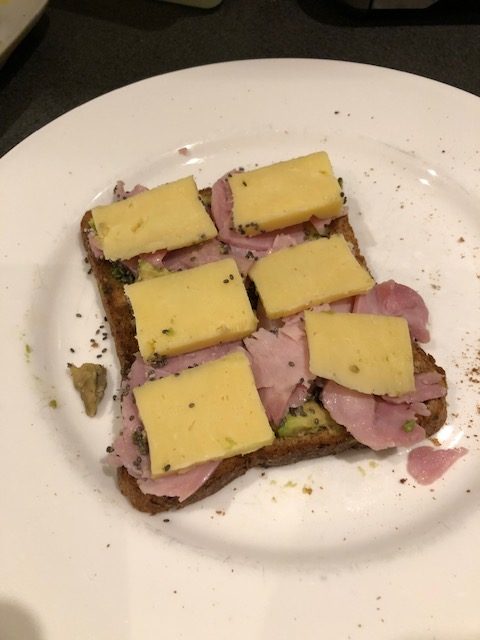
This snack had 2 blocks of carb in the form of a slice of bread, 2 blocks of avocado (In the form of 2 (overly generous) teaspoons ) 42g of ham (as one block of protein) and 28g of cheese (as another block of protein).
I sneaked in a tea spoonful of chia seeds for extra fibre and a mini scrap of butter as an old habit
and ended up on toast like this
I’ll be explaining in great details how the zone block system works, but its intention is to ensure that each meal or snack has a balance of the main 3 macro nutrients: carbs protein and fat.
Ill be a launching a free ” how to zone course” some time in the next few months so do join my mailing list and ill tell you when you can get it
Effective exercise can generate powerful huge forces if they are initiated controlled and dominated by the hip.
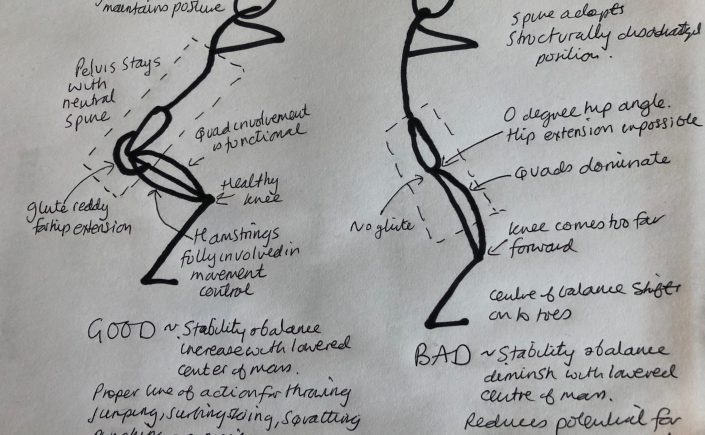
Many untrained athletes have a muted hip which creates postures and mechanics that reduce power output, promotes postures and mechanics that are considered by many to be unsound.
In simple terms the Muted Hip Function (MHF) results from the legs compensating for the failed of the hip, in effect using leg extension to compensate for non existent hip extension.
According to the Crossfit Journal the causes and consequences of MHF include but are not limited to:
• structurally disadvantaged spinal posture
• low glute recruitment
• low hamstring recruitment
• pelvis abandoning the spine and chasing the legs
• centre of gravity shifting dramatically backward
• centre of balance shifting toward toes
• knee experiencing unsound shear force
• leg extension being the only productive effort
• hip extension not being possible with low hip angle
• pelvis rotating the wrong way
The cure is deliberate and focused training. Thats why you probably need a trainer like me. Why not join the mailing list a get useful information
It’s a big, big, sweep of the arm, but most of your lifts can be (could be) compared to your back squat. If you back squat 100kg, the chances are you can snatch up to 60kg, and clean 75kg. Bear in mind these figures could vary by as much as 15%
Front Squat
Snatch
Clean
87.5%
60%
75%
Overhead Squat
Power Snatch
Power Clean
67.5%
55%
65%
Deadlift
Snatch Pull
Clean Pull
125%
90%
100%
Christian Thibaudeau adds extra ratios and insights here
Waxman’s gym has a fascinating “Weightlifting Lift Calculator” here
My take home message is this: once you start struggling with your olympic lifts, and your technique is quite good, start to consider improving your strength.
Once all the fuss goes, the 20 squat programme is doing 20 squats, with your ten rep max.
It’s one of the oldest lifting programs there is. It was introduced by John McCallum in 1968 and was originally coined “Squats and Milk” because old school lifters would drink a gallon of milk a day (GOMAD) while on it. According to the Jacked factory “This routine is not for the mentally weak individual. It will test your will power and bring you to a threshold that will either make or break you. One of the reasons why this routine works so well is the “breathing squats”. Generally around rep 15 or so you’ll be out of breath, legs burning, telling yourself this was a horrible idea while you stand there with the weight on your back. At this point the reps come few and far between as you muster up the strength to squat out another rep”.
Strossen publishes a well-marketed book, assuming you fancy doing this for 6 weeks:
Assuming you get to a decent gym, that allows your to do some barbell movements, how do you go about developing the strength you so long for? The reality is that the average Gym instructor may know a bit about hypertrophy ( ” 3 sets of 10 mate!”) but thats about it. Sitting in a Globo gym among a pile of machines does that to people. Its tragic. But, lets say, you have something heavy and you want to lift it, how many sets, how many reps?
One of the secrets of elite trainers, like me,is that we are quite well read: we look at British, American and Russian strength training literature. ( mind you, if Tabata is Japanese, add Japanese literature to that list).An interesting piece of research was carried out by soviet Sports scientist, AS Prilepin, who studied the training logs of 1000 leading weightlifting champions .The table below is an averaging of these logs and shows the % of 1 rep max , the amount of reps performed per set, the optimal amount of reps per workout, and the range of reps used indicated by the research. This table is specifically for gaining maximal strength
The Prilepin Table:
Intensity
Reps per set
Recommended optimal Total of Reps
Range of reps seen in research
Below 70%
3 – 6
24
18-30
70 – 79%
3 – 6
18
12 – 24
80 – 89%
2 – 4
15
10 – 20
90% and above
1 – 2
7
4 – 10
There are ofcourse a few points worthy of mention. These tables were extracted from the training journals of olympic weight lifters and its possible to argue that this would not apply to other lifts ( the slower lifts like the squat, deadlift press etc).
This also assumes you have a reliable 1 rep max figure, and for that matter, an up to date one.
What I don’t know ( and if anyone does , please let me know) does he use the idea of a 1 rep max as your best ever lift. If you look at Zatsiorsky and Kraemer, they establish a difference between a training max and a competition 1 rep max. They suggest that the difference is about 12.5% +/- 2.5% in superior weightlifters. The further make the distinction that a training max is a load you lift with no emotional arousal which can be monitored by your heart rate. If someone says, lift that weight, and your heart rate zooms up in anticipation, that load is (probably) above your training max. This ,ofcourse, assumes some experience. Stopping the average sedentary person and saying, lift that weight, will probably get most people heart rate up!
These tables and information are, of course a snap shot. Im not discussing long term fatigue, issues of scheduling. Yet.
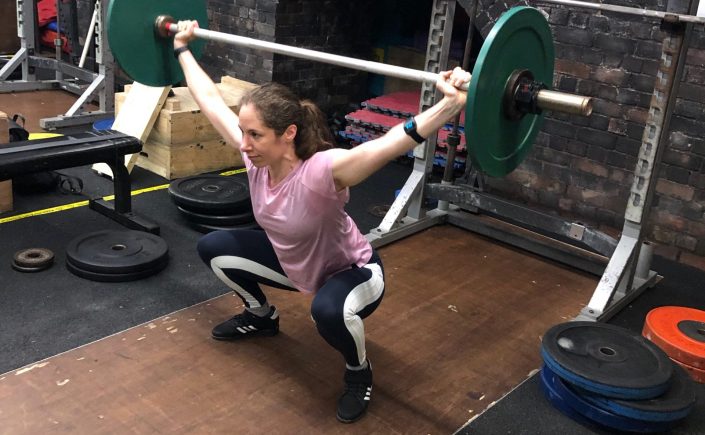
There seems to be a developing debate between ‘shoulders shrugged’ and ‘shoulders down with external arm rotation’ when overhead squatting, or hanging from a bar. As happens, too often. a therapist decides that their simplistic view of the world is “king” and attempts to foist it on others. The explanations they give often seem credible as they have quite good anatomical knowledge .
Here are some ideas and observations: I dont claim to be right. I do claim to be inspired by Greg Glassman and all those who teach the level 1 certification. The Crossfit gift is it’s encouragement to think.
At first glance the debate seems to be about the elevation of the shoulder; and that, by implication is wrong and bad (sorry, I have a very childlike view of the world; wrong and bad, nice and good!
)So when I heard the advice ‘shoulders down’, I panicked (I do this a lot; I’m 50 and already practising to be a bewildered OAP)In a real world, a pull up from the ground begins with shoulders elevated (especially if you are small and the bar/branch is high). We train the pull up because it is functional. It lifts us up from unfriendly places towards, hopefully, friendlier places; out of rivers onto the bank, from the ground into trees. The hang is a totally natural move and part of our physiology. An elevated shoulder girdle is, surely, part of the reaching-up process.
The shrug has also been part of physical training for many years. Paul Kelso produces an excellent book (Kelso’s Shrug book) which details (too) many types of shrugs.
But Jeff Martone said in his Kettlebell Certification, “Pull your shoulder down when Turkish get-upping”, er, people” (he does that a lot). This didn’t make sense to me. If something is bearing down on me, I naturally push back (this is probably a psychological thing that few years in therapy could sort out. Its also the basis of an anti- welsh sheep joke)
I though about Olympic lifting, and as a result of an hour watching You Tube (and bearing in mind different camera angles and musculature) I’d subjectively say 80% had ‘active shoulders’ while attempting to shove their shoulders up.
However, on the cover of Kono’s book,” Weightlifting, Olympic style (a world champion)”, Kono’s shoulders appear to be down and packed. However the text states he ‘uses traps violently in his pulls’ and suggests you ‘should be fighting against the compressive force that the arms and body are subjected to by exerting a counter force to stretch as tall as possible and at the same time, pushing the bar as high as possible’.
Greg Everett was in his book olympic weightlifting, is anti packing ( see page 61, 62), so well and truely on the side of the shruggers.
Then I saw an article by Craig Liebenson “ Y exercise for correcting the most common faulty movement pattern of the shoulder/neck region” (J body work 2011 15, 391-394)
“in the upper back . shoulder girdle or neck area the key faulty movement is an abnormal scapulohumeral rhythm. this causes the shoulder girdle to shrug up towards the ears and results in increased neck/shoulder muscle tension, rounded shoulders and forward head posture. these are the hall marks of dysfunction which predispose to either pain or loss of athletic performance”
His key solution is to learn how to “pack the shoulder”:
Then I started thinking. Up to now my thinking (above) had been that of a tearful 4 year old, “he said, then she said then he said…sob”
If you have been taught how to squat properly its the same shoulder position as for the deadlift and the front squat: Shoulders back and down ( not pinched!) There’s a natural place for them which make you look as if you have a noble posture and are worth procreating with ( probably what the therapists mean by packed)
Noble, shoulders down..good breeding stock…
If from this position you shrug, or overhead squat, when you shrug your shoulders, they elevate nicely, they dont roll over. and here I think is the main cause of the confusion.
unless the set up is correct, and especially if the trainee has rounded shoulders( and a forward head posture)
dont stoop.. and dont carry this into your physical training
The upward driving shrug becomes a functionally misconceived and misdirected forward roll of the scaplua, no doubt lured by a tight and cheeky pec minor( along with its tight chest cronies, the pec major, the subclavicular, and tight intercostals under some locked down fascia) thus changing the direction of the glenoid fossa into in a sub optimal position could probably result in injury.
the immoral shoulder.. shoulder too forward
In short, there is nothing wrong with the core crossfit cue of “try to get your shoulders into your ears” Firstly Remember cues are quick “fun” summaries. After all “hips, hips hips” or the often heard “iipsipsipsips” doesn’t really summarized hip extension, so shoulders in ears isnt the whole story.
i wonder if the better advise is to set the shoulders back and down, and then, as long as the movement is in that plan, its ok to shrug?
At Crossfit London we have always been lucky, We have always had the coaching point “kittens” to guide our training and shrugging: You want to bounce the (2) sleeping kittems (the ones on your shoulder) straight up and off, not off to the front. For the overhead squat, raise those kittens as high as possible gets properly set shoulders to engage and brace against the weight to come in the overhead squat and snatch: Up is, by the way, up there, not towards me… good job!
Feedback much appreciated.
Some Extra Research Observations
While researching this, I came across some interesting articles and observations
1) Median nerve and Overactive traps
There is much concern about the constant elevated positioning of the shoulder girdle., this can be due to the preconditioning of the median nerve . the upper trap becomes over active to reduce tension in the median nerve, by elevating the shoulder girdle.
2) Perhaps Depression Not so Good
According to “Influence of scapular position on the pressure pain threshold of the upper trapezius muscle region “ 2008 (European journal of pain) a position of scapula depression ( could that be scapula packing) will maintain the upper trapezius muscle region in a lengthened position, causing excessive strain. Hmm, Put that in your theraputic pipe, but don’t smoke , it as it will ruin your karma..
3) Single arms
interestingly, many commentators on shoulder function, were based on open chain activity, tennis, swimming, dumbbell where the movement has instability,,, unlike a pull up, bar, which is locked…..Im not sure if this means anything, but thought i mention it.
.
4) The Upper tarpezius Does not elevate the shoulder !!!
check out “Anatomy and Actions of the Trapezius Muscle,” by Johnson and Bogduk, et al., nicely reviewed by Warren hammer. The Upper Traps, dont elevate.
The programmes I discuss here have many objectives, one of which is to help you find your strength head – shorthand for developing your strength knowledge. In this article we visit the basic language of weightlifting and how it relates to the concept of relative intensity.
When it comes to using weight; in simple terms, people think this: lift the heaviest weight you can, that’s your 1 rep max; then based on that you can lift 90% of it 3 times (3reps), 85% of it 5 times, 75% 10 times. If you do 3 rounds of 3 reps, that’s 3 sets.
So weight lifting is a mix of percentages, sets and reps, all based on a one rep max. Simples!
This is a great place to start, but to develop your strength head, you need to develop your knowledge and insights into the strength game.
Some time ago, Zatsiorsky pointed out there are two types of one rep maxes you can have: a competition 1 rep max, and a training 1 rep max.
A) A competition max is where you get hyped up and get a PB and scream a lot.
B) A training 1 rep max
Marvellous.
However, often people skip the full definition of a 1 rep training max.
A maximum training weight is the heaviest weight you can lift without substantial emotional stress.
Damn. No screaming.
For athletes, the difference between the two is great. The example Zatsiorsky cites is that for athletes who lift 200 kg during a competition, a 180kg is typically above their maximum training weight. As a possible indicator, if your heart rate increases before your lift, that’s a sign of emotional engagement. Weightlifting is meant to stress your body, not your mind.
That’s the job of your partner and employer.
In short, if you screamed it up – it’s too heavy to use as a basis for regular training.
So, if you are calculating reps and sets using a 1 rep max, please, please use the right one; otherwise you’ll break. Maybe not today, maybe not tomorrow, but soon… If you want to properly test your 1 rep max, book a PT session with one of the training team.
If you have been lifting regularly for a while, you have probably begun to review strength literature and you are probably aware that lifting 80% of your 1 rep max provokes strength gain.
So, when lifting sets of 5, you’d probably like to put 80% of your 1 rep max on the bar. Everyone does that, but think about what it is you’d are actually be doing.
Let’s forget weightlifting for a moment, and talk about bricks. Imagine you are a labourer on a building site. Lets say we run a test to see how many bricks you can move in a day. For argument’s sake, let’s say you can move 1000.
Normally in training we wouldn’t want to move the 1000, we would do 800 ( 80%) but many people want to set 5 reps of that. So there you are, lifting 5 x 800 =4000.
If you tried to do that in a day, you’d probably die.
Back to the weight room. So you can lift 100kg calmly as your 1 rep max. You’ve been told if you lift 80% and over of this figure, you are strength training. So, to keep the maths easy, if you lift 80kg, you are strength training. But do you lift that 80% five times?
As you see from my poor labourer example, the first 800 was probably easy, but the next 800, isn’t easy, the 3rd 800 is getting you to breaking point.
In short, 80% lifted multiple times, isn’t perceived by the body as 80%. It sees it as much, much heavier because of the volume. The bricklayer, is of course a silly example – but try and get the message rather than be sidetracked in the endurance aspect of the example.
In simple terms, because you are lifting in sets of multiple reps, a load of 67% of your 1 rep max lifted 5 times has a relative intensity of 79%. It feels like 79%, your body thinks it’s 79%. It is 79%
Putting 76% of you 1 rep max on your bar for 5, has the effect of being 88%.
70% feels like =82%,
73% feels like = 85%.
80% on the bar for 5, is like lifting 91%.
Relative intensity is the simple observation that volume, load and rest effects how your body feels and adapts to weight.
Coach Robb Rogers gives a fuller description here:
Remember your muscles are dumb, they don’t know or care about percentages. They just know what feels heavy.
According to Mike Tuchscherer; “The body responds to things like the force of the muscle’s contraction, how long the contraction lasts, and how many contractions there were. A percentage isn’t necessarily a precise way to describe this, as different lifters will perform differently.”
In take-home terms, if today you went to CrossFit London or CrossFit SE11, and during the strength session, you only got to 68% of your (proper) 1 rep Training max for 5; you actually hit the 80% in relative intensity. That’s the 80% you need to nudge your strength along.
For now, in our general programme, we are not obsessing about percentages; but those who do know their lifts, I hope will be grateful for this insight. For the rest of you, simply work to a set of 5 that you can comfortably lift, bearing in mind these RPE (rates of perceived exertion) as guidance.
On a scale from 1 to 10:
9: Heavy Effort. Could have done one more rep. 8: Could have done two or three more reps, but glad you didn’t have to. 7: Bar speed is “snappy” if maximal force is applied 6: Bar speed is “snappy” with moderate effort
After a while, I suspect a “five” you can do in class will be at an RPE between 7 and 8.
Once you bedded this concept of relative intensity into your head, you can look forward to many years of safe, effective lifting.
More insights coming soon.
Grateful thanks to Coach Chet Morjaria @ Strength Education and to Coach Anthony Waller @ CrossFit London for the numerous corrections and observations they supplied
Part of the programme we will teach you is to maintain a natural lordosis , most of the time, especially when squatting or lunging. However its possible to attempt to over engage your lordosis and crush joints together. the flexibility for squats and lunges comes through the hips, not by excessively arching your lumbar curve. The mantra is “find the problem, fix the problem”. If when squatting you find ankle and hip flexibility issues, do not compensate in your back.







 Andrew Stemler