The paper “Minimum Effective Training Dose Required for 1RM Strength in Powerlifters” (PMC34527944 Patroklos Androulakis-Korakakis et al) explores the concept of the “Minimum Effective Training Dose” (METD). Basically, what is the least you can do to boost strength.
After numerous tests and interviews, they concluded
You can expect to gain strength by doing:3-6 working sets of 1-5 repetitions each week, with these sets spread across 1-3 sessions per week per powerlift, using loads above 80% 1RM at a Rate of Perceived Exertion (RPE) of 7.5-9.5 for 6-12 weeks.
If that was too much its possible to perform autoregulated single repetition sets at an RPE of 9-9.5 though strength gains will be less likely to be meaningful.
However, the addition of 2-3 back-off sets at ~80% of the single repetitions load, may produce greater gains over 6 weeks while following a 2-3-1 squat-bench press-deadlift weekly training frequency.
it was observed that when utilizing accessory exercises in the context of METD, PL athletes typically utilize 1-3 accessory exercises per powerlift, at an RPE in the range of 7-9 and utilize a repetition range of ~6-10 repetitions.
Findings from this study highlight five main themes where participants experience medicines as: 1) life-saving and indispensable, 2) normal and a daily routine, 3) confusing and concerning, 4) unsuitable without adjustment, and 5) intrusive and unwelcome. These results can be the basis for mutually agreed prescribing through a co-creative approach that aims at enhancing open and honest dialogues between patients and healthcare professionals in partnership about medicines.
The conclusion was “In conclusion, the results from this study indicate the need for a co-creation of a treatment plan in partnership between patients and healthcare providers when prescribing medicines. This research can be seen as a call to action for researchers who focus on improving medicine-taking to recognise the importance of the patients’ lived experiences of medicine-taking and how this may impact on their actual medicine-taking”
This has impolications in the strength and fitness arena! programmes must be built in partnership with the client!
I often set 531 as an initial program for people to look to get stronger in the squat, press bench and deadlift. I called these notes “A “work in progress” overview of the 531 ( and “beyond 531) protocol“
These notes assume you know how to actually do the moves!!
I start them off with building to a 3 rep max, and use that 3 rep figure as a 1 rep max (of course it isn’t, but it gives you a nice margin for those days you dont want to smash your lifting)
Week 1
Week 2
Week 3
Week 4
65% x 5 reps
70% x 3 reps
75% x 5 reps
40% x 5 reps
75% x 5 reps
80% x 3 reps
85% x 3 reps
50% x 5 reps
85% x 5 +or more reps
90% x 3+ or more reps
95% x 1+ or more reps
60% x 5 reps
75% x 5
80% x3
85 x 3
50% x 5
65% x 5+
70% x 3+
75% x 5+
40% x 5
Ideally week 4 is a deload, but people often skip it!
The one rep max you use in this regime is actually your 3 rep max!!
On your first class, youll choose the move you want (normally squat, or deadlift or bench or press) and you will work up to the heaviest set of 3 you can safely manage with good form.
Imagine you know you can lift 100kg once. The chances are you can lift 90kg 3 times. You take 90kg as your 1 rep max For example, in this example your week one week figures would be
65% = 58.5 75% = 67.5 85%= 76.5
The cycle starts when you do!
Many people lift too heavy too quickly, this regime gets you to focus on long term efforts. Its often observed that many people over-estimate what they can do in the next month, but underestimate what they can do in the next year.
Youll notice some of the percentage figures have a + sign. This means do as many reps as you can with good form
At the end of each cycle 3-4 week cycle you increase the weight by “up to” 5kg for squats and deadlift, and “up to” 2.5kg for bench and press.
In each class you can choose a move and do the accessory move associated with it, or simply do 2 moves!!
At the end of each session youll be expected to work up to 3 x 5 of pull ups and/or dips, then start adding weight. Youll be given a program to achieve this. If you have no pullups/dipd, youll start with negatives (or push ups, ring rows).
Some people decide to chase body building targets. We set you up for this on an individualised basis.
Strength class Accessory moves.
Accessory exercises serves many purposes. Basically you want to hit the main lift with a full tank, then do some “accessory”
Accessory exercises offers you the chance to continue to develop the moves without the same risk of injury/overuse you’d be exposed to if you just performed the main lift over and over. Although this stands at odds with the 531 accessory programming called “boring but big” where you simply do the same exercise for 5 sets of 10. In fairness, the loading is lighter, but there is still a risk
Accessory exercises also allow you to focus on different muscle groups or stimulate the same muscles in different ways. This is supposed to reduce your weakness and imbalances and makes you stronger and more resilient. The correct accessory will make you stronger and support your main lift.
This however makes assumptions about how you want to train.
If you want to come once a week and do all 4 lifts in a session (possible) , you really have to put a wriggle on, and there will be no chance for any accessory work . Its ok, it still works although long term you need to increase the stimulus!
Assuming you want to devote a full hour to a single skill, you’ll need to build in extra accessory moves, Ideally targeted at the weaknesses we have observed when performing the main move.
Whether or not you strength train once a week, twice a week, or 4 times a week, to have a stronger future you need to perform the lifts at least once a week!
If you add a 1kg a week to your lifts, that could mean in a years time you’ll have todays deadlift PLUS 50kg, todays squat Plus 50kg (obviously this gets harder the stronger your starting point)
Here are the suggested accessory moves with some warm up ideas
Press
Suggested warm up moves Inch worm Static hang Banded shoulders
Accessory
Boring but big 5 x 10 Press again (at anywhere 40-70%, build it up)
Or a mix or selection from these
Dips, 3- 5 x 5 (weighted) (or build to 5 unweighted. Ask for the regime) Dumbbell rows 3 x 8/12 Shrugs 3 x 8/15 Flaps 10 on each move. Build weight
Back arm (tricep) extension raises. Standing or lying 3 x 6/8 (vary each session) Landmine variations. “Lift behind” move
Deadlift
Suggested Warm up ideas
Banded hamstring PNF, Broad jumps, Lunges Deadlift variations This is where you will choose a near match as your main deadlift Deadlift off blocks Deficit deadlift Banded deadlift Pauses
Accessory
Boring but big 5 x 10 deadlift (at anywhere 40-70%, build it up)
Or a mix or selection from these
Sledge push 20 length of gym ( start with your 10 rep figure and build from there) Lunges 3 sets 6/8 reps per leg Hanging ab/ straight leg raise 3 x 8/10 Chins 2-5 sets x 5 (weighted) (or build to 5 unweighted. Ask for the regime) Good mornings 3 x6/8
Back raises 3 x 8/10 Reverse hyper 3 x 8/10
BENCH PRESS
Warm up Banded shoulders Push up variations Flaps 5-10 on each move
Main lift variation Larson press Pauses Bands
block
Accessory
Boring but big 5 x 10 bench press (at anywhere 40-60%, build it up)
Or a mix or selection from these
Push ups (close grip) 3 x 8-12 Tricep extensions 3 x 6, 8, 10 (vary each sesion) Skull crushers 3 x 6, 8, 10 (vary each sesion) Barbell incline press 3 x 6, 8, 10 (vary each sesion) Tricep extension raises. Standing or lying 3 x 6/8 (vary each session)
Squat
Warm up ideas Crab walks, monster walks Air squats
Rolling pistols Broad jumps
Alternative Box squats Pauses Bands
Boring but big 5 x 10 (at anywhere 40-60%, build it up)
Or a mix or selection from these
Step ups 3 x 6/8 reps each leg (vary each session) Bulgarian split 3 x 6/8 reps each leg (vary each session) Sledge push
Bicep bulging
The aim is to get between 9 and 24 sets a week ( so I’ve settled on 15 total work sets of between 8 and 12 reps when you hit 12 reps, increase the weight, so you just about get 8, then build up over the next few workouts)
3 sets bicep curls 3 sets “elbows behind” ( drag curls or lying supine on a bench) 3 sets elbows forward ( elbow on bench, or armd blaster or seated concentration curls) 3 cross body hammer curls 3 waiter curls!
This is currently done in one session, but the target is weekly, so you could do 2 sessions of say 6 to 7 sets.
Pull up and dips
Work your way to 3 x 5 pull ups, then start adding weight. If you have no pull ups, ask andrew for the pull up program CORE:
side planks, ( 90 seconds) Dish hold , build to 45 seconds: arch hold to 30 seconds.
During the session, start building GHD sit ups start low numbers ( with that knee push down) say 3 sets of 3-5. Build to a total set of 50-100.
Successful Strength training like marriage is measured in years not weeks or months
Pay attention to the basics . Lift often, lift heavy (5 plus,, but vary from 5 to 1) be happy with small increases. Every relationship or “thing” in your life requires consistency
Don’t panic if you plateau.
In what other part of (real) human existence do we expect to have increases all the time . We can tamper with economics and pretend we have yearly growth: some NHS workers ( apparently ) get a grade increase each year , but that always. always unravels. “Maybe not today, maybe not tomorrow…….’
The hall marks of successful strength training (marriage) is patience and maturity: watch for the opportunity to improve but don’t obsess., be happy with consolidation, treasure consistency and above all, be confident enough to rest and take it easy.
Eat well and sleep well
Bear in mind that all advanced programming is dedicated to one phenomenon, failure. Many marriages fail because one partner isn’t happy with the perfection they have, and instead indulges in fantasy . Don’t let the strength porn of a few gifted ( psychotic) individuals deprave and corrupt your normal image of how things are.
Failure is rushing at fantasy target too hard and fast.
Having preached consistency, it’s equally essential to mix it up and be creative. Add some strongman training, add and vary assistance exercises.
Variety has always been the spice of life But variety is still just a spice. It makes the fundamentals seem a bit different that’s all. It still needs the fundamentals/
In short, don’t see strength as something geeky or the preserve of experts. See it as the perfect romance or marriage, demanding consistent loyalty commitment and work , along with romance and variation.
So to be successful, research how to be romantic and simply build it into your strength regime
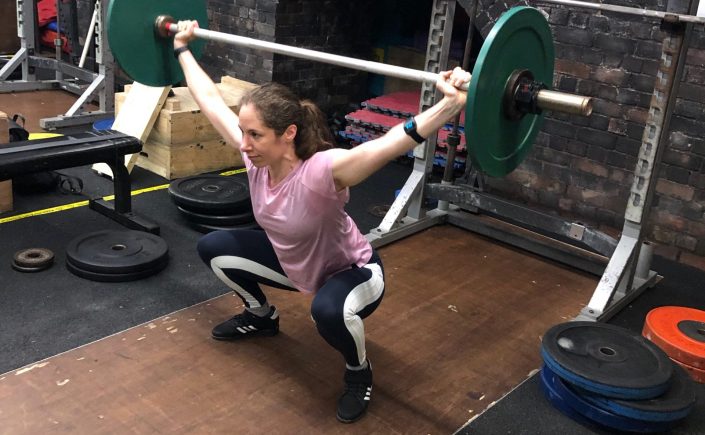
It’s a big, big, sweep of the arm, but most of your lifts can be (could be) compared to your back squat. If you back squat 100kg, the chances are you can snatch up to 60kg, and clean 75kg. Bear in mind these figures could vary by as much as 15%
Front Squat
Snatch
Clean
87.5%
60%
75%
Overhead Squat
Power Snatch
Power Clean
67.5%
55%
65%
Deadlift
Snatch Pull
Clean Pull
125%
90%
100%
Christian Thibaudeau adds extra ratios and insights here
Waxman’s gym has a fascinating “Weightlifting Lift Calculator” here
My take home message is this: once you start struggling with your olympic lifts, and your technique is quite good, start to consider improving your strength.
Assuming you get to a decent gym, that allows your to do some barbell movements, how do you go about developing the strength you so long for? The reality is that the average Gym instructor may know a bit about hypertrophy ( ” 3 sets of 10 mate!”) but thats about it. Sitting in a Globo gym among a pile of machines does that to people. Its tragic. But, lets say, you have something heavy and you want to lift it, how many sets, how many reps?
One of the secrets of elite trainers, like me,is that we are quite well read: we look at British, American and Russian strength training literature. ( mind you, if Tabata is Japanese, add Japanese literature to that list).An interesting piece of research was carried out by soviet Sports scientist, AS Prilepin, who studied the training logs of 1000 leading weightlifting champions .The table below is an averaging of these logs and shows the % of 1 rep max , the amount of reps performed per set, the optimal amount of reps per workout, and the range of reps used indicated by the research. This table is specifically for gaining maximal strength
The Prilepin Table:
Intensity
Reps per set
Recommended optimal Total of Reps
Range of reps seen in research
Below 70%
3 – 6
24
18-30
70 – 79%
3 – 6
18
12 – 24
80 – 89%
2 – 4
15
10 – 20
90% and above
1 – 2
7
4 – 10
There are ofcourse a few points worthy of mention. These tables were extracted from the training journals of olympic weight lifters and its possible to argue that this would not apply to other lifts ( the slower lifts like the squat, deadlift press etc).
This also assumes you have a reliable 1 rep max figure, and for that matter, an up to date one.
What I don’t know ( and if anyone does , please let me know) does he use the idea of a 1 rep max as your best ever lift. If you look at Zatsiorsky and Kraemer, they establish a difference between a training max and a competition 1 rep max. They suggest that the difference is about 12.5% +/- 2.5% in superior weightlifters. The further make the distinction that a training max is a load you lift with no emotional arousal which can be monitored by your heart rate. If someone says, lift that weight, and your heart rate zooms up in anticipation, that load is (probably) above your training max. This ,ofcourse, assumes some experience. Stopping the average sedentary person and saying, lift that weight, will probably get most people heart rate up!
These tables and information are, of course a snap shot. Im not discussing long term fatigue, issues of scheduling. Yet.


 Andrew Stemler