"Back In the Office" campaign

While supporting any and all well meaning people who want to help back pain, I find myself at odds with one recommendation of the forth coming “back in the office” campaign promoted by the Charity Back care (6th -12th October 2014)
Whilst i endorse most of the aims of this campaign

  • Stand not Sit while you work
  • Stretch your back at your desk at least every half hour
  • Set your workstation just right
  • Ergonomic furniture, a hype or a necessity?
  • Use headsets and stop straining those neck muscles!
  • Take regular breaks especially if you work long hours
  • Employers guidelines

I think based on current research, that the “stretch your back ” suggestion, is probably  best  treated with caution

Stretching , twisting and cracking your back?

 
If you stretch twist and crack your back I have one message for you: pack it in!!
“Soft tissue injuries result from excessive tension, so excessive tension in the rehabilitation situation is counterproductive…stretching of …chronically tight tissue is counterproductive. It may give an initial sensation of relief because the muscle spindles have been deadened, but this practice…weakens the tissue further because of the weakened proprioceptive response.”
Boo Schexnayder
“stop trying to Stretch and mobilise! Let tissues settle and regain their proprioceptive abilities so they tell the truth”
Stuart McGill

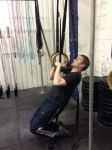
Coaching the Muscle-up: introducing “the angle”

There is a danger in learning only the strength elements of gymnastics: Sure levers, muscle ups are cool, but so much of the lessons of gymnastic rely on you understanding how to efficiently use gravity, angles and lean the achieve movement.

To learn the muscle up, you must at some stage use the kneeling muscle up drill: but there are 2 set ups. A crude, arm strength builder, is with the knees under the rings where the pull is straight up. This is a great starting point as it improves arm strength, although the ideal movement pattern isn’t trained. Another variation of this exercise moves the toes under the rings and brings in a larger lean back. Here the pull is, in theory. to the hips, meaning the shoulders have the space to be swooped over the rings by a drop of the feet. This drill requires no break at the hips. Ill try and do a video later.

in the meantime, think about what a lean in certain circumstances can achieve

The lean, can direct energy

The lean, can direct energy

The role of axial torque in disc herniation.

Marshall LW and McGill SM. (2010) The role of axial torque in disc herniation. Clinical Biomechanics, 25(1):6-9.  you can review an abstract here
Which is worse  lifting and twisting or twisting alone ? Or was the 10960’s dance, the twist, actually safe as long as you didn’t lean forward

This study investigated the role of “repeated dynamic axial torque/twist combined with repeated flexion on the disc herniation mechanism”
1) Axial torque/twist in combination with repetitive flexion extension motion, regardless of order, encouraged radial delamination within the annulus .
2) Alternatively, repetitive flexion motion alone encouraged posterior or posterolateral nucleus tracking through the annulus.
3)  Axial torque/twist alone was unable to initiate a disc herniation.
4)   X-ray images with (contrast and computed tomography) are   not good at detecting radial delamination
The problem this paper gives me is whether or not “twisting exercises” ( without flexion) should be removed from back exercises . It concludes afterall that “Axial torque/twist alone was unable to initiate a disc herniation”. Ill try and find out