About six months ago , the light of my life discovered Korean films on Netflix. Since then I’ve been bombarded with Korean history , Korean romance , Korean police dramas , Korean “ grim reapers “( it’s “ a thing “) Korean zombies and even Korean prison dramas .
The one theme they all have in common , is a focus on food ! In particular , they all mention kimchi . Eating it , making it , fermenting it , and serving it to others!
So what is Kimchi? Its highly nutritious and boasts numerous health benefits, thanks to its ingredients and fermentation process. Here are some reasons why kimchi is good for you!!
1. Rich in Probiotics
• Fermented foods like kimchi contain beneficial bacteria, such as Lactobacillus. These probiotics support gut health, improve digestion, and strengthen the immune system. Woo hoo!
2. Packed with Nutrients
• Kimchi is made with nutrient-rich ingredients like napa cabbage, radishes, garlic, ginger, and chili peppers. It provides vitamins A, B, C, and K, as well as essential minerals like calcium and potassium. All welcome in todays nutrient deprived diet
3. High in Antioxidants
• The vegetables and spices in kimchi are loaded with antioxidants, which help reduce inflammation and combat oxidative stress.
4. Supports Weight Management
• Kimchi is low in calories and high in fiber, making it a filling and healthy addition to meals. Some studies suggest probiotics in kimchi may support weight loss.
5. Promotes Heart Health
• Kimchi can help reduce cholesterol levels and improve blood pressure, likely due to its high fiber content and the presence of garlic, which contains allicin and selenium.
6. Boosts Immunity
• The probiotics and nutrients in kimchi strengthen the immune system, helping the body fight infections and illnesses.
7. May Improve Skin Health
• Kimchi’s antioxidants and probiotics can help maintain healthy skin by reducing inflammation and promoting good gut health, which is linked to clearer skin.
8. Supports Mental Health
• Gut health is closely linked to mental health. Probiotics in kimchi may positively influence mood and reduce symptoms of anxiety and depression.
Things to Keep in Mind
• Kimchi is often high in sodium, so individuals with high blood pressure or salt sensitivities should consume it in moderation.
• If you’re new to fermented foods, start with small portions to avoid digestive discomfort.
Kimchi is not only delicious but also a powerful functional food that can contribute to overall health when included in a balanced diet.
I’d say , give it a go . I should say that I’ve always like pickles so trying this was fun . My partner hates pickles , so this is all a bit traumatic for her !
I bought mine from the “ loon fung” store in Stratford but there are lots of options on Amazon
A limiting belief is a belief that constrains you in some way, often by creating self-imposed barriers or restrictions on what you can achieve.
In the context of exercise and weight loss, a limiting belief might be the belief that you’re not capable of losing weight or that you’ll never be able to stick to an exercise routine.
These beliefs can undermine your ability to exercise and lose weight by demotivating you, causing you to give up easily, or leading you to engage in self-sabotaging behaviors.
For example, if you believe that you’re destined to be overweight, you might not even bother trying to exercise or eat healthily because you don’t believe it will make a difference. Identifying and challenging these limiting beliefs is crucial for making progress towards your fitness and weight loss goals.
Everyone talks about living a better happier life. But what theoretical approaches can you take to change your attitude towards , say food , exercise , anger , drug and alcohol abuse.
Here are summaries of some of the top behavior change theories
:1. Transtheoretical Model (TTM): Also known as the Stages of Change model, TTM describes behavior change as a process that occurs in stages: pre-contemplation, contemplation, preparation, action, and maintenance.
2. Health Belief Model (HBM): HBM suggests that people’s beliefs about a health threat, perceived benefits of action, perceived barriers to action, cues to action, and self-efficacy influence their readiness to take action.
3. Social Cognitive Theory (SCT): SCT emphasizes the role of social influences, observational learning, and self-efficacy in behavior change. It suggests that behavior is influenced by the interactions between personal factors, environmental factors, and behaviors.
4. Theory of Planned Behavior (TPB): TPB proposes that attitudes, subjective norms, and perceived behavioral control predict an individual’s intention to engage in a behavior, which in turn predicts actual behavior.
5. Operant Conditioning: This theory, popularized by B.F. Skinner, suggests that behavior is shaped by the consequences that follow it. Positive reinforcement, negative reinforcement, punishment, and extinction are the main mechanisms.
6. Self-Determination Theory (SDT): SDT emphasizes the importance of intrinsic motivation and the satisfaction of psychological needs (autonomy, competence, and relatedness) in driving behavior change.
7. Social Ecological Model (SEM): SEM considers the complex interplay between individual, interpersonal, organizational, community, and societal factors in influencing behavior. It emphasizes the importance of multiple levels of influence in behavior change interventions.
These theories could provide a framework for understanding how and why behavior change occurs, and they are often used in designing interventions to promote healthy behaviour’s. However it seems that obesity rates are soaring with allegedly 95 % of people who start a diet , failing .
The battle really is on to something that works . There are lots of stories and Instagram takes of success , but they tend to be the exception .
By the time I was 10, I’d witnessed numerous passionate and emotional conversions . I seen sinners galore “come to Christ”. However , I also saw lots of the same converts the days and weeks after their unique conversion experience, reverting to type ! It seems that drugs, booze, sex, power and money ( or whatever Evil/ sin torments you ) is very difficult to shake. Even the help of a God doesn’t seem to make it that much easier !
I suppose this is why I’m fascinated by books and literature and activities that claim to fix your mind ( aka mindset , aka your attitude , aka your beliefs aka whatever label makes you feel you can charge a lot for your view point) .
Over the years I’ve studied lots of weird things from stage hypnotism, firewalking , witchcraft ( after all you get to fly on broom sticks and make love potions ) even tile and board breaking . I’ve had to sit in meditation circles, bow at shrines and temples and look in awe as people who wonder the streets , screaming at someone who wasn’t there .
It seems that we are sort of obsessed , and if we are not , we ought to be , by our thoughts and beliefs . We can allegedly sit in a big mortgage free house , with piles of money yet be lonely and miserable , and people with amazing gifts can destroy themselves with drink !’ We have the capacity to to be happy in the most terrible of circumstances, yet struggle to keep from stuffing twenty donuts in our mouth even if we know our excessive weight us killing us
On a mental level , it seems as if we are collective failures. We are totally out of contact with methods they could bring us happiness and seemingly we are destined to reproduce the same behaviours that make us miserable.
To be helpful , I thought I’d start reviewing the work of popular writers who have discussed and suggested solutions to our problems
I’ll start with the infamous Tony Robbins, a well-known motivational speaker and life coach. Here are some of his ideas :
1. Setting Clear Goals: Robbins emphasizes the importance of setting clear, specific, and compelling goals. This involves defining what you want to achieve and why it’s important to you.
2. Visualizing Success: Visualization is a powerful technique advocated by Robbins. He encourages people to vividly imagine themselves achieving their goals, experiencing the emotions associated with success.
3. Positive Affirmations: Robbins promotes the use of positive affirmations to reprogram the subconscious mind for success. Affirmations are positive statements that reinforce desired beliefs and behaviors.
4. Modeling Success: Robbins believes in modeling successful individuals to learn from their strategies and behaviors. By studying the habits and mindset of successful people, one can replicate their success.
5. Mastering Emotional State: Robbins teaches techniques to manage and control emotions effectively. This includes strategies for overcoming fear, anxiety, and limiting beliefs that may hinder personal growth.
6. Taking Massive Action: Robbins emphasizes the importance of taking massive action towards your goals. He encourages individuals to commit fully and take consistent, determined action to achieve success.
7. Embracing Failure and Learning: Robbins teaches that failure is a natural part of the journey to success. He encourages people to embrace failure as an opportunity for growth and learning, rather than allowing it to deter them.
8. Developing Resilience: Robbins helps individuals build resilience to bounce back from setbacks and challenges. This involves cultivating a strong mindset, perseverance, and the ability to adapt in the face of adversity.
I came across an interesting article that suggested that a certain type of exercise could make you as thin as our other ape colleagues.
Im sure you have all mused on the fact that we are fatter than our chimp ape brothers.
Its the number one topic of conversation in our gym!
Unfairly, primates have less than 9% body fat, a healthy range for humans is anywhere from 14% to 31%. Even for those super fit skinny people with amazing muscles.
Despite having nearly identical DNA sequences, chimps and early humans underwent critical shifts in how DNA is packaged inside their fat cells, As a result, the researchers say, this decreased the human body’s ability to turn “bad” calorie-storing fat into the “good” calorie-burning kind. basically we needed to store more fat to fee our growing brains.
Normally most of the DNA within a cell is condensed into coils and loops and tightly wound around proteins, such that only certain DNA regions are loosely packed enough to be accessible to the cellular machinery that turns genes on and off.
The researchers identified roughly 780 DNA regions that were accessible in chimps and macaques, but had become more bunched up in humans. Examining these regions in detail, the team also noticed a recurring snippet of DNA that helps convert fat from one cell type to another.
But, we need to back track.
There are 2 types of fat. White fat that stores calories, and beige and brown fat which can burn calories rather than store them to generate heat and keep us warm.
“We’ve lost some of the ability to shunt fat cells toward beige or brown fat, and we’re stuck down the white fat pathway,” Swain-Lenz said. It’s still possible to activate the body’s limited brown fat by doing things like exposing people to cold temperatures, she explained, “but we need to work for it.” This accounts for the cold shower crazes and the insane idea of “thermal loading” which I had to test.
In the six to eight million years since humans and chimps went their separate ways, human brains have roughly tripled in size. Chimpanzee brains haven’t budged.
The human brain uses more energy, pound for pound, than any other tissue. Steering fat cells toward calorie-storing white fat rather than calorie-burning brown fat, the thinking goes, would have given our ancestors a survival advantage.
This raises the remote possibility that in the future we could find a way of manipulating and switching genes on and off and magically have 9% body fat.
In the future.
NOT NOW.
In fact in an interview the lead researcher Swain-Lenz said, a question she gets a lot is: “Are you going to make me skinny?”
The Tiny Habits process, developed by BJ Fogg, is a method for behavior change that focuses on making small, sustainable adjustments to our daily routines. It operates on the principle that by starting with tiny, easily achievable actions, we can create lasting habits.
However, the new habit has to be something you want to do, not something you are obliged to do and shockingly, you have to celebrate after each performance!!
The process consists of several steps:
1. Identify the target behavior you want to do: often flossing your teeth is used as an example.
2. Define a tiny version of the behavior: Break down the behavior into a small, simple action that takes less than 30 seconds to complete. Using flossing your teeth, you would floss one tooth only.
3. Anchor the new behavior to an existing habit: Find an existing habit or routine that you already do consistently. Use this habit as a trigger or cue to remind yourself to perform the tiny behavior. thinking about flossing your teeth, its logical to anchor this to brushing your teeth
4. You need to look carefully at your anchor process and ask yourself what is the last part of brushing your teeth. This is called the trailing edge. Some spit then put their toothbrush down. It makes sense to have your floss right by where you put your toothbrush which is super easy to immediately pick up.
5. You now floss one tooth! You now celebrate! Maybe you punch the air, go “yaay”, or maybe you give yourself a pat!
6. To set up the habit you basically say, when I put my toothbrush down I’ll pick up my floss, floss one tooth, then celebrate.
7. Once you have flossed one tooth and celebrated, obviously you can go on to floss them all if you want to, BUT to develop the habit, all you NEED to do, and MUST do is the tiny habit.
Weirdly you’ll find this process can help you unlock many benefits beyond just the habit you have targeted. The mistakes you will make are: not identifying the trailing edge of your anchor habit, you’ll make the habit way too big, and because you are shy, you’ll think that celebrating is silly.
I recently wrote this outline of what I consider to be the most effective methods of helping people manage their weight.
The weight management industry is huge yet unregulated, and its advice is contradictory and confusing. I thought it ethical to clearly outline the strategy I will use to help you build the capacity in managing what you eat. You dont have to like all of this.
OBJECTIVE 1 Restore normal eating
The last 30 years have proven beyond doubt that simply manipulating food – be it by calorie counting, playing with macros, bingeing on a specific type of food, banning others and playing with time slots – has little lasting positive effect.Apart from not working, attempts to deploy starvation and deprivation methods merely result in disordered eating.Stop dieting and start eating normally. Basically, that means the plate method. A highly validated, effective nutritious method harking back to the “good old days” of “meat and two veg”
Objective 2 :Master your mind
Most people have no idea how to master their own minds. Our thinking is wrong, we do not recognise the influence our bad habits have, are often too inflexible in our approach to life, and have little to no idea as to how to change our behaviour.Our aim – using cutting-edge business, elite sport, and combat techniques – is to put you in control of your mindDon’t commit to goals, commit to processes.Treat goals with contempt. Goals are about the results you want to achieve. Systems are the processes that lead to those results.Goals are fine for the general direction of travel, but systems give you progress. Problems arise when you use your energy to focus on your goals rather than perfecting your system. Every sports person, and competitor wants to win. The winners are those who optimise their system.
Goals destroy your happiness. Your belief that joy and success appear only when your goal is achieved means you are never happy. Instead of tormenting yourself with goals, fall in love with the process.Goals are at odds with long-term processes. If you have a specific goal, what happens when you reach it? The purpose of setting goals is to win. The process of building systems is to continue playing the game.Setting up your system and processes is not a euphoria moment where you revel in positivity. Effective plans anticipate the barriers you may encounter and help you plan in advance about solving them. Otherwise, you can fall at the first fence. These barriers are known as inflection points. We help you imagine unpleasant situations in advance and write out a plan for responding. This strategy isn’t speculation, it’s taken from the Starbucks playbook. This is how willpower becomes a habit. By choosing a response to an issue in advance, that becomes the behaviour when that inflection point arises.
Objective 3 Build Better Habits.
We get you to understand habits. We guide you to identify the bad or unhelpful habits you’ve acquired, and how to transform them into better, more helpful habits. It’s certainly unhelpful to harangue people with generic exhortations to “meditate,” or “drink water”.Increasingly research has shown that those struggling with weight management often have certain habits in common. The more flexible you become in your daily life, the easier it is to manage what you eat.
Objective 4 Understand Will power
.For years people have been made to feel like failures when their willpower faded and their diet collapsed. It was thought that willpower was a skill to be learned, like riding a bike. This is a useful analogy. If you ride your bike on Monday, you don’t expect to be unable to ride it on Tuesday. So, if you have the skill to eat healthily on Monday, then Tuesday should be a breeze! We now view willpower as a muscle that needs both exercise and practice, but can equally end in failure. Willpower is a finite resource that needs to be managed. We will help you build your willpower.Some find the concept of willpower unhelpful, so we also explore the idea of “grit”. To make you more “gritty” we need to engage your interest, develop your ability to practice, discover your real (higher) purpose and build your hope. Researchers like Angela Duckworth have popularised and validated this approach.Little winsLittle wins have been shown to be crucial in redesigning how you think and feel about situations. By using simple daily tasks, we will get you some early successes.The underpinning theme is to help you find out how the mind works.We support you in studying powerful mind management models that can help you become a more happy, confident, healthier, and more successful person. We will help you understand the struggles that happen within your mind and know how to apply this insight to every area of your life. You have to changeTo manage your weight, you must change. At a fundamental level, you need to change your beliefs and values. This may sound drastic, but as the British cycling team found out, change is successful when made in 1% increments.
Objective 5. RECONNECT WITH YOUR EMOTIONS. Practicing healthy eating, building better habits, and understanding your mind is helpful. It’s also found that building your emotional resilience is equally important. However, secure within our relative wealth and comfort, much of our lives to date have ignored the need to attend to our emotional health. The overused phrase “How do you feel?” Is hackneyed, but the question remains essential. If you follow the work of Julie M Simon, you may quickly trace many issues as being created by a failure to manage your emotions. In its simplest form, people need to recognise, identify and accept their emotions.Once this is done, you can move forward to finding a solution.Emotions are too often either ignored or discounted. In other words, you are taught to ignore your emotional state. What can you do? You still have the emotions, you still feel them, fear sadness, and anger (more choice here!).How do you deal with them? You haven’t been taught how to cope with emotions so you need to soothe yourself. The number one choice of self-medication is food, although later on it could be drugs, booze, or pornography. Every time you feel joy, sadness, happiness, or failure, you go straight to food. Essentially, food becomes the only thing that means you can control your emotions. Where does this get you? If you cannot identify or control your emotions, then realistically you cannot control your food. It seems that food is the only thing that keeps you sane. For years you have used it to smother emotions, so it makes sense that you won’t allow it to be restricted or measured. If you do restrict, then it makes sense that you’ll binge later on during the day.Our program guides you through the emotional maze and helps you reconnect with your emotions, dealing with them in a better way than binging on cake
Objective 6 . Understand Trauma. One of the last pieces of the puzzle is trauma. Today this is an overused word. In this program, we use it to describe a “failed freeze” response.In simple terms, if you are attacked, most people think you have two options: fight or flight. Actually, you have four: fight, flight, a search for social support, or “the freeze” response. On a primal level, predators don’t like eating “dead meat”, so often creatures that freeze stand a higher chance of escaping. The mouse feigns death while the cat is staring, but when the cat loses interest the mouse runs like hell! The full freeze response is freeze THEN run.You may not have experienced a war zone or been mugged in the street; but what if your boss walks up and shouts at you, and you sit there and take it? Once your madcap boss wanders off, if you stay put, the chances are that you are accumulating micro traumas.. You froze, but you didn’t run. This leaves you feeling very unsafe. You do not need to be shot in a war zone to feel trauma (more here). Using drills developed for the military, our program gets to restore the safety you need and teaches you how to stop it from happening again.
It’s super important for you to understand how you feel. Once you can identify your feelings you can accept them, and offer yourself unconditional acceptance.
Often people get really stuck? How do you feel?
Gosh, where do you start?
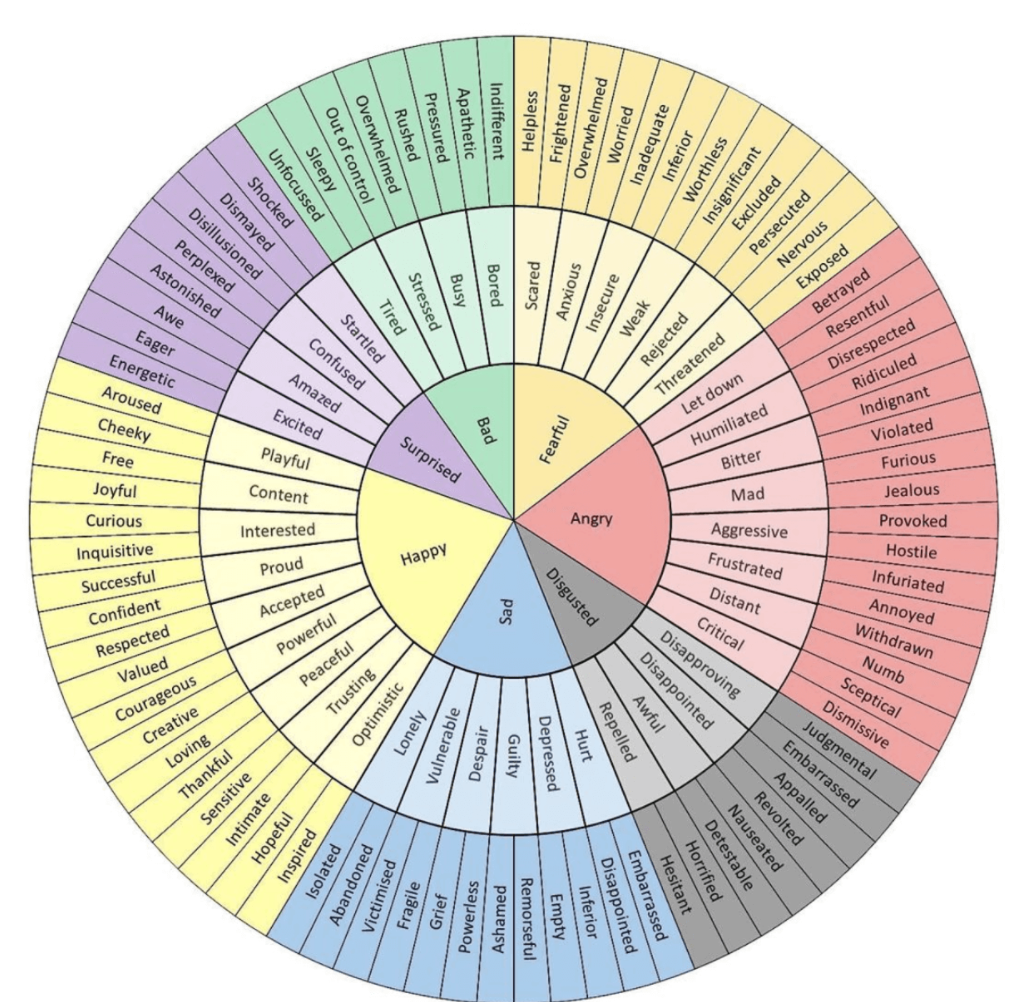
Its often a good idea to use a chart, or list as a prompt.
There are many useful lists to choose from. Plutchik, Aristotle and Darwin have all produced emotions lists. This is a useful chart from wikimedia
If you study the chart you’ll see that its very possible to have more than one emotional feeling at any one time. you can be sad, lonely and disappointed, all at the same time.
Most dysfunctional behaviour probably comes from trauma, we normally associated trauma with great big awful stuff. However, it seems that it can also accumulate over time. No one considers that the rage, rejection and blame that children are subjected to amounts to trauma
Maybe trauma is the wrong word, maybe its core issues or core wounds. Maybe it’s as classic as the death of a thousand cuts
It seems that numerous petty wounds, accumulated over time can begin to disconnect you from your emotions. Julie Simons in The emotional Eaters Repair Manual gives the following examples of the stuff that you could be subjected to as a child that could have effects later on.
Abandonment: a caregiver dies or is so overworked that they are “not available.
Attack: your caregiver attacks you (everything from a wack to constant aggression, threats, or ridicule
Betrayal: your caregiver lies or makes empty promises.
Blame, you were blamed for the feelings and actions of others
Deceived: you were intentionally misled.
Neglected: simple neglect of your physical and emotional needs
Domination: excessively controlled
Engulfment: you were smothered
Exploitation. You were made to do excessive and age-inappropriate chores
Fragmentation: your caregiver was mentally ill.
parentification. you were made to be responsible for others.
Rejection: dismissed as useless or worthless.
Shame: regularly criticized.
Violation: invasion of your space.
But what could be the mechanism or process? Why would having to do extra chores or get a slap on the back of your legs mean you are unable to control certain aspects of your behavior when you are older?
As a small person, your job is to learn lots of stuff, verbs, going to the toilet, and setting fire to things. You also should learn how to manage your emotions. The correct process of looking after your emotional health is to understand how you feel, then accept those feelings as appropriate, and then make sure you have enough emotional resources to support going forward. Once you have this process, you can move quickly to technical solutions.
However, if you are brought up by idiots, no one asks you how you are. Your emotions are either ignored or discounted. In other words, you are taught to ignore your emotional state. As a child, what do you do? You still have the emotions. You still feel them, fear sadness, and anger (more choice here!).
How do you deal with them? You haven’t been taught how to cope with emotions so you need to soothe yourself. The number one choice of self-medication is food (although later on, it could be drugs, booze, or pornography). Every time you feel joy, sadness, happiness, or failure, you go straight to food. Basically, food becomes the only thing that means you can control your emotions. Where does this get you? It means that realistically you cannot control your food. Food is the only thing that keeps you sane. for years you have used it to push down emotions so it makes sense that you won’t allow it to be restricted or measured. If you do restrict it makes sense that you’ll binge later on during the day.






 Andrew Stemler
