in the 60’s to 70’s you would have been hard pressed to ignore the isometrics movement. Vic O’beck published “How to Exercise without moving a muscle” in 1964 and it became very popular.
Like many fitness fades, the interest faded from main stream use, due in part to silly claims. A regime that promises to get you fit and trim in 90 seconds a day is bound to sell you the book or course, but fail to deliver much , if any, fitness.
This is a shame, as given the right objectives, the static hold has a really useful role to play. According to James Hewitt who wrote Isometrics for you: Get fit and trim in 90 seconds a day in 1966 “without special apparatus and without moving a muscle you can grow stronger and build, or reshape your body to nearer your hearts’ desire. The static contraction has been part of physical culture systems for a very long time. Hatha yoga contains postures held without movement”.
Put simply, isometrics are a system of physical exercises in which muscles are caused to act against each other or against a fixed object. It’s a form of exercise involving the static contraction of a muscle without any visible movement in the angle of the joint.
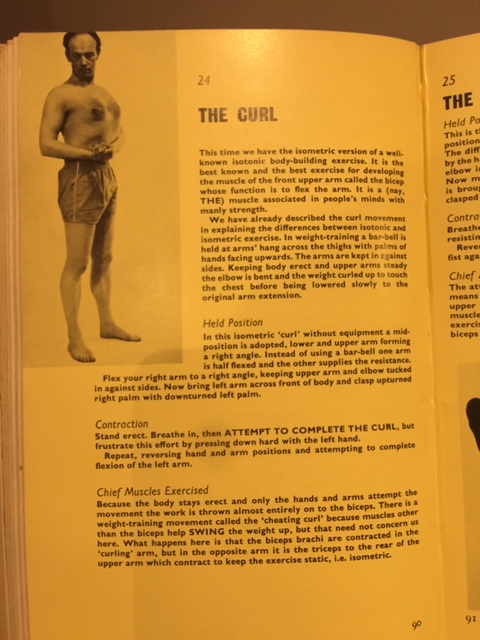
The popular regimes focused on basic body building type exercises and suggested a 6 second static contraction with a maximum, or comfortable maximum contraction. This bicep curl picture gives you a good idea.
Whilst this had some value, the use of the extended static hold in functional fitness is probably in developing the capacity to simply hold postures which contribute to actual exercises. The reality is that if you want to kick up to a rock solid free standing handstand, or do 20 plus pull ups, you better be able to hold a static ( albeit “leaning” ) handstand against the wall, and hang for 60, 90, 120, 180 seconds. Extra grip strength is always useful!
Btw you could find yourself struggling at 10 seconds when you start. Just do what you can and build up
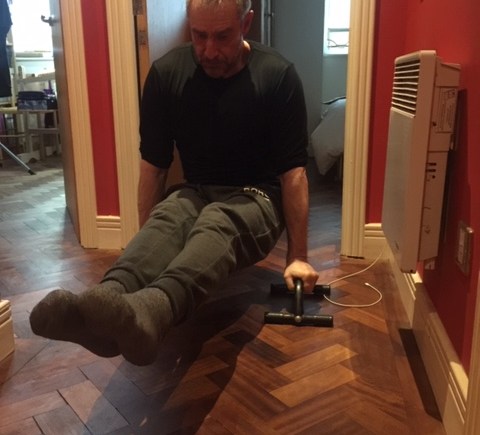
So think about your regime and hunt out obvious postures to practice: the side planks, lunging pushes against a wall and deadlift holds spring to mind. Adding the L sit, a horse stance ( the old martial arts favourite) and a “hip up” hold can , when combined, make a really useful home exercise regime.
Successful Strength training like marriage is measured in years not weeks or months
Pay attention to the basics . Lift often, lift heavy (5 plus,, but vary from 5 to 1) be happy with small increases. Every relationship or “thing” in your life requires consistency
Don’t panic if you plateau.
In what other part of (real) human existence do we expect to have increases all the time . We can tamper with economics and pretend we have yearly growth: some NHS workers ( apparently ) get a grade increase each year , but that always. always unravels. “Maybe not today, maybe not tomorrow…….’
The hall marks of successful strength training (marriage) is patience and maturity: watch for the opportunity to improve but don’t obsess., be happy with consolidation, treasure consistency and above all, be confident enough to rest and take it easy.
Eat well and sleep well
Bear in mind that all advanced programming is dedicated to one phenomenon, failure. Many marriages fail because one partner isn’t happy with the perfection they have, and instead indulges in fantasy . Don’t let the strength porn of a few gifted ( psychotic) individuals deprave and corrupt your normal image of how things are.
Failure is rushing at fantasy target too hard and fast.
Having preached consistency, it’s equally essential to mix it up and be creative. Add some strongman training, add and vary assistance exercises.
Variety has always been the spice of life But variety is still just a spice. It makes the fundamentals seem a bit different that’s all. It still needs the fundamentals/
In short, don’t see strength as something geeky or the preserve of experts. See it as the perfect romance or marriage, demanding consistent loyalty commitment and work , along with romance and variation.
So to be successful, research how to be romantic and simply build it into your strength regime
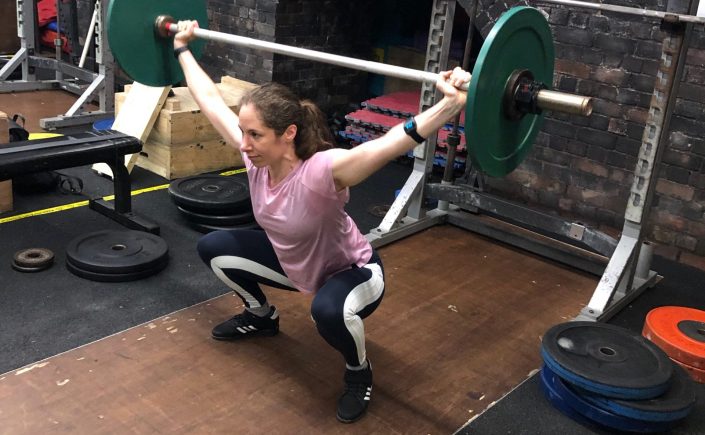
You can analyse and use the olympics lifts in many many ways. One is to view the full skill is a pressure test for your front and overhead squat. The pure ” beautiful” form of the lifts are seen as the squat clean and squat snatch.
Put in other words, it tests if you own a superb front and back squat to the extend that you can jump into it with a great big weight. Any squat wobble or misunderstanding of your squat form means that, under pressure, you won’t be get under the bar.
Take home message: don’t skimp on your front squat and overhead squat practice!
It’s a big, big, sweep of the arm, but most of your lifts can be (could be) compared to your back squat. If you back squat 100kg, the chances are you can snatch up to 60kg, and clean 75kg. Bear in mind these figures could vary by as much as 15%
Front Squat
Snatch
Clean
87.5%
60%
75%
Overhead Squat
Power Snatch
Power Clean
67.5%
55%
65%
Deadlift
Snatch Pull
Clean Pull
125%
90%
100%
Christian Thibaudeau adds extra ratios and insights here
Waxman’s gym has a fascinating “Weightlifting Lift Calculator” here
My take home message is this: once you start struggling with your olympic lifts, and your technique is quite good, start to consider improving your strength.
You are a self fulfilling prophecy! Your early teachers, the trainers you have met, the sports you have tried and failed at have pretty much taught you that you are weak, uncoordinated and basically crap. So, when you look at the WODs we publish on the Crossfit London UK site, you must to be thinking: “you have to be joking! I cant do that!”
How you account for failure and success and the feelings these evoke is the subject of attributions; the perceived causes of events and behaviours. Theories about attributions focus on your perceptions and interpretations that affect your behaviour.
The attributions we make about ourselves and others affect our behaviour.
If you cannot snatch (an olympic lift) you would behave differently depending on why you think you cannot. Perhaps you don’t know how, or need more practice; in which case you may attend a Crossfit London UK skill seminar. However if you think its because you are weak and too uncoordinated to learn, you could simply give up and go back to a leg extension machine in your local fitness centre. The attributions you make about others also effects how you feel about them. If you watch a classmate attempt a snatch , how you perceive their attempt will be different if you think they lack the strength or that they are lazy!
Weiner et al (1974) has been credited with bringing attribution theory to prominence by developing an attributional theory of achievement behaviour. He specifically felt that the difference between high and low achievers is the difference in attributional patterns (or how you think about stuff)
According to Weiner, if you had to assess why you screwed up a workout, or came last in the Crossfit games, your explanations could fall into one of 4 categories: ability, effort, luck, task difficulty.
However these four categories are not the critical aspect, the locus of causality (where the “blame” lies) and stability are the two essential dimensions.
The locus of causality can either be internal or external, ie ability and effort are internal, luck and task difficulty are external. Are these stable? Your ability is stable, however your effort is unstable and can vary from workout to workout: luck, unstable.
Later Weiner added a third dimension; controllability. Some factors are internal, but not very controllable, ie aptitude and natural ability.
Often people make internal attributions for winning and external ones for failure. In team sports, external attributions normally seem to come from the loosing side (lucky breaks, officials’ calls, weather). The tendency to attribute success internally and failure externally can be seen as setting up a self serving bias. If you complete a workout faster than class mate, you would prefer to think that your extra effort won the day, not that your rival was ill that day.
Weiner suggests that the internal/external dimension can correlate to feelings of pride and shame, with the internal attributions provoking stronger feelings: you take a greater pride in a victory you earned!
The stability of these factors also has an effect: a stable attribution leads you to expect the same outcome: if you have failed in the snatch because you its too complicated for you, you can expect the same results in the future. The controllability of the factor effects our moral judgements: we praise those who give extra effort and dislike those who shirk.
However, the results of studies are confusing. Some have identified winners as internal stable and controllable, others that winners make more stable and controllable, but not more internal, attributions.
Spink and Roberts (1980) showed winners made more internal attributions, more importantly they actually found two types of winners satisfied, and dissatisfied winners who felt the victory was too easy. Satisfied losers attributed losses to task difficulty, dissatisfied losers looked to their own low ability. Essentially, McAuley(1985) found perceived success to be a better predictor of internal stable controllable atttributions than objective success.
Attributions and Emotions.
It is quite popular to link attributions and emotions. Weiner identified outcome-dependent emotions (associated with actual outcomes) and attribution-dependent emotions (the reason for the outcomes)
Work by Biddle ( 1993) indicated performance satisfaction (or subjective appraisal) is one of the best predictors of emotion, and that attributions play a role.
Dweck (1978) deploys attributional theory in the field of learned helplessness. We all come across those individuals ( do you think this of yourself) who “know” they are slow, uncoordinated and too un-athletic to take part in sports or get fit ( or Crossfit) Here we can help by making these people attribute their failings to unstable, controllable factors including a lack of practice, instruction and techniques.
In reality, at Crossfit London, we find that many people who have been dismissed as weaklings, or overweight, uncoordinated failures can often make substantial improvements in performance and fitness. Our focus is to get you to work on those things you can control, and make stable; we do our best to get you to forget the vicious labels that incompetent sports teachers and trainers may have lazily given you. Our teaching is made progressive so that we can take beginners and make them skilled performers. Our approach will get the best out of your efforts and enhance your feelings of personal control.
The programmes I discuss here have many objectives, one of which is to help you find your strength head – shorthand for developing your strength knowledge. In this article we visit the basic language of weightlifting and how it relates to the concept of relative intensity.
When it comes to using weight; in simple terms, people think this: lift the heaviest weight you can, that’s your 1 rep max; then based on that you can lift 90% of it 3 times (3reps), 85% of it 5 times, 75% 10 times. If you do 3 rounds of 3 reps, that’s 3 sets.
So weight lifting is a mix of percentages, sets and reps, all based on a one rep max. Simples!
This is a great place to start, but to develop your strength head, you need to develop your knowledge and insights into the strength game.
Some time ago, Zatsiorsky pointed out there are two types of one rep maxes you can have: a competition 1 rep max, and a training 1 rep max.
A) A competition max is where you get hyped up and get a PB and scream a lot.
B) A training 1 rep max
Marvellous.
However, often people skip the full definition of a 1 rep training max.
A maximum training weight is the heaviest weight you can lift without substantial emotional stress.
Damn. No screaming.
For athletes, the difference between the two is great. The example Zatsiorsky cites is that for athletes who lift 200 kg during a competition, a 180kg is typically above their maximum training weight. As a possible indicator, if your heart rate increases before your lift, that’s a sign of emotional engagement. Weightlifting is meant to stress your body, not your mind.
That’s the job of your partner and employer.
In short, if you screamed it up – it’s too heavy to use as a basis for regular training.
So, if you are calculating reps and sets using a 1 rep max, please, please use the right one; otherwise you’ll break. Maybe not today, maybe not tomorrow, but soon… If you want to properly test your 1 rep max, book a PT session with one of the training team.
If you have been lifting regularly for a while, you have probably begun to review strength literature and you are probably aware that lifting 80% of your 1 rep max provokes strength gain.
So, when lifting sets of 5, you’d probably like to put 80% of your 1 rep max on the bar. Everyone does that, but think about what it is you’d are actually be doing.
Let’s forget weightlifting for a moment, and talk about bricks. Imagine you are a labourer on a building site. Lets say we run a test to see how many bricks you can move in a day. For argument’s sake, let’s say you can move 1000.
Normally in training we wouldn’t want to move the 1000, we would do 800 ( 80%) but many people want to set 5 reps of that. So there you are, lifting 5 x 800 =4000.
If you tried to do that in a day, you’d probably die.
Back to the weight room. So you can lift 100kg calmly as your 1 rep max. You’ve been told if you lift 80% and over of this figure, you are strength training. So, to keep the maths easy, if you lift 80kg, you are strength training. But do you lift that 80% five times?
As you see from my poor labourer example, the first 800 was probably easy, but the next 800, isn’t easy, the 3rd 800 is getting you to breaking point.
In short, 80% lifted multiple times, isn’t perceived by the body as 80%. It sees it as much, much heavier because of the volume. The bricklayer, is of course a silly example – but try and get the message rather than be sidetracked in the endurance aspect of the example.
In simple terms, because you are lifting in sets of multiple reps, a load of 67% of your 1 rep max lifted 5 times has a relative intensity of 79%. It feels like 79%, your body thinks it’s 79%. It is 79%
Putting 76% of you 1 rep max on your bar for 5, has the effect of being 88%.
70% feels like =82%,
73% feels like = 85%.
80% on the bar for 5, is like lifting 91%.
Relative intensity is the simple observation that volume, load and rest effects how your body feels and adapts to weight.
Coach Robb Rogers gives a fuller description here:
Remember your muscles are dumb, they don’t know or care about percentages. They just know what feels heavy.
According to Mike Tuchscherer; “The body responds to things like the force of the muscle’s contraction, how long the contraction lasts, and how many contractions there were. A percentage isn’t necessarily a precise way to describe this, as different lifters will perform differently.”
In take-home terms, if today you went to CrossFit London or CrossFit SE11, and during the strength session, you only got to 68% of your (proper) 1 rep Training max for 5; you actually hit the 80% in relative intensity. That’s the 80% you need to nudge your strength along.
For now, in our general programme, we are not obsessing about percentages; but those who do know their lifts, I hope will be grateful for this insight. For the rest of you, simply work to a set of 5 that you can comfortably lift, bearing in mind these RPE (rates of perceived exertion) as guidance.
On a scale from 1 to 10:
9: Heavy Effort. Could have done one more rep. 8: Could have done two or three more reps, but glad you didn’t have to. 7: Bar speed is “snappy” if maximal force is applied 6: Bar speed is “snappy” with moderate effort
After a while, I suspect a “five” you can do in class will be at an RPE between 7 and 8.
Once you bedded this concept of relative intensity into your head, you can look forward to many years of safe, effective lifting.
More insights coming soon.
Grateful thanks to Coach Chet Morjaria @ Strength Education and to Coach Anthony Waller @ CrossFit London for the numerous corrections and observations they supplied






 Andrew Stemler