This is quite a classic stretch. I remember doing this back in the 1990’s.
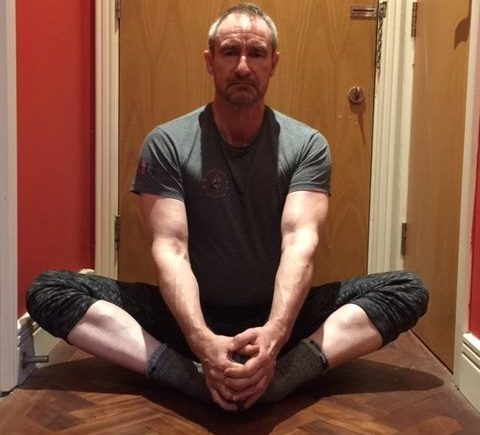
Sit down, stick one leg out straight with the sole of the other foot facing the inside of your straight leg.
Bend forward from your hips, not your back. Hold for 10-60 seconds, or 3,4,5, sets of 10 seconds.
Some calming rhythmic breathing is always handy. Some talk about adding meditation. I must I admit I stretch while watching TV!
As a test, it’s worth noting that whilst your hamstring ( the back of your leg) will feel tight and engaged, if you poke the top of your (straight )leg, it (the quadriceps) will feel relaxed.
Obviously, do both sides.
There will be more hamstring stretches as we develop into the full splits.
No modern discussion of flexibility, trigger points or pain is complete without talking about fascia.
I was introduced to fascia by Julian Baker of the Bowen technique during some guided dissection sessions back in 2012 ( which means I have dissected corpses as part of my studies).
Its the “sort of fatty stuff directly under your skin See here
Years ago this “stuff was simply cut away by laboratory assistants so you could see the actual muscles.
It’s only now that people see this as a new communication highway for our endocrine, circulatory, or nervous systems.
Today much “tightness” is attributed to dysfunction in the fascia. Although this is far from proven it’s useful working hypothesis that makes us focus on trigger points. They are “a hyper irritable locus with a taut band of skeletal muscle, located in the muscular tissue and/or its associated fascia.”
Sometimes called knots, trigger points can be quite painful, will cause stiffness and weakness of the affected muscle, and restrict the muscle’s full range of motion.
Fascia can also stick to muscles in what Gill calls “fuzz” ( if you cannot pick the skin off your muscle, its arguably adhered and interrupting muscle function, reducing range of motion
When poking around your body, you can often find what needs attention if 1. You press on the skin, and its super painful with pressure 2. you cannot pick the skin away from the muscle. This should glide, not stick 3. You feel special tension in an area when you stretch
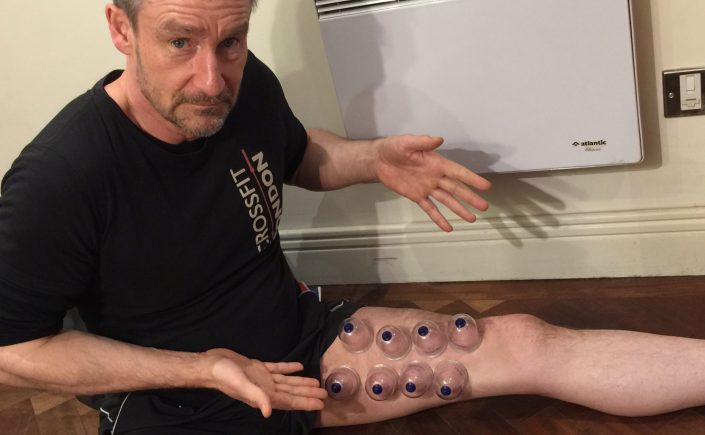
This is sorted by, being bothered enough to do something about it. Practically that means a mix, but consistent mix , of gentle (and not so gentle) massage, skin rolling and pressure applied by your fingers, objects, cupping, or better still someone else.
This stuff goes under the heading of Myofascial Release.
It’s uncomfortable which is why few people use it or do it. Sort of like flexibility. You have to get used to that weird discomfort.
The problem is that medically, no one wants to be a muscle doctor. So it’s the orphan organ.
If you have enough flexibility to squat, why do you need more. Crucially, if you cannot squat well because of flexibility who cares. Most lift the weight anyway, and if they screw their back who cares!
Stretching is uncomfortable, boring, the evidence is very conflicted and many charlatans insist that flexibility is a “star gate” to spiritual well being and enlightenment. This obviously puts any right mind individual off stretching.
The bigger your flexibility tool kit, the better your flexibility training will go. So, it was fun to come across “Effect of Cupping Therapy on Range of Motion, Pain Threshold, and Muscle Activity of the Hamstring Muscle Compared to Passive Stretching” It’s a fascinating read.
Kim et al, set out to review the effects of cupping on flexibility. The conclusion was that cupping therapy has a positive effect on flexibility equal to passive stretching. Allegedly more convenient and easier to work on patients than passive stretching. Therefore, cupping therapy should be considered as another option to treat range of motion issues.
They tested this protocol: “Cupping therapy was applied to the hamstring muscle for 5 minutes in the cupping therapy group. The passive stretching group was treated with a passive stretching for 10 seconds and repeated 9 times”
This is the same result that Lacross, 2014 found. Cupping therapy may induce a change in flexibility (equal to passive stretching). Maybe cupping actually gets into the tissues! This depth of effect , allegedly, increases the neurophysiological activity at the level of nociceptors, the spinal cord, and other nerves, and ultimately leads to significant relaxation (Musial et al., 2013). Cupping has also been found to affect the body up to four inches into the tissues (Hanan and Eman, 2013).
So, yes to cupping. Its fairly cheap, quite safe and a good DIY thing if you make sure you are suitable for this treatment. Bound to be good for facebook and instagram photos. Get a cheapie set for £35
Lacross ZT. Treatment Outcomes of Myofascial Decompression on Hamstring Pathology. 2014.
Musial F, Spohn D, Rolke R. Naturopathic reflex therapies for the treatment of chronic back and neck pain-Part 1: neurobiological foundations. Forsch Komplementmed. 2013;20(3):219-24.
Hanan S, Eman S. Cupping therapy (Al-Hijama): It’s impact on persistent non-specific lower back pain and client disability. Life Sci J. 2013;10:631-42.
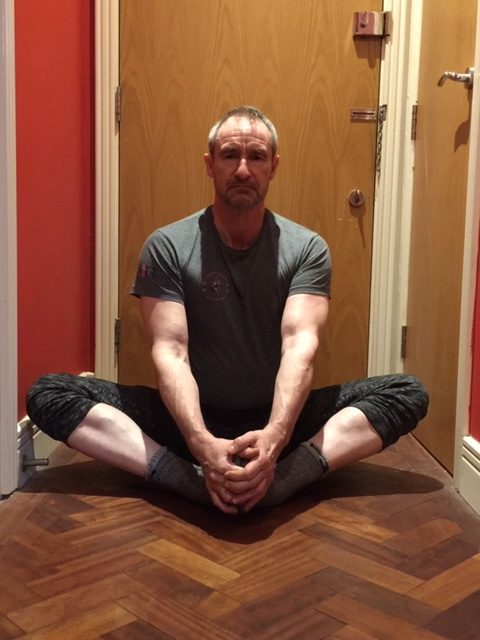
A great starting stretch, as, in simple terms, all you have to do is to plonk yourself down on the floor (bed, bench, loo) put the soles of your feet together, grab them, and lean forward from the hips.
Simply, pull your elbows to the floor, or lean form the hips to build the stretch which you’ll feel on the inside of your upper legs.
You’ll find that once you have held a stretch, it starts to ease off as the body gets used to it. This could be an opportunity to improve the stretch by pulling or maybe pushing your knees to the floor, or leaning further forward from your hips.
If you train in a leisure centre, you’ll be told to do this for 10 seconds. However, the modern evidence is that stretches need to be held (or accumulated) for up to 2 minutes and beyond. Start off gently and build time time in the stretch sensibly.
We will show you lots of variations to this stretch.
I refer to this “genius” so often, that I thought I should post up this reference here.
Alfredson H Pietila T Jonsson P Lorentzon R. Heavy‐load eccentric calf muscle training for the treatment of chronic achilles tendinosis. Am J Sports Med. 1998;26(3):360‐366. [PubMed] [Google Scholar]
This is a report that has changed the lives of so many people, it’s ridiculous. It’s basically stretching a tendon through its eccentric phase, under load.
Here is a much younger me trying it out, back in the days when I was sufferer!
For those who want to dig further into this issue, check out this useful review.
Where ever I go I find people abandoned by the fitness industry!
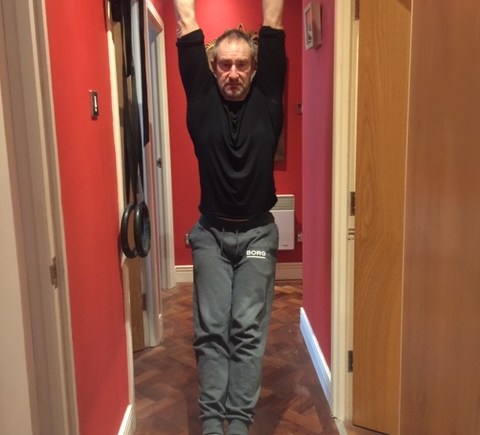
My evidence for this is the failure of so many people to be able to do a pull up.
I’ve written about this phenomenon in the past. Often in slightly rude, slightly risque, terms.
But let me, again, emphasise how to get your first pull up.
Obviously, any arm strength helps. If you’ve been bicep curling, doing push-ups, tricep extensions, some other weird bodybuilding isolation exercise you got off the internet, you must be better of than someone who hasn’t used their arms since birth, but as my article “Pull ups and girls” proved, generic exercises do not give you pull-ups.



 Andrew Stemler