Lie on the floor with your knees flexed (feet on the floor) and stick your fingers into the meat of your ass.
Squeeze your ass cheeks together as your method of engaging them and not by trying to over extend your hips or play with your pelvis; keep that neutral.
Once that is mastered, bridge the torso off the floor. At this stage, you , a friend or your trainer needs to feel your hamstrings. People who are “hamstring dominant and gluteal deficient will engage the hamstrings prior to moving” (McGill: page 195 Ultimate back Fitness).
This is the wrong pattern. The glutes should drive this action. To help we can put our foot against your toes, and whilst asking you to squeeze your ass, we can help your quads engage by lightly cueing from the knees ( so either a finger hook under the knee to gently pull them up, or if you know each other, a quad stroke ( to encourage the hamstrings to switch off) ).
Once you get your ass engaging, “Boom” your back gets a bit more resilient and your squat gets better!

Help your back find its way: tape it up!
If you struggle to maintain a neutral spine when deadlifting or squatting, or sitting for that matter, a “bit of gaffer tape” either side of your lumbar spine can give some very useful feedback. Set your neutral back, and get someone to stick tape either side of your spine ( the boney bit in the middle): when you stoop it pulls, and reminds you to maintain a better back position ( but don’t tape into a hyper- lordotic position!!)

Obvious point, but make sure you are not allergic to the tape you are going to use! This can really help you save your back and cut down your pack pain. Essentially it tells the body where your back is. Often back pain sufferer’s have no idea what their back is doing.
3 interesting exercises for Scheuermann's
I came across these interesting, non lethal looking exercises , allegedly for Scheuermann’s . I have a couple of occasional clients with this condition, so I’ve sent it over to test!
I’ll report back.
From a risk assessment point of view, lying on a swiss ball for 3 minutes, shouldn’t kill you. Nor should leaning against a door, or snoozing on a towel.
Evaluating the Schroth Method
Once you start looking at the whole area of scoliosis and conditions like Scheuermann’s disease you inevitably end up reviewing the work of Christa Lehnert-schroth and her “Three-dimensional Treatment for Scoliosis”
Over the next few months we will evaluate and practice some of the aspects of this method and look at the 3 segment concept , scoliotic breathing patterns. We might as well throw in sun and air now!
Exercise out doors whenever possible. “Many people need clean living air, more than nutrition. Next to natural nutrition, air, light and sun are the best physiological means to stimulate and increase the body’s defences” (Bottomberg). As someone who trains in a railway arch in East London I would endorse fresh air wouldn’t I!
MRI: Does that spell f.u.n?
Often doctors send you for an MRI because they want to stop you complaining. They should send you off to answer specific questions or validate , in invalidate, clinical assumptions. Either way, its as well to know, in advance, what the process feels like. Here is a great personal reflection from the blog “In love with lower back pain”.
Handstands for scoliosis and back pain
I have a belief that handstands have a role is developing the Core and aiding spinal mechanics. However, Im sure this has not been studied in any depth. The aim of this review is simply to collect enough evidence from easily accessible sources to justify experimenting with my clients.
Whilst Im not sure about many of her recommendations, it was interesting to note that Sarah Key recommends the handstand for her scoliosis patients.
“the best specific strengthening exercise is handstands….. being upside down it literally tricks both sides of the para-spinal muscles into working equally hard in keeping you upright and balanced”
According to site that sells inversion tables, “In mild cases of Scoliosis, research and clinical studies have shown that inversion tables and regular exercise can have a positive effect on treating the physical defect. Unfortunately, inversion therapy has not been shown to effectively treat Scoliosis in severe cases”
BTW, I’m not validating passively hanging upside down. The benefit of a handstand is that your body needs to be the tightest its ever been.
The “Mindbodygreen” blog by Heidi Kristoffer discusses that handstands can heal, but to avoid headstands! I must admit, I’ve never been a headstand fan!
Whilst this is far from anything resembling science, hanging people upside down , making them handstand, seems not to kill people, so it may be worth experimenting with, as long as a proper posture ( neutral spine) is maintained. .
I’m assuming that I’ll develop the handstand from a good plank position, then walk it slowly up the wall!
I should say, I think that handstands will help IF people have adequate shoulder flexibility: hanging in an awful arch could do harm
Scoliosis Review: some reports
Regular readers will know that is was my intention to conduct a lot of research on scoliosis and then publish some results. I am however, getting quite a lot of interest, so rather than sit on research , Ill publish thoughts and theories as i come across reports and Journals; There is a risk that i can publish something that could be wrong and need to correct it later However, the value in people feeding back, digging out reports or treatments, is worth a possible public U turn!
regards
Andrew Stemler ( andrew@crossfitlondonuk.com)
Is physical activity contraindicated for individuals with scoliosis? A systematic literature review
[Sports capacity of patients with scoliosis].
von Strempel A, Scholz M, Daentzer M
Sportverletz Sportschaden. 1993 Jun; 7(2):58-62.
Cobb angle less than 20. No restrictions
For curves of 20° to 30°, they recommended restriction from what they call performance sport; but school sports and competitive sports were allowed.
For curves of 30° to 50° or 20° to 30° with progression of 5° in 6 months, they allowed school sports with patients wearing a brace
Recommended these sports,:horseback riding, tennis, table tennis but not “performance sport or competitive sports at club level”. competitive sports allowed at school under the watchful eye of a teacher. For curves of 50° or more, they recommended endurance sports (eg, cycling, swimming, hiking, jogging)”
Idiopathic scoliosis and spondylolysis in the female athlete. Tips for treatment.
Omey ML, Micheli LJ, Gerbino PG 2nd
Clin Orthop Relat Res. 2000 Mar; (372):74-84.
Scoliosis is not a contraindication to participation in sports and asserted that, unless a scoliosis was severe, it would not reduce physical function..
“Scoliosis is not a contraindication to participation in sports by the young athlete”; and they suggested examination for underlying pathology (eg, syringomyelia, disk herniation, degenerative spinal disease) if pain accompanied scoliosis.
They also encouraged active strengthening and flexibility exercises for the spine during brace wearing and maintained that sports may be played while the athlete was not wearing a brace. Specifically asserted that swimming and water activity may be helpful to maintain flexibility, strength, and endurance.
Professional volleyball should be avoided, but recreational/amateur volleyball is acceptable.
Spinal deformity in the adolescent athlete.
Wood KB
Clin Sports Med. 2002 Jan; 21(1):77-92.
“There is no objective evidence in the literature to suggest that active participation in any sport is directly associated with worsening of scoliotic curvatures beyond that of the natural history of the disorder.”
Recommended active exercise for brace wearers and encouraged brace wearing during exercise. No study exists showing negative effects of contact sports on the curve of a braced individual. He encouraged all athletics out of a brace, not only for physical benefit, but for psychologic and social well-being!
Spinal deformity and athletics.
Schiller JR, Eberson CP
Sports Med Arthrosc. 2008 Mar; 16(1):26-31.
Recommends flexibility training and indicated that patients with scoliosis treated non-operatively can participate in all sporting activities.
Sport participation while wearing a brace was allowed and that sport participation out of a brace was also possible.
Conditioning should focus on flexibility of the spine and core strengthening and felt that the addition of plyometrics and power lifting after appropriate conditioning was acceptable. Athletes with scoliosis should be encouraged to participate in sport.
For postoperative patients, they maintained that sports participation should be at the discretion of the surgeon.
They did not recommend against torque sports for postoperative patients (eg, gymnastics, ballet, swimming, wrestling, javelin), as had previous authors.
Serial Case Reporting Yoga for Idiopathic and Degenerative Scoliosis: my justification for the side plank
Should a client with Scoliosis perform the side Plank? I think so, as a strong side plank, when matched with a strong plank and a good “brace” means the torso is “nice and locked down” ( highly scientific stuff)
The paper, “Serial Case Reporting Yoga for Idiopathic and Degenerative Scoliosis” came to my attention as it was reported In the Wall street Journal. I chased the actual study down to an obscure Journal
Global advances in Health and Medicine.
So, it got some people to perform the side plank
“Results: The mean self-reported practice of the side plank was 1.5 minutes per day, 6.1 days per week, for a mean follow-up period of 6.8 months. Among all patients, a significant improvement in the Cobb angle of the primary scoliotic curve of 32.0% was found. Among 19 compliant patients, the mean improvement rose to 40.9%. Improvements did not differ significantly among adolescent idiopathic and degenerative subtypes (49.6% and 38.4%, respectively).
Conclusions: Asymmetrically strengthening the convex side of the primary curve with daily practice of the side plank pose held for as long as possible for an average of 6.8 months significantly reduced the angle of primary scoliotic curves. These results warrant further testing”
My own take on this is that no harm resulted from this experiment, and it makes sense to test strengthening both sides. The core and torso needs to be braced: lets do it all! I should say the self reporting , does not make this the best evidence ever, but , interesting . The side plank is used by Stuart McGill in the treatment of back pain. It seems safe, if monitored, to use and test.
We will see how my client responds

will this help clients with scoliosis?
Has Tiger just made my year?
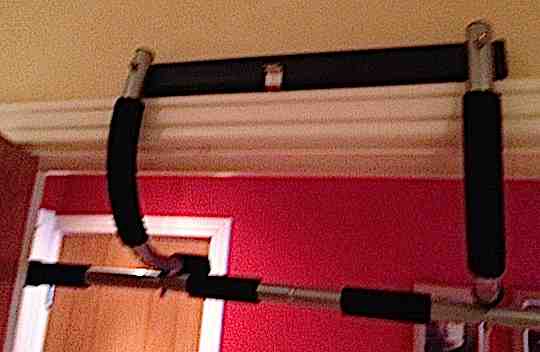
The retailer Tiger, may just have made my year. At Crossfit London, everyone needs pull ups ( both strict and kipping). As a famous trainer, I’m always setting pull ups as a target,
Im often writing about them. I frequently ask, “What if you have no pull ups, surely no one will want to marry you”.
But often people say, I don’t want to smash my flat up by bolting a pull up bar to the wall or the ceiling, or Im renting, or I have a nervous cat… sometimes, they say, they are too expensive.
So, it was a delight to see that Tiger has produced a pull up bar for £10. And its one you slot in and pack away. Easy to make, £10, easy to slot into a door of between 61 and 81cm, and , so the box says , will take up to 120 kg person. Obviously not for kipping, so its “just” for strict pull ups. But strict pull ups are great.
Im not sure they are in every store: they were in Westfield East, but I couldn’t see them at the Stratford Shopping Centre store ( when I looked today).
Be careful of your deadlift form: why sport science reports can mislead you
Much of the development of human movement comes from coaches comparing techinques. Better coaches hang out with other coaches, go on their courses, read their blogs, learn, analyse, video, and humbly put stuff up for criticism. Many sport science papers purport to do the same thing. However, the only value of a report of an experiment is, if you can reproduce the experiment yourself.
Do you remember those basic physics and chemistry experiments we did at school? We followed the exact doses, mixed , shook, heated and retreated to a safe distance. The instructions told us, how much, in what container , in what proportion. to what temperature.
This often isn’t the case in sport science journals. Sport scientists casually say they are testing the efficacy of , say, the deadlift and squat but often fail to explain what they mean. This frequently means back specialists often prescribe or ban movements where there is no correct understanding about what the movement is and how to perform it. I often see clients who have been banned from performing movements they do well and perfectly, and being set drills and movements, which, clearly, the instructor had not the faintest idea of the correct form or the correct mechanics .
The picture here is from a leading book on back issues and is supposed to be the correct form of the deadlift. It is, unfortunately not brilliant, (probably for all the best reasons), but, if you deadlifted in this way, you would , eventually, overload your back ( as always, poor form needs to be mixed with repetition and escalating load weight to be truly nasty).
This is not an attack on sport scientists ( I do that elsewhere). After all, all research is useful , it is a plea to look for the instructions or method in the report you are reading. Can you reproduce what they did? If not, treat the information with caution.
We will post later the correct way to deadlift.

 Andrew Stemler