Some nice basics from Ken Hub.
To understand back pain, you have to understand what is hurting
Back Pain
I like the approach, but, with back pain, its quite possible to get into a cycle of fixing, then re-injuring your back. As long as you work the problem too, this is a great way to understand pain and what strategies to implement in the long term
Get rid of your "slumping place"
Everyone has a happy place: part of your mind that you can go to when you are happy.
Some naughty children have a naughty step: where they are sent to “reflect” after being naughty.
Smokers have a smoking place.
As someone with repeating back pain ( assuming its not a red flag or something more serious) I can pretty much guarantee that you have a “slumping place”
Its where you sneak off to and slump. The (normally) soft cushions allow you to collapse your back, for hours as you watch TV or read or surf the internet. In many cases the cushions have become moulded to the flexion based spinal curve that will make your back ache.
You feel it as you lie there ( slump/sit there). You know its bad for you, but, it feels so good.
Here is a picture of my slump place. I try to avoid it like the plague. I try and sit on my wooden seat if i can , or if I want a nap or a lie down, the hard floor with appropriate lumbar support, but, BUT, if I want to guarantee to make my back hurt, this is where I will slump.

My Slumping Place
It used to be one of those reclining seats…. now its this sofa type thing
Maybe like me, you cannot actually throw it out: so be it, Learn to avoid it.

Join the mailing list. Click here
Guest Post by Don McCauley : The catapult finally explained!!
THE fundamental handstand error
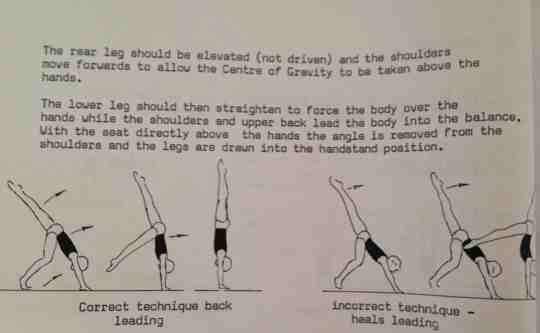
For years I have approached my handstand in the wrong way. I have to teach a lot of terrified adults to handstand, and many find it easier to begin with their hands on the floor. This means that one leg is “long” behind, and the other leg “curled up”underneath.
The tendency is to use the long leg to swing up. Ive been doing it for years, but it makes your handstand erratic because as it swings it moves you into an arch, often meaning your foot is forward of your hands when you attempt to finish it. It also means you are throwing yourself into the handstand rather than place it .
More seriously, if this pattern is taken into the round off, the lead leg zooms around, and the real power leg is de-emphasised.
See if you have this fault and fix it
Round off: not bringing legs together
Try adding height. As you see I have other issues but this gave me the time to bring my legs together and begin to lift my chest
This is a bit unprofessional of me to cut and paste this, but Im using it as a marker until I review the original work
A review of 1985 Volvo Award winner in clinical science: objective assessment of spine function following industrial injury: a prospective study with comparison group and 1-year follow-up.
Abstract
It is now 2 decades since Mayer et al published their Volvo Award-winning paper entitled “Objective assessment of spine function following industrial injury: a prospective study with comparison group and one-year follow-up.” Their landmark paper reported that return to work rates of patients that underwent a “functional restoration” treatment program were double that of a comparative group of patients that were denied treatment by their insurers. These results were considered extraordinary and inspired both debate and enthusiasm. Our goal is to review this landmark study, report on its strengths and weaknesses, and review the studies that have attempted to replicate this work in other settings. We also highlight its contribution to our current knowledge about the treatment of back pain and disability. The major weaknesses of the paper of Mayer et al are the possibility of selection bias in the development of their cohort of patients and the lack of a true randomized controlled study design. These factors may have inflated the rates of return to work. Regardless, their reported results were robust, and cannot be easily dismissed. During the last 20 years, this treatment model has received considerable study worldwide, and it is generally agreed that it is superior to standard care for reducing work absence in patients with chronic low back pain. Additionally, the concepts underlying functional restoration have been found to be highly relevant to patients with chronic low back pain, medical providers, and disability systems and continue to gain acceptance and integration into the care of patients throughout the industrialized world.
Blood supply of the spine."Old faithful" and "Glymphatic"
I discovered recently, that once you start suggesting that stretching your back isn’t a good idea (at all) the yoga and pilates lobby comes out. So you engage with them. You point them to research, they come back with belief, you point out that stretching the back only deadens the nerve endings, you supply references, they supply none.
Eventually, though, even they get a bit worried by their lack of causality and science. What does stretching do, they ask themselves. They come back with, what I call, “the old faithful Argument”
The Old faithful argument runs like this. You need to move your back, and stretch it, to pump the blood in an out.
To begin to understand “bad backs” we need to understand the vascular and neuro anatomy of the spine. I am no expert on this, but here is my 1st attempt at some cut and pasting to inform my future thinking
This following link goes into worrying detail about the blood supply of the spine. My take home message , I think , is this. The spine is amazingly well supplied with blood. Things may go wrong, but in most cases, if you need to move the spine to pump blood in and out, you have very , very severe problems.Nothing to do with normal back pain.
The veins in the back are quiet amazing too
“In 2011, researchers from the Department of Neurological Surgery at Ohio State Medical Center summarized the significance and current understanding of several aspects of the CSVS in their review article: “Today, the vertebral venous plexus is considered part of the cerebrospinal venous system, which is regarded as a unique, large-capacitance, valveless plexiform venous network in which flow is bidirectional that plays an important role in the regulation of intracranial pressure with changes in posture and in venous outflow from the brain, whereas in disease states, it provides a potential route for the spread of tumor, infection, or emboli.”
Maybe we need to pump the spinal lymphatic system?
“the lymphatic system does not extend into the brain or spinal cord, despite the high metabolic activity of neural tissue and its high sensitivity to changes in the extracellular environment, including the build-up of metabolic waste products. Such an absence of lymphatic vessels has led scientists to believe that an alternative process exists, which takes the place of this critical lymphatic function” ( well according to Wikipedia)
In the same review, it suggests this
“In 2012, it was shown that AQP4 is essential for paravascular CSF–ISF exchange. Analysis of genetically modified mice that lacked the AQP4 gene revealed that the bulk flow-dependent clearance of interstitial solutes decreases by 70% in the absence of AQP4. Based upon this role of AQP4-dependent glial water transport in the process of paravascular interstitial solute clearance, Iliff and Nedergaard termed this brain-wide glio-vascular pathway the ‘glymphatic system’.”
Sooo, we need to get a handle on what the hell the “glymphatic system” is! maybe this helps. As the PR says, “It’s as if Dr. Nedergaard and her colleagues have uncovered a network of hidden caves and these exciting results highlight the potential importance of the network in normal brain function,” said Roderick Corriveau, Ph.D., a program director at NINDS.
Take home message: get more sleep. Stretching a bit to pump blood in and out of your spine is probably incorrect
Muscular dysfunction elicited by creep of lumbar viscoelastic tissue M. Solomonow
Muscular dysfunction elicited by creep of lumbar viscoelastic tissue
M. Solomonow 2002
Before you stretch your back, or let a back “professional” stretch your back please, please, read this
4LBP-13-Dysf-JEK
M. Solomonow 2002
Before you stretch your back, or let a back “professional” stretch your back please, please, read this
4LBP-13-Dysf-JEK
The relationship of lumbar flexion to disability in patients with low back pain
The relationship of lumbar flexion to disability in patients with low back pain, by M Scott Sullivan , Lisa Donegan Shoaf and Daniel L Riddle (Physical Therapy March 2000 vol. 80 no. 3 240-250)
is an interesting study
method
Patients completed the Roland-Morris Back Pain Questionnaire (RMQ), and the therapists assessed lumbar spine flexion AROM (active range of motion) using a dual-inclinometer technique at the initial visit and again at discharge.
Conclusion
Measures of lumbar flexion AROM should not be used as surrogate measures of disability. Lumbar spine flexion AROM and disability are weakly correlated, suggesting that flexion AROM measures should not be used as treatment goals.
Free full study here. it “sort of” breaks the link between spine mobility and future back trouble.
The study also draws some very interesting observations about therapist biases
As always, this gives us another crop of references to follow up
 Andrew Stemler