Isometric exercises are effective for building strength because they involve muscle contractions without any movement, focusing on holding a position under tension. Here are a few reasons why they are beneficial for strength:
1. Increased Muscle Activation: Isometric exercises engage multiple muscle fibers to maintain a static position, enhancing muscle recruitment and activation, which leads to strength gains.
2. Improved Joint Stability: By holding a position, isometric exercises help strengthen the stabilizing muscles around joints, improving overall joint stability and reducing the risk of injury.
3. Target Weak Points: Isometrics can be used to strengthen specific points in a range of motion where someone might be weaker, such as holding a plank to work on core stability or holding a squat to target leg strength.
4. Minimal Equipment Required: Since these exercises don’t require dynamic movement, they often don’t need equipment, making them accessible and convenient.
5. Lower Risk of Injury: Isometric exercises put less stress on joints and tendons compared to dynamic movements, making them a safer option, especially for rehabilitation or injury prevention.
Isometric training complements dynamic strength training, making it a valuable addition to an overall fitness routine.
Findings from this study highlight five main themes where participants experience medicines as: 1) life-saving and indispensable, 2) normal and a daily routine, 3) confusing and concerning, 4) unsuitable without adjustment, and 5) intrusive and unwelcome. These results can be the basis for mutually agreed prescribing through a co-creative approach that aims at enhancing open and honest dialogues between patients and healthcare professionals in partnership about medicines.
The conclusion was “In conclusion, the results from this study indicate the need for a co-creation of a treatment plan in partnership between patients and healthcare providers when prescribing medicines. This research can be seen as a call to action for researchers who focus on improving medicine-taking to recognise the importance of the patients’ lived experiences of medicine-taking and how this may impact on their actual medicine-taking”
This has impolications in the strength and fitness arena! programmes must be built in partnership with the client!
I often set 531 as an initial program for people to look to get stronger in the squat, press bench and deadlift. I called these notes “A “work in progress” overview of the 531 ( and “beyond 531) protocol“
These notes assume you know how to actually do the moves!!
I start them off with building to a 3 rep max, and use that 3 rep figure as a 1 rep max (of course it isn’t, but it gives you a nice margin for those days you dont want to smash your lifting)
Week 1
Week 2
Week 3
Week 4
65% x 5 reps
70% x 3 reps
75% x 5 reps
40% x 5 reps
75% x 5 reps
80% x 3 reps
85% x 3 reps
50% x 5 reps
85% x 5 +or more reps
90% x 3+ or more reps
95% x 1+ or more reps
60% x 5 reps
75% x 5
80% x3
85 x 3
50% x 5
65% x 5+
70% x 3+
75% x 5+
40% x 5
Ideally week 4 is a deload, but people often skip it!
The one rep max you use in this regime is actually your 3 rep max!!
On your first class, youll choose the move you want (normally squat, or deadlift or bench or press) and you will work up to the heaviest set of 3 you can safely manage with good form.
Imagine you know you can lift 100kg once. The chances are you can lift 90kg 3 times. You take 90kg as your 1 rep max For example, in this example your week one week figures would be
65% = 58.5 75% = 67.5 85%= 76.5
The cycle starts when you do!
Many people lift too heavy too quickly, this regime gets you to focus on long term efforts. Its often observed that many people over-estimate what they can do in the next month, but underestimate what they can do in the next year.
Youll notice some of the percentage figures have a + sign. This means do as many reps as you can with good form
At the end of each cycle 3-4 week cycle you increase the weight by “up to” 5kg for squats and deadlift, and “up to” 2.5kg for bench and press.
In each class you can choose a move and do the accessory move associated with it, or simply do 2 moves!!
At the end of each session youll be expected to work up to 3 x 5 of pull ups and/or dips, then start adding weight. Youll be given a program to achieve this. If you have no pullups/dipd, youll start with negatives (or push ups, ring rows).
Some people decide to chase body building targets. We set you up for this on an individualised basis.
Strength class Accessory moves.
Accessory exercises serves many purposes. Basically you want to hit the main lift with a full tank, then do some “accessory”
Accessory exercises offers you the chance to continue to develop the moves without the same risk of injury/overuse you’d be exposed to if you just performed the main lift over and over. Although this stands at odds with the 531 accessory programming called “boring but big” where you simply do the same exercise for 5 sets of 10. In fairness, the loading is lighter, but there is still a risk
Accessory exercises also allow you to focus on different muscle groups or stimulate the same muscles in different ways. This is supposed to reduce your weakness and imbalances and makes you stronger and more resilient. The correct accessory will make you stronger and support your main lift.
This however makes assumptions about how you want to train.
If you want to come once a week and do all 4 lifts in a session (possible) , you really have to put a wriggle on, and there will be no chance for any accessory work . Its ok, it still works although long term you need to increase the stimulus!
Assuming you want to devote a full hour to a single skill, you’ll need to build in extra accessory moves, Ideally targeted at the weaknesses we have observed when performing the main move.
Whether or not you strength train once a week, twice a week, or 4 times a week, to have a stronger future you need to perform the lifts at least once a week!
If you add a 1kg a week to your lifts, that could mean in a years time you’ll have todays deadlift PLUS 50kg, todays squat Plus 50kg (obviously this gets harder the stronger your starting point)
Here are the suggested accessory moves with some warm up ideas
Press
Suggested warm up moves Inch worm Static hang Banded shoulders
Accessory
Boring but big 5 x 10 Press again (at anywhere 40-70%, build it up)
Or a mix or selection from these
Dips, 3- 5 x 5 (weighted) (or build to 5 unweighted. Ask for the regime) Dumbbell rows 3 x 8/12 Shrugs 3 x 8/15 Flaps 10 on each move. Build weight
Back arm (tricep) extension raises. Standing or lying 3 x 6/8 (vary each session) Landmine variations. “Lift behind” move
Deadlift
Suggested Warm up ideas
Banded hamstring PNF, Broad jumps, Lunges Deadlift variations This is where you will choose a near match as your main deadlift Deadlift off blocks Deficit deadlift Banded deadlift Pauses
Accessory
Boring but big 5 x 10 deadlift (at anywhere 40-70%, build it up)
Or a mix or selection from these
Sledge push 20 length of gym ( start with your 10 rep figure and build from there) Lunges 3 sets 6/8 reps per leg Hanging ab/ straight leg raise 3 x 8/10 Chins 2-5 sets x 5 (weighted) (or build to 5 unweighted. Ask for the regime) Good mornings 3 x6/8
Back raises 3 x 8/10 Reverse hyper 3 x 8/10
BENCH PRESS
Warm up Banded shoulders Push up variations Flaps 5-10 on each move
Main lift variation Larson press Pauses Bands
block
Accessory
Boring but big 5 x 10 bench press (at anywhere 40-60%, build it up)
Or a mix or selection from these
Push ups (close grip) 3 x 8-12 Tricep extensions 3 x 6, 8, 10 (vary each sesion) Skull crushers 3 x 6, 8, 10 (vary each sesion) Barbell incline press 3 x 6, 8, 10 (vary each sesion) Tricep extension raises. Standing or lying 3 x 6/8 (vary each session)
Squat
Warm up ideas Crab walks, monster walks Air squats
Rolling pistols Broad jumps
Alternative Box squats Pauses Bands
Boring but big 5 x 10 (at anywhere 40-60%, build it up)
Or a mix or selection from these
Step ups 3 x 6/8 reps each leg (vary each session) Bulgarian split 3 x 6/8 reps each leg (vary each session) Sledge push
Bicep bulging
The aim is to get between 9 and 24 sets a week ( so I’ve settled on 15 total work sets of between 8 and 12 reps when you hit 12 reps, increase the weight, so you just about get 8, then build up over the next few workouts)
3 sets bicep curls 3 sets “elbows behind” ( drag curls or lying supine on a bench) 3 sets elbows forward ( elbow on bench, or armd blaster or seated concentration curls) 3 cross body hammer curls 3 waiter curls!
This is currently done in one session, but the target is weekly, so you could do 2 sessions of say 6 to 7 sets.
Pull up and dips
Work your way to 3 x 5 pull ups, then start adding weight. If you have no pull ups, ask andrew for the pull up program CORE:
side planks, ( 90 seconds) Dish hold , build to 45 seconds: arch hold to 30 seconds.
During the session, start building GHD sit ups start low numbers ( with that knee push down) say 3 sets of 3-5. Build to a total set of 50-100.
To have a fantastic core you need to strengthen and engage your core muscles in a move called the dish shape, or the hollow hold.
This video starts you on the road to the perfect dish
I like this move because you can learn it at home!
The value of this move is that it starts you on the road of learning the handstand. You take the shape you have been learning, make the pelvic tilt more obvious, build it into a plank then walk the plank up the wall!
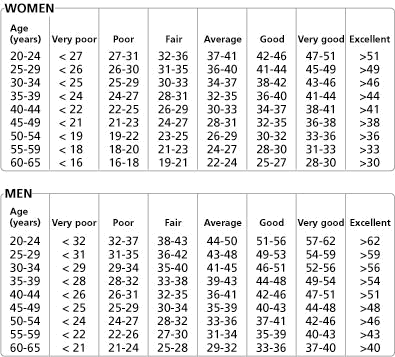
If you have 12 minutes spare, plus warm up and cool down time, you can find out: how aerobically fit you are, a theoretical VO2 Max figure and how well you do for your age. Run, walk, crawl as far as you can in 12 mins. Then compare here.
If you want a VO2 Max “figure” try this (very crude) calculation: VO2max = (22.351 x kilometers) – 11.288 = mL/kg/min Then look yourself up here:
Try not to kill yourself. You may need to build up running times, and possibly get medical clearance. Some need to walk. It doesn’t matter if your first go is a poor result. Use it to motivate you to get better.
As the CrossFit website will tell you ” CrossFit is constantly varied functional movements performed at high intensity”
People are so impressed with how fun and effective Crossfit workouts (WODs) are, that they often forget to see the whole prescription. This often expresses itself in conversations about programming, where some insist that to be “crossfit” A crossfit programme should be totally varied and random. This is an understandable misinterpretation as in the crossfit journal ( October 2004 page 6) Greg Glassman wrote:
“ the WOD is responsible for quite a bit of confusion about the crossfit method. Crossfit is a strength and conditioning system built on constantly varied, if not, randomized functional movements executed at high intensity . The WOD is but one example of Crossfit programming.”
Like most crossfitters I quickly jumped to the conclusion that Crossfit, as a strength and conditioning regime was all about variety. After all, that’s what the website did. It varied.
All the time.
Surely I thought, you deadlift 11111, on one day, then Fran the next, then a 5k run, then rest day, then onto infinite variation. I clearly remembered this paragraph “Five or six days per week mix these elements in as many combinations and patterns as creativity will allow. Routine is the enemy”
Voila. End of debate!
However, I worried me, that I found among all the “constantly varied“ statements Greg’s description of a regular class at the original crossfit facility. Indeed the days before my certification in 2005 Id witnessed this format
“One of our favourite workout patterns is to warm up, and then perform three to five sets of 3 to 5 reps of a fundamental lift at a moderately comfortable pace, followed by a 10 minute circuit of gymnastics elements at a blistering pace, and finally finish with 2 to 10 minutes of high intensity metabolic conditioning. There is nothing sacred here” ( CFJ October 2002 page 9)
So, I thought, they are regularly practicing and training gymnastics and the major lifts, then doing wods.
This backed up my subsequent clinical experience. Those who did regular muscle up work, got muscle ups, bigger squatters squatted well, the x gymnasts popped up into handstands.
People who limited their Crossfit to a wod, or a series of Wod’s struggled.
Then I re-read the “100 words. The statement that summarises the crossfit prescription To be honest. I actually read the 100 words properly for the 1st time . To help you understand my revelation, Ive added some “Ands” and some numbers ( my views are in the brackets)
Here is the prescription:
1) Eat meat and vegetables, nuts and seeds, some fruit, little starch and no sugar. Keep intake to levels that will support exercise but not body fat.
(Ok! Not everyone does, but yep TICK)
And
2) Practice and train major lifts: Deadlift, clean, squat, presses, C&J, and snatch.
(Er, ok, not randomise, but training and practise like you’d find in an oly club. Ok, I can do that. Tick)
And
3) Similarly, master the basics of gymnastics: pull-ups, dips, rope climb, push-ups, sit-ups, presses to handstand, pirouettes, flips, splits, and holds.
( wow, er regular practise and training too. Like any sport, regular practice and training. OK)
And
4) Bike, run, swim, row, etc, hard and fast.
(ok.that too wow)
And
5) Five or six days per week mix these elements in as many combinations and patterns as creativity will allow. Routine is the enemy. Keep workouts short and intense.
(Oh I get it!!! Once you have done your regular training, do workouts that combine what you know! That makes sense)
And
6) Regularly learn and play new sports.
( if I had time, but yes, I get it)
Many think that crossfit is about total variety in every aspect of training. It is never the less clear that “creativity” occurs in the workouts, not in the regular practice and training .
This model is totally familiar to any team or combat sports person. As a fighter, I trained and worked for perfection in moves and combinations. I had medicine balls dropped on my abs with tedious regularity. I worked the heavy bag. A LOT. But every session had a WOD . In that sport it was a sparring sessions: here the unknown and unknowable “punched me in the face!’. A LOT.
So, structured practice, plus a random WOD.
But the question frequently comes up . In these wods, are there targets or is it just random?
“If you are doing the workout of the day, you are training for these ( the benchmark) wods” . (CFJ Sept 2003 page 4) Back then, the benchmarks were the 6 sisters Angie, Barbara Chelsea, Diane Elizabeth and Fran. In short, Crossfit quickly decided that, in preparing for the unknown, It was as well to target success in benchmark workouts. After all, “Success with high rep calisthenic movements won’t come to be without regular practice. Not all of that practice need be a max rep, but it needs to be regular.” (CFJ April 2003 page 3) Incidentally the warm up is the perfect place for that practice”. (CFJ April 2003 page 3)
But, its too often asserted that “its gotta be random. Its crossfit innit”
Not according to the crossfire level 1 trainer guide. At page 51 it clearly says that “What your programme needs is not to become routine”. Bear in mind that at the time Crossfit began, all that was available at most “leisure centres” was basic bodybuilding and jogging routines. Equally, when discussing variation, Crossfit says that no two, 3 day cycles are the same: so if you spot that back squats and the lunge comes up a few times in a week. It’s not lack of variance, You need to assess what comes before and after the move.
So whats the take home messages
1) Everything you have read and heard about crossfits variation, randomness, excitement, brilliance, is true, but probably written with mainly the WODS in mind. If you simply did Crossfit Wods, it would give you excellent fitness. But thats only part of the 100 word prescription
2) Better Crossfiters looks to the 100 word prescription: it makes you regularly train and practise weightlifting, gymnastics and cardio, then also, mixes those elements up for a workout.
3) Don’t let anyone kid you that regular practise in Olympic lifting, squats or gymnastics, somehow isn’t Crossfit.
The programmes I discuss here have many objectives, one of which is to help you find your strength head – shorthand for developing your strength knowledge. In this article we visit the basic language of weightlifting and how it relates to the concept of relative intensity.
When it comes to using weight; in simple terms, people think this: lift the heaviest weight you can, that’s your 1 rep max; then based on that you can lift 90% of it 3 times (3reps), 85% of it 5 times, 75% 10 times. If you do 3 rounds of 3 reps, that’s 3 sets.
So weight lifting is a mix of percentages, sets and reps, all based on a one rep max. Simples!
This is a great place to start, but to develop your strength head, you need to develop your knowledge and insights into the strength game.
Some time ago, Zatsiorsky pointed out there are two types of one rep maxes you can have: a competition 1 rep max, and a training 1 rep max.
A) A competition max is where you get hyped up and get a PB and scream a lot.
B) A training 1 rep max
Marvellous.
However, often people skip the full definition of a 1 rep training max.
A maximum training weight is the heaviest weight you can lift without substantial emotional stress.
Damn. No screaming.
For athletes, the difference between the two is great. The example Zatsiorsky cites is that for athletes who lift 200 kg during a competition, a 180kg is typically above their maximum training weight. As a possible indicator, if your heart rate increases before your lift, that’s a sign of emotional engagement. Weightlifting is meant to stress your body, not your mind.
That’s the job of your partner and employer.
In short, if you screamed it up – it’s too heavy to use as a basis for regular training.
So, if you are calculating reps and sets using a 1 rep max, please, please use the right one; otherwise you’ll break. Maybe not today, maybe not tomorrow, but soon… If you want to properly test your 1 rep max, book a PT session with one of the training team.
If you have been lifting regularly for a while, you have probably begun to review strength literature and you are probably aware that lifting 80% of your 1 rep max provokes strength gain.
So, when lifting sets of 5, you’d probably like to put 80% of your 1 rep max on the bar. Everyone does that, but think about what it is you’d are actually be doing.
Let’s forget weightlifting for a moment, and talk about bricks. Imagine you are a labourer on a building site. Lets say we run a test to see how many bricks you can move in a day. For argument’s sake, let’s say you can move 1000.
Normally in training we wouldn’t want to move the 1000, we would do 800 ( 80%) but many people want to set 5 reps of that. So there you are, lifting 5 x 800 =4000.
If you tried to do that in a day, you’d probably die.
Back to the weight room. So you can lift 100kg calmly as your 1 rep max. You’ve been told if you lift 80% and over of this figure, you are strength training. So, to keep the maths easy, if you lift 80kg, you are strength training. But do you lift that 80% five times?
As you see from my poor labourer example, the first 800 was probably easy, but the next 800, isn’t easy, the 3rd 800 is getting you to breaking point.
In short, 80% lifted multiple times, isn’t perceived by the body as 80%. It sees it as much, much heavier because of the volume. The bricklayer, is of course a silly example – but try and get the message rather than be sidetracked in the endurance aspect of the example.
In simple terms, because you are lifting in sets of multiple reps, a load of 67% of your 1 rep max lifted 5 times has a relative intensity of 79%. It feels like 79%, your body thinks it’s 79%. It is 79%
Putting 76% of you 1 rep max on your bar for 5, has the effect of being 88%.
70% feels like =82%,
73% feels like = 85%.
80% on the bar for 5, is like lifting 91%.
Relative intensity is the simple observation that volume, load and rest effects how your body feels and adapts to weight.
Coach Robb Rogers gives a fuller description here:
Remember your muscles are dumb, they don’t know or care about percentages. They just know what feels heavy.
According to Mike Tuchscherer; “The body responds to things like the force of the muscle’s contraction, how long the contraction lasts, and how many contractions there were. A percentage isn’t necessarily a precise way to describe this, as different lifters will perform differently.”
In take-home terms, if today you went to CrossFit London or CrossFit SE11, and during the strength session, you only got to 68% of your (proper) 1 rep Training max for 5; you actually hit the 80% in relative intensity. That’s the 80% you need to nudge your strength along.
For now, in our general programme, we are not obsessing about percentages; but those who do know their lifts, I hope will be grateful for this insight. For the rest of you, simply work to a set of 5 that you can comfortably lift, bearing in mind these RPE (rates of perceived exertion) as guidance.
On a scale from 1 to 10:
9: Heavy Effort. Could have done one more rep. 8: Could have done two or three more reps, but glad you didn’t have to. 7: Bar speed is “snappy” if maximal force is applied 6: Bar speed is “snappy” with moderate effort
After a while, I suspect a “five” you can do in class will be at an RPE between 7 and 8.
Once you bedded this concept of relative intensity into your head, you can look forward to many years of safe, effective lifting.
More insights coming soon.
Grateful thanks to Coach Chet Morjaria @ Strength Education and to Coach Anthony Waller @ CrossFit London for the numerous corrections and observations they supplied




 Andrew Stemler