Isometrics revisited

in the 60’s to 70’s  you would have been hard pressed to ignore the isometrics movement. Vic O’beck published “How to Exercise without moving a muscle” in 1964 and it became very popular.

During the late 60’s early 70’s the Daily Express ran a regular cartoon in its pages which popularised the exercise regime. The cartoons were eventually bundled into a book Isometrics. How to exercise without moving a muscle, in strip cartoons from the Daily Express.

Like many fitness fades, the interest faded from main stream use, due in part to silly claims. A regime that promises to get you fit and trim in 90 seconds a day is bound to sell you the book or course, but fail to deliver much , if any, fitness.

This is a shame, as given the right objectives, the static hold has a really useful role to play. According to James Hewitt who wrote Isometrics for you: Get fit and trim in 90 seconds a day in 1966  “without special apparatus and without moving a muscle you can grow stronger and build, or reshape your body to nearer your hearts’ desire. The static  contraction has been part of physical culture systems  for a very long time. Hatha yoga contains postures  held without movement”.

Put simply, isometrics are a system of physical exercises in which muscles are caused to act against each other or against a fixed object. It’s a form of exercise involving the static contraction of a muscle without any visible movement in the angle of the joint.

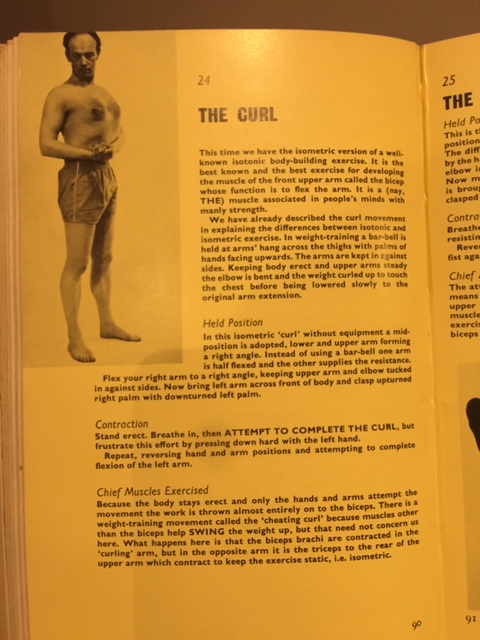
The popular regimes focused on basic body building type exercises and suggested a 6  second static contraction  with a maximum, or comfortable maximum contraction. This bicep curl picture gives you a good idea.

bicepcurl

Whilst this had some value, the use of the extended static hold in functional fitness is probably in developing the capacity to simply hold postures which contribute to actual exercises. The reality is that if you want to kick up to a rock solid free standing handstand, or do 20 plus pull ups, you better be able to hold a static ( albeit “leaning” ) handstand against the wall, and hang for 60, 90, 120, 180 seconds. Extra grip strength is always useful!

Btw you could find yourself struggling at 10 seconds when you start. Just do what you can and build up

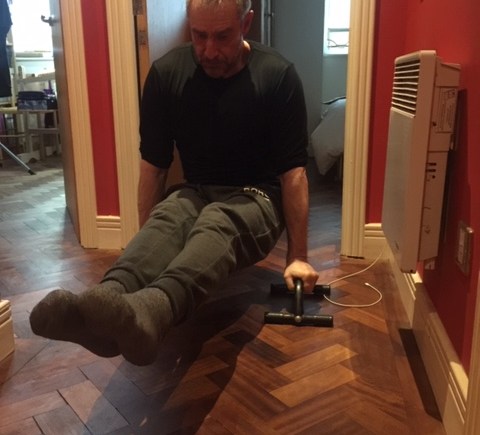
So think about your regime and hunt out obvious postures to practice: the side planks, lunging pushes against a wall and deadlift holds spring to mind. Adding the L sit, a horse stance ( the old martial arts favourite) and a “hip up” hold can , when combined,  make a really useful home exercise regime.

No more, “I cannot get to the gym”!!

Shoulder mobility

It’s pretty crucial that everybody has an easy to do shoulder mobilising routine.

This is the  shoulder regime  I use extensively with my clients. Sort of easy, just needs a light band.  Equally if you forget your band, use an imaginary one.

The gymnastic dish shape or hollow hold

To have a fantastic core you need to strengthen and engage your core muscles in a move called the dish shape, or the hollow hold.

This video starts you on the road to the perfect dish

I like this move because you can learn it at home!

The value of this move is that it starts you on the road of learning the handstand. You take the shape you have been learning, make the pelvic tilt more obvious,  build it into a plank then walk the plank up the wall!

All at home!

Home pull up bar and gymnastic rings

When working through my home training courses, the chances are you will need a pull up bar. Many landlords won’t let you screw them into a wall, so get one that slides in and out of a door way. I’ve liked the JML one because, like me, its been around for ages,

JML Awesome Gym Door Frame Workout/Pull-Up Bar Home Gym for Upper Body Exercises

but there are lots of cheaper ones around too

I have to say that I own my own home so, Ive screwed mine into the wall.

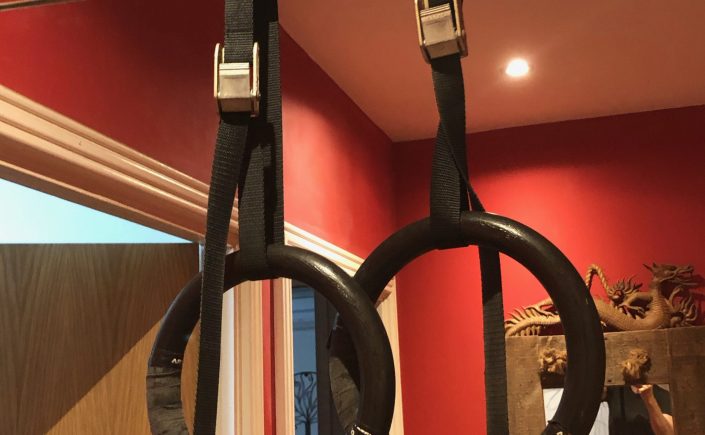
Once you have a pull up bar, you can get a set of gymnastic rings. I started importing them in 2005 in tiny batches, and I think they cost £50 plus.

Today £20 gets you a nice wooden pair. Here is a good example, opt for wood if you can.

Sundried Wooden Gymnastic Rings with Straps Exercise Gym Rings Crossfit Gymnastics Athletic Dip Rings

If you want to start using your Gymnastic rings, anf you can afford  99p  ( or £1 less 1p) you can get a copy of my old ring training guide, thats rudely been scored as a 1 star!! Try and be more generous

Ring Training: Using gymnastic rings in the fitness Environment

Is Successful Strength Training like Marriage ?

Successful Strength training like marriage is measured in years not weeks or months

Pay attention to the basics . Lift often, lift heavy (5 plus,, but vary from 5 to 1) be happy with small increases. Every relationship or “thing” in your life requires consistency

Don’t panic if you plateau.

In what other part of (real) human existence do we expect to have increases all the time . We can tamper with economics and pretend we have yearly growth: some NHS workers ( apparently ) get a grade increase each year , but that always. always unravels. “Maybe not today, maybe not tomorrow…….’

The hall marks of successful strength training (marriage) is patience and maturity: watch for the opportunity to improve but don’t obsess., be happy with consolidation, treasure consistency and above all, be confident enough to rest and take it easy.

Eat well and sleep well

Bear in mind that all advanced programming is dedicated to one phenomenon, failure. Many marriages fail because one partner isn’t happy with the perfection they have, and instead indulges in fantasy . Don’t let the strength porn of a few gifted ( psychotic) individuals deprave and corrupt your normal image of how things are.

Failure is rushing at fantasy target too hard and fast.

Having preached consistency, it’s equally essential to mix it up and be creative. Add some strongman training, add and vary assistance exercises.

Variety has always been the spice of life But variety is still just a spice. It makes the fundamentals seem a bit different that’s all. It still needs the fundamentals/

In short, don’t see strength as something geeky or the preserve of experts. See it as the perfect romance or marriage, demanding consistent loyalty commitment and work , along with romance and variation.

So to be successful, research how to be romantic and simply build it into your strength regime

Build your Push ups

There are a lot of very dull, unimaginative push up regimes on the internet. My aim is to get you 100 push ups in, about, 6 weeks.

For the purposes of the first part of this this post, Im going to assume you can do 10 strict push ups in one go. (If you have none, skip further down)

The 1st thing i need you to do is to do a test, one today, one tomorrow. today I want you to attempt the most continuous push ups you can. Record it.

Tomorrow, I want you to attempt as many push ups as you can in 2 minutes . You can take as many breaks as you like, you can do lots of singles. Does not matter. Just do as many as you can in 2 minutes.

This gives you an interesting base line to begin with.

For now, you have two alternating protocols to follow

1) Without being too prescriptive, I need you to get to 10 sets of 10 push ups, with no more than 90 seconds rest. At this stage, this means, shooting for 10 reps, then resting for 90 seconds, so the reps could look like this.

10, 10, 8, 7, 6, 5, 4, 4, 6, 8.

2) 3 sets of maximum push ups. go down and do as many push ups as you can, rest 2 minutes, then do it again 2 more times.

So, do 1 on day 1, 2 on day 2, then a rest day. then 1 and 2 again.

That should get you started for now.

BUT WHAT IF YOU HAVE NO PUSH UPS. Ive seen lots of people with no push ups struggling on “box” and knee versions. Whilst they are interesting if you are really really weak, i have never seen anyone successfully get a full push up by using these shortened versions. The 2 best techniques to use are the eccentric phase and Isometrics. Put simply, get into the top of a push up, and lower yourself down as slowly as you can. Do this 4 or 5 times with 60 seconds rest ( more if you need it.). Then while lying on the floor, try and push yourself up. Put as much effort in as you can, and push for 7 seconds. Rest for 30 seconds and go again. ( say 4 times). You may not move, but you are building the specific strength to do so.

If you want “functional Fitness” should you be “Olympic Weightlifting”

I’m sometimes asked why people who want to develop functional fitness should Olympic lift.

Here is my answer.(well, it was when I wrote this in 2007)

Depending upon your view, I have either a very narrow or very broad definition of functional fitness. I simply look at those people I would want to take with me into the unknown. Recent crises have seen buildings collapse, crowds riot, aid in need of unloading and rival villages or postcode gangs in need of killing or a good shanking.

I know I annoy a lot of strength trainees who expect me to marvel at their deadlift, and wee little runners who want me to stand drop-jawed at the fact their genetic profile means they can prance around like a gazelle all week. My problem is this specialism produces useless gits. There, I’ve said it. Are you are kettlebell specialist? Yes, no, sorry – you’re a git. Same with 400m runners, same with deadlifters: Introverted, useless gits.

In a normal world, nature does not throw you component challenges of strength or distance or flexibility – it just drops you in holes, floods your home, collapses buildings on your family. Are you a fantastic deadlifter, tough, because you now have to run 10k to get some water? A yoga specialist? Damn, you now have to shift a ton of rubble to rescue your family. A runner? Now you have to pull yourself out of a hole. Bugger!

So that’s my view. Agree or not.

But what are the Olympic lifts?

According to me, in a less witty writing style:

“The Olympic lifts are a sole-participant, self-paced skill performed in a static environmental context. The move is initiated by the performer, which according to Gentile (Schmidt & Weisberg, 2000) makes this a closed motor skill. It is an object manipulation action function involving the change of position of a barbell (Magill 2007), requiring correct management and the adjustment of body position to counteract the in-balance created by the object and conforms to skill definitions suggested by both Knapp (cited in Guthrie 1953) and Magill (2007): a learned ability, maximum certainty, minimum of time and energy with predetermined results and, according to Schmidt & Weisberg (2000) produced as a function of practice.

The snatch for example is a ground based multi-joint weightlifting exercise. The athlete exerts large multiple-muscle group force whilst standing on his own feet, thus developing balance and coordination. The speed develops the nervous system (Garhammer, 1985). The move requires a triple extension at the ankle, knee and hip – a jumping athletic movement, which demands the athlete recruits muscles in a synchronized pattern. The move develops explosive power: and requires a high degree of kinesthesis or proprioception (Magill, 2007) The larger muscles are mainly used, making this a gross motor skill, requiring both gross motor and psychomotor ability (Magill, 2007)” (Stemler, 2009)

Phew

But for those who like multiple references:

According to Arthur Drechsler, author of The Weightlifting Encyclopedia often cited as “the single most important book ever written on Olympic weightlifting” (by people who cannot possibly have the read this boring book),

1. Practicing the (Olympic) lifts [the snatch and the clean-and- jerk as well as related lifting techniques] teaches an athlete how to explode.
2. Practicing proper technique in the Olympic lifts teaches an athlete to apply force with his or her muscle groups in the proper sequences.
3. In mastering the Olympic lifts, the athlete learns how to accelerate objects under varying degrees of resistance.
4. The athlete learns to receive force from another moving body effectively, and becomes conditioned to accept such forces.
5. The athlete learns to move effectively from an eccentric to concentric muscle action.
6. The actual movements performed while executing the Olympic lifts are among the most common and fundamental in sports.
7. Practicing the Olympic lifts trains an athlete’s explosive capabilities, and the lifts themselves measure the effectiveness of the athlete in generating explosive power to a greater degree than most other exercises they can practice.
8. The Olympic lifts are simply fun to do.

Chiu and Schilling (2005) observe that Olympic weightlifting is associated with improvements in motor control, noticeably improved activation of muscle groups and motor units, and activation of more fast-twitch fibers. Hence the skills are also taught to many athletes as part of their strength, conditioning and power programmes, and are not pursed as a sport in their own right.

How do you learn this stuff.

Without a doubt, you must learn the snatch with a bit of PVC pipe in a drill based seminar. A good 2 hours of marine-type drilling will get you the basics of the snatch.You can build on this in the years to come. I recommend this because it was the way I was taught. It’s the method we use on the i-course, and I have used it for 5 years of one-on-one and class training. It has received praise in scientific literature.

I think it’s very superior to throwing a 20kg bar at someone and telling them to get on with it. I see this approach too often in the few remaining “authentic” lifting clubs around – or certainly those that are competition-orientated who believe that your training should be as abusive and poor as the training they had, combined with the belief that breaking complex skills down is “spoon feeding”.

Me, I love being spoon fed.

Once you have the basics, start adding weight. It’s as simple as that.

So Olympic lifting is essential to be a functional athlete?

There are generations of strong, effective, functional people who have destroyed whole civilizations, and mutilated acres of this planet’s surface who never heard of the Olympic lifts, let alone screwed one up. (Incidently, missing a lift is the more fun part of lifting: hence the famous books, “When Lifting Goes Bad”,” Missed Lifts That Amost Killed Me”, “Missed Lifts That Almost Killed The Cat”, “Missed Lifts That Actually Got The Cat”,”Why Your Cat Doesn’t Want You to Olympic Lift”.)

So, no, it’s not essential.

In the same way it’s not essential to buy your girlfriend flowers.

If it’s so great how come its so underground?

For those of us who have lifted for a while, and see throwing a bar into the air then catching it as normal, we must remember that all this fun has all but been wiped out as a general fitness activity. Most gyms don’t have bars, certainly cannot be bothered to buy expensive bumper plates, and will go beserk if you drop a weight on the floor. Above all they don’t employ staff with enough skill to teach the lifts. Those that have the skill at your local leisure centre, quickly leave.

As a competitive activity, lifting appeals to a minority of a minority. As an all-day sporting event in anything below Olympic level, to watch or to take part in, it is viciously boring. I don’t intend to compete/watch again. If I do, I’m taking a spoon to scoop out my eyes with halfway through the day, just to break the boredom.

But to take an activity this effective and make it this unheard of, takes some doing. Until recently Olympic lifting has been seen as a dedicated sport (yawn, yawn, see above), controlled by a very well meaning, government handout-obsessed but incompetent group of old boys who have managed to make a boring sport difficult to access and learn. The years of mismanagement and introspective alienation of new trainees needs acknowledgement and praise. Their love and devotion to the sport is without question. If only that was enough.

But why did the Olympic lifts come crashing back to life.

Rapid, force-generating hip extension has always been at the heart of athletics ( jumping, sprinting etc), but this force has always been seen as a single explosion The few athletes who are encouraged to take up the Olympic lifts normally focus on low-repetition and high weight, in pursuit of Olympic weightlifting’s objectives of power and strength.

According to Greg Glassman, Crossfits founder, the value of the lifts outstrips their much-promoted development of strength and power. Those who struggle to learn the clean often suffer from a lack of sufficient speed, flexibility and ability irrespective of how much imagined strength they possess. Refinement of the move calls for exacting standards of coordination accuracy and balance which often outstrips the ability of most strength specialists

His observation that directly proportional to the load you can clean are the benefits, strength, power, accuracy, flexibility, speed, accuracy, agility and balance, is a standard proposition. However his second, unique, world-changing, visionary observation was that your cardiorespiratory endurance and stamina are directly proportional to the reps and loads you can clean. Crossfit, to my knowledge, was unique in the early days in requiring repeated hip extension under fatiguing conditions which, arguably, is more functionally relevant than the best you can lift. The ability to do one thing explosively, once, is very overrated (there is the potential for a smutty joke here that I am rising above).

Heretically, Greg also goes on to state that you don’t need to be able to do the lifts super-well to get super-benefits. This must have a been a stinging slap in the face for the old boys who had spent years of effort working out the most effective way to lift half a kilo more.

This is a complete exercise which incorporates a “super-useful” core to extremity motor recruitment pattern, along with learning how to generate and transmit large and sudden forces.

From another perspective, it builds bravery and stupidity, the two essentials for any elite functional athlete . The Olympic lifts involve throwing stuff from the floor to above your head (while standing). Visualise the issue – you have thrown something heavy into the air, and it’s now crashing down upon you…

You have two options,

1) Run like hell or
2) Stay and catch it.

Option 1 is sensible and demonstrates a mature ability to identify risk. Option 2 is dangerous, foolhardy, bound to end in tears – and – incidently, the right answer.
Coffee spikes your Cholesterol: the Cafestol and Kahweol effect

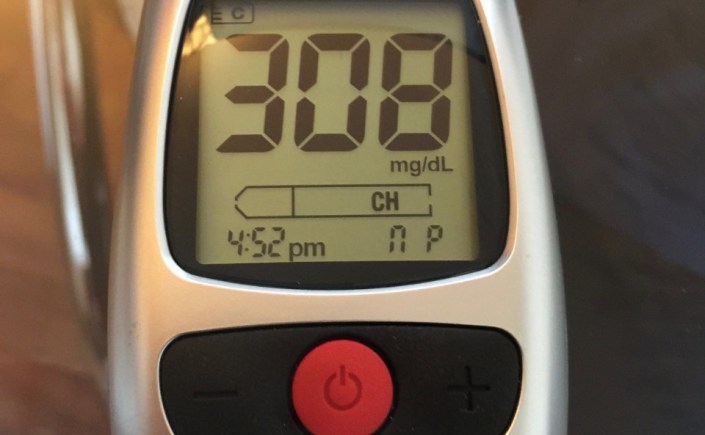
The bad news of a high cholesterol reading was a bit of a shock for me.

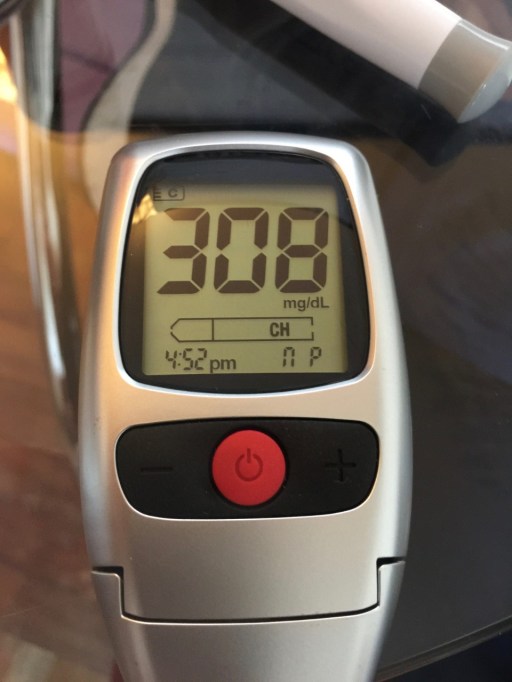
308 reading

I knew my diet had slipped (too much red meat, too much cheese: I love cheese). Equally,  I knew that to reduce  cholesterol  “all you had to do”  was cut down on red meat and saturated fat.

I’d been doing blood work for some of my clients and was able to  use my home blood test machine to check my level.

I was horrified.

3 weeks after a major diet shift my cholesterol remained  stupidly high. I looked over  the guidelines again, and  focused on the fibre content, so I bought fibre ( oat and wheat) and added that. Rather than my horror 311 readings I was getting 270’s 280’s.

Still,  80 points over my threshold.

I then started daily tests and compared the results with my food diary. I saw days where I had nothing but some fruit and a few cups of coffee with stupid cholesterol levels.

Equally, I noticed a no coffee day, producing a low reading.

I started researching coffee.  A lot.

What I rediscovered was this.

By the turn of the  20th century, medical, and food researchers knew one thing for sure.

Unfiltered coffee is a cholesterol bomb. There were so many studies all saying the same thing, and much of the research can be seen in this report

“Cafestol and Kahweol.  Review of Toxicological Literature 1999”.

Source here

Drink unfiltered coffee and it sends your Cholesterol rocketing due to two chemicals in coffee called Cafestol and Kahweol.

The numerous tests and reports quoted in the review of Toxicological Literature nailed this fact to the mast  (see appendix 1)

So why doesn’t every coffee shop in the UK have a massive warning plastered all over it? Everybody hears how bad red meat and saturated fat  is for cholesterol, so when you see your doctor after a high cholesterol test, why don’t they ask about your coffee consumption?

Well, everybody loves coffee. So there is an understandable bias in its favour.

Crucially in the 1990’s when this was discovered, most people drank filtered coffee “the cholesterol-raising effect seems to be limited to coffee that hasn’t been filtered, which includes Turkish coffee, coffee brewed in a French press, and the boiled coffee consumed in Scandinavia”   . (Harvard health in 2012 ) in fact “The cholesterol-raising ingredients in coffee are oily substances called diterpenes, and the two main types in coffee are cafestol (pronounced CAF-es-tol) and kahweol (pronounced KAH-we-awl).

But a paper filter traps most of the cafestol and kahweol, so coffee that’s been filtered probably has little, if any, effect on cholesterol levels.”

This was fine back in the last 20th century.  We mainly drank filtered coffee then .

I’m 58, I know.

But Guess what? Since the start of the 21st century unfiltered coffee consumption has rocketed. While some coffee shops have an unfiltered coffee option, most push and market unfiltered coffee

I don’t know how many coffee shops there were in 1999, but since 2008 the amount of coffee shops in the UK have grown from 10,000 to 25,000 in 2019. Most  coffee shops offer unfiltered coffee.

Thats a lot of cholesterol raising!

So, I should make it clear, I love coffee. The only effect  this  rediscovery has had  on me is to switch to filtered coffee. I’ve even cut filter paper into  small  circles to put into espresso machines. Some coffee shop don’t mind doing this.

The real horror is this.

If I had gone back to my doctor, they would have pushed me to go on statins. They would not have even mentioned coffee. Im guessing that anyone who has 2 cups of unfiltered coffee a day, and is on statins, should drink filtered coffee and get retested ( having chatted to their doctor first , ofcourse)

In balance I should say that coffee and caffeine have health effects. I think, almost all of which can be obtained through the filtered variety.


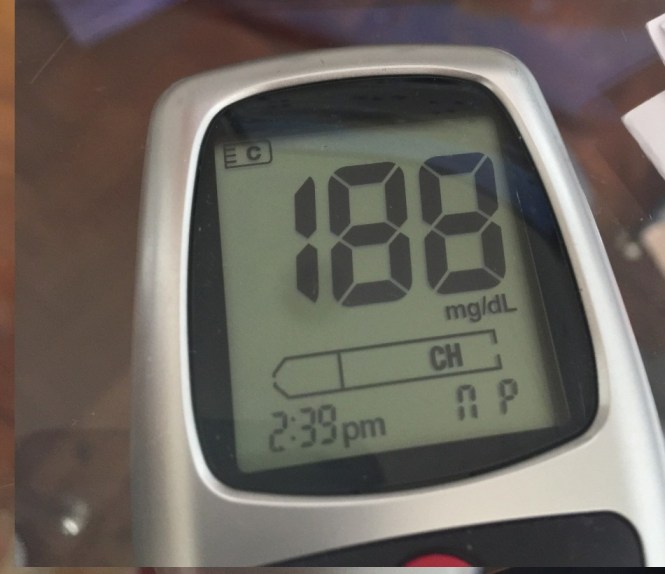
188 reading

with filtered coffee my readings returned to “normal”


Appendix 1

In an open randomized study, healthy male and female volunteers who drank coffee containing 148 mg cafestol and kahweol daily for 30 days exhibited a considerable rise in total cholesterol (average mean, 31.6%), low density lipoprotein (LDL) cholesterol (50.2%), and triglyceride concentrations (87%) versus the control group (Heckers et al., 1994).

In three volunteers, consumption of highly purified cafestol (73 mg/day; 0.23 mmol/day) and kahweol (58 mg/day; 0.19 mmol/day) as the corresponding mono- and dipalmitates for 6 weeks increased the serum levels of cholesterol by 66 mg/dL (1.7 mmol/L) and triglycerides by 162 mg/dL (1.83 mmol/L) (Weusten-Van der Wouw et al., 1994).

In a randomized, crossover trial using healthy, normolipemic volunteers, six subjects received 2 g Arabica oil containing 72 mg (0.23 mmol) cafestol per day and 53 mg (0.17 mmol) kahweol per day, and five subjects received 2 g Robusta oil providing 40 mg (0.13 mmol) cafestol per day and 2 mg (0.006 mmol) kahweol per day (Mensink et al., 1995). Compared to a control group given placebo oil, serum triglyceride levels increased 71% in the group receiving Arabica oil and 61% in the group given Robusta oil. Serum cholesterol concentrations were increased by 13% for both oils.

references

Cafestol and Kahweol.  Review of Toxicological Literature 1999  accessed online  (Sept/Oct 2019) https://ntp.niehs.nih.gov/ntp/htdocs/chem_background/exsumpdf/cafestol_508.pdf

Heckers, H., U. Göbel, and U. Kleppel. 1994. End of the coffee mystery: Diterpene alcohols raise serum low-density lipoprotein cholesterol and triglyceride levels. J. Intern. Med. 235(2):192-193.

Weusten-Van der Wouw, M.P.M.E., M.B. Katan, R. Viani, A.C. Huggett, R. Liardon, P.G. Lund-Larsen, D.S. Thelle, I. Ahola, A. Aro, S. Meyboom, and A.C. Beynen. 1994. Identity of the cholesterol-raising factor from boiled coffee and its effects on liver function enzymes. J. Lipid Res. 35:721-733.


Basic life support: First aid

As its “restart a heart” week, I thought it would be good to put the official CPR  guidance on this site.  First aid protocols are set by reference to the standards of the resuscitation council and to the current edition of the first aid guides produced by The St John Ambulance and the Red Cross.

You can look up the  Resuscitation Council here

SEQUENCE Technical description
SAFETY Make sure you, the victim and any bystanders are safe


RESPONSE Check the victim for a response

  • Gently shake his shoulders and ask loudly: “Are you all right?”

If he responds leave him in the position in which you find him, provided there is no further danger; try to find out what is wrong with him and get help if needed; reassess him regularly

AIRWAY Open the airway

  • Turn the victim onto his back
  • Place your hand on his forehead and gently tilt his head back; with your fingertips under the point of the victim’s chin, lift the chin to open the airway
BREATHING Look, listen and feel for normal breathing for no more than 10 seconds
In the first few minutes after cardiac arrest, a victim may be barely breathing, or taking infrequent, slow and noisy gasps. Do not confuse this with normal breathing. If you have any doubt whether breathing is normal, act as if it is they are not breathing normally and prepare to start CPR
DIAL 999 Call an ambulance (999)

  • Ask a helper to call if possible otherwise call them yourself
  • Stay with the victim when making the call if possible
  • Activate the speaker function on the phone to aid communication with the ambulance service
SEND FOR AED Send someone to get an AED if available
If you are on your own, do not leave the victim, start CPR
CIRCULATION Start chest compressions

  • Kneel by the side of the victim
  • Place the heel of one hand in the centre of the victim’s chest; (which is the lower half of the victim’s breastbone (sternum))
  • Place the heel of your other hand on top of the first hand
  • Interlock the fingers of your hands and ensure that pressure is not applied over the victim’s ribs
  • Keep your arms straight
  • Do not apply any pressure over the upper abdomen or the bottom end of the bony sternum (breastbone)
  • Position your shoulders vertically above the victim’s chest and press down on the sternum to a depth of 5–6 cm
  • After each compression, release all the pressure on the chest without losing contact between your hands and the sternum;
  • Repeat at a rate of 100–120 min-1
GIVE RESCUE BREATHS After 30 compressions open the airway again using head tilt and chin lift and give 2 rescue breaths

  • Pinch the soft part of the nose closed, using the index finger and thumb of your hand on the forehead
  • Allow the mouth to open, but maintain chin lift
  • Take a normal breath and place your lips around his mouth, making sure that you have a good seal
  • Blow steadily into the mouth while watching for the chest to rise, taking about 1 second as in normal breathing; this is an effective rescue breath
  • Maintaining head tilt and chin lift, take your mouth away from the victim and watch for the chest to fall as air comes out
  • Take another normal breath and blow into the victim’s mouth once more to achieve a total of two effective rescue breaths. Do not interrupt compressions by more than 10 seconds to deliver two breaths. Then return your hands without delay to the correct position on the sternum and give a further 30 chest compressions

Continue with chest compressions and rescue breaths in a ratio of 30:2

If you are untrained or unable to do rescue breaths, give chest compression only CPR (i.e. continuous compressions at a rate of at least 100–120 min-1)

IF AN AED ARRIVES Switch on the AED

  • Attach the electrode pads on the victim’s bare chest
  • If more than one rescuer is present, CPR should be continued while electrode pads are being attached to the chest
  • Follow the spoken/visual directions
  • Ensure that nobody is touching the victim while the AED is analysing the rhythm

If a shock is indicated, deliver shock

  • Ensure that nobody is touching the victim
  • Push shock button as directed (fully automatic AEDs will deliver the shock automatically)
  • Immediately restart CPR at a ratio of 30:2
  • Continue as directed by the voice/visual prompts

If no shock is indicated, continue CPR

  • Immediately resume CPR
  • Continue as directed by the voice/visual prompts
CONTINUE CPR Do not interrupt resuscitation until:

  • A health professional tells you to stop
  • You become exhausted
  • The victim is definitely waking up, moving, opening eyes and breathing normally

It is rare for CPR alone to restart the heart. Unless you are certain the person has recovered continue CPR

RECOVERY POSITION If you are certain the victim is breathing normally but is still unresponsive, place in the recovery position

  • Remove the victim’s glasses, if worn
  • Kneel beside the victim and make sure that both his legs are straight
  • Place the arm nearest to you out at right angles to his body, elbow bent with the hand palm-up
  • Bring the far arm across the chest, and hold the back of the hand against the victim’s cheek nearest to you
  • With your other hand, grasp the far leg just above the knee and pull it up, keeping the foot on the ground
  • Keeping his hand pressed against his cheek, pull on the far leg to roll the victim towards you on to his side
  • Adjust the upper leg so that both the hip and knee are bent at right angles
  • Tilt the head back to make sure that the airway remains open
  • If necessary, adjust the hand under the cheek to keep the head tilted and facing downwards to allow liquid material to drain from the mouth
  • Check breathing regularly

Be prepared to restart CPR immediately if the victim deteriorates or stops breathing normally

Basic life support
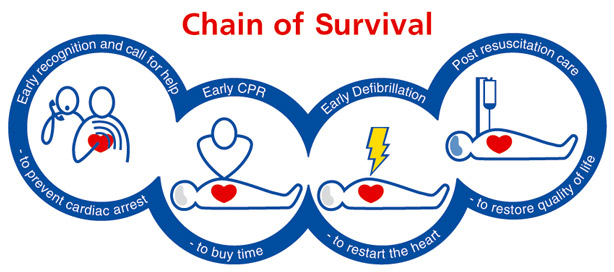
ChainOfSurvival