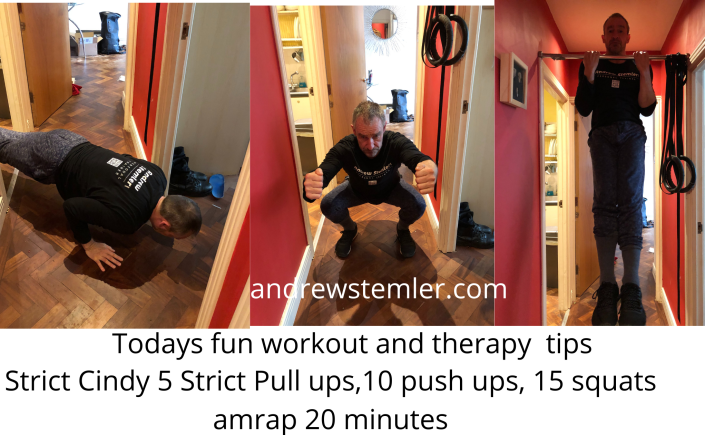
Build hanging time !

On an increasing basis you’ll see portable pull up bars being erected in public places with a ”can you hang for 90 seconds? ”challenge

Often there is a prize involved , but the task is made harder as the bar ( on the versions I’ve seen ) spins a bit making holding onto it rather hard .

Whilst I’ll talk about coping with the spin in another article , I thought it would be best to build up your hang ability on a normal bar .

Hopefully this 6 week training schedule will be helpful. It assumes you can hang for 45 seconds.

• Day 1: Hang for 45 seconds, rest for 1 minute, repeat 3 times. • Day 3: Hang for 50 seconds, rest for 1 minute, repeat 3 times. • Day 5: Hang for 55 seconds, rest for 1 minute, repeat 3 times. • Day 7: Rest

Week 3: Day 1: Hang for 60 seconds, rest for 1 minute, repeat 3 times. • Day 3: Hang for 65 seconds, rest for 1 minute, repeat 3 times. • Day 5: Hang for 70 seconds, rest for 1 minute, repeat 3 times. • Day 7: Rest.

Week 4:• Day 1: Hang for 75 seconds, rest for 1 minute, repeat 3 times. • Day 3: Hang for 80 seconds, rest for 1 minute, repeat 3 times. • Day 5: Hang for 85 seconds, rest for 1 minute, repeat 3 times. • Day 7: Rest.

Week 5:• Day 1: Hang for 85 seconds, rest for 1 minute, repeat 3 times. • Day 3: Hang for 88 seconds, rest for 1 minute, repeat 3 times. • Day 5: Hang for 90 seconds, rest for 1 minute, repeat 3 times. • Day 7: Rest.

Week 6:• Day 1: Hang for 90 seconds, rest for 1 minute, repeat 3 times. • Day 3: Hang for 92 seconds, rest for 1 minute, repeat 3 times. • Day 5: Hang for 94 seconds, rest for 1 minute, repeat 3 times. • Day 7: Rest.

This program gradually increases the time you hang from the pull-up bar each week, allowing your muscles to adapt and get stronger.

Even if you don’t make the 90 seconds , hanging from a bar is really , really good for your shoulders ( unless your doctor has told you that you have exploding shoulders and will die if you use them )

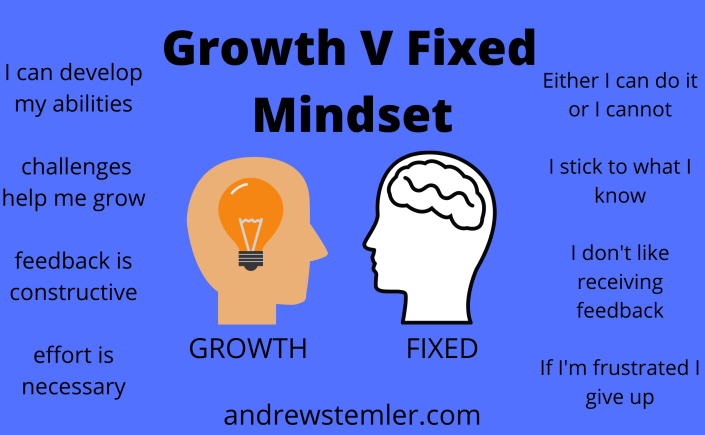
Limiting beliefs

A limiting belief is a belief that constrains you in some way, often by creating self-imposed barriers or restrictions on what you can achieve.

In the context of exercise and weight loss, a limiting belief might be the belief that you’re not capable of losing weight or that you’ll never be able to stick to an exercise routine.

These beliefs can undermine your ability to exercise and lose weight by demotivating you, causing you to give up easily, or leading you to engage in self-sabotaging behaviors.

For example, if you believe that you’re destined to be overweight, you might not even bother trying to exercise or eat healthily because you don’t believe it will make a difference. Identifying and challenging these limiting beliefs is crucial for making progress towards your fitness and weight loss goals.

How do you change your behaviour ?

Everyone talks about living a better happier life. But what theoretical approaches can you take to change your attitude towards , say food , exercise , anger , drug and alcohol abuse.

Here are summaries of some of the top behavior change theories

:1. Transtheoretical Model (TTM): Also known as the Stages of Change model, TTM describes behavior change as a process that occurs in stages: pre-contemplation, contemplation, preparation, action, and maintenance.

2. Health Belief Model (HBM): HBM suggests that people’s beliefs about a health threat, perceived benefits of action, perceived barriers to action, cues to action, and self-efficacy influence their readiness to take action.

3. Social Cognitive Theory (SCT): SCT emphasizes the role of social influences, observational learning, and self-efficacy in behavior change. It suggests that behavior is influenced by the interactions between personal factors, environmental factors, and behaviors.

4. Theory of Planned Behavior (TPB): TPB proposes that attitudes, subjective norms, and perceived behavioral control predict an individual’s intention to engage in a behavior, which in turn predicts actual behavior.

5. Operant Conditioning: This theory, popularized by B.F. Skinner, suggests that behavior is shaped by the consequences that follow it. Positive reinforcement, negative reinforcement, punishment, and extinction are the main mechanisms.

6. Self-Determination Theory (SDT): SDT emphasizes the importance of intrinsic motivation and the satisfaction of psychological needs (autonomy, competence, and relatedness) in driving behavior change.

7. Social Ecological Model (SEM): SEM considers the complex interplay between individual, interpersonal, organizational, community, and societal factors in influencing behavior. It emphasizes the importance of multiple levels of influence in behavior change interventions.

These theories could provide a framework for understanding how and why behavior change occurs, and they are often used in designing interventions to promote healthy behaviour’s. However it seems that obesity rates are soaring with allegedly 95 % of people who start a diet , failing .

The battle really is on to something that works . There are lots of stories and Instagram takes of success , but they tend to be the exception .