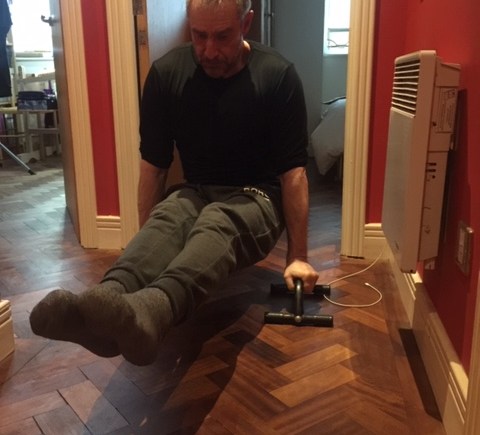
Isometrics revisited

in the 60’s to 70’s  you would have been hard pressed to ignore the isometrics movement. Vic O’beck published “How to Exercise without moving a muscle” in 1964 and it became very popular.

During the late 60’s early 70’s the Daily Express ran a regular cartoon in its pages which popularised the exercise regime. The cartoons were eventually bundled into a book Isometrics. How to exercise without moving a muscle, in strip cartoons from the Daily Express.

Like many fitness fades, the interest faded from main stream use, due in part to silly claims. A regime that promises to get you fit and trim in 90 seconds a day is bound to sell you the book or course, but fail to deliver much , if any, fitness.

This is a shame, as given the right objectives, the static hold has a really useful role to play. According to James Hewitt who wrote Isometrics for you: Get fit and trim in 90 seconds a day in 1966  “without special apparatus and without moving a muscle you can grow stronger and build, or reshape your body to nearer your hearts’ desire. The static  contraction has been part of physical culture systems  for a very long time. Hatha yoga contains postures  held without movement”.

Put simply, isometrics are a system of physical exercises in which muscles are caused to act against each other or against a fixed object. It’s a form of exercise involving the static contraction of a muscle without any visible movement in the angle of the joint.

The popular regimes focused on basic body building type exercises and suggested a 6  second static contraction  with a maximum, or comfortable maximum contraction. This bicep curl picture gives you a good idea.
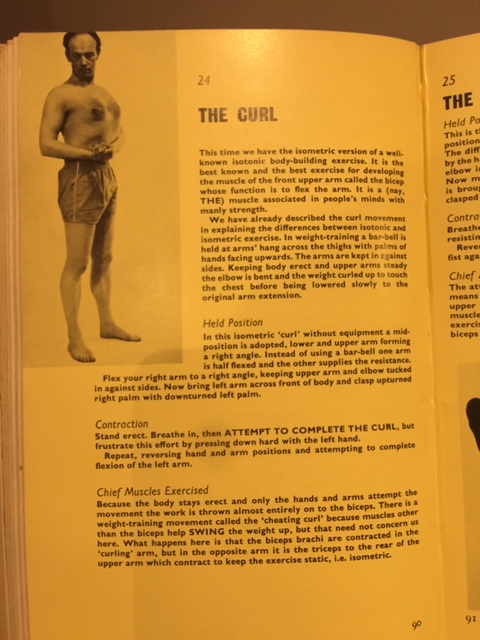
bicepcurl

Whilst this had some value, the use of the extended static hold in functional fitness is probably in developing the capacity to simply hold postures which contribute to actual exercises. The reality is that if you want to kick up to a rock solid free standing handstand, or do 20 plus pull ups, you better be able to hold a static ( albeit “leaning” ) handstand against the wall, and hang for 60, 90, 120, 180 seconds. Extra grip strength is always useful!

Btw you could find yourself struggling at 10 seconds when you start. Just do what you can and build up

So think about your regime and hunt out obvious postures to practice: the side planks, lunging pushes against a wall and deadlift holds spring to mind. Adding the L sit, a horse stance ( the old martial arts favourite) and a “hip up” hold can , when combined,  make a really useful home exercise regime.

No more, “I cannot get to the gym”!!
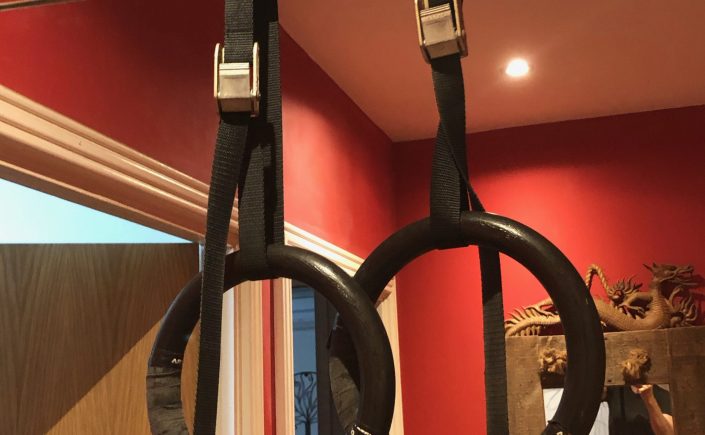
Home pull up bar and gymnastic rings

When working through my home training courses, the chances are you will need a pull up bar. Many landlords won’t let you screw them into a wall, so get one that slides in and out of a door way. I’ve liked the JML one because, like me, its been around for ages,

JML Awesome Gym Door Frame Workout/Pull-Up Bar Home Gym for Upper Body Exercises

but there are lots of cheaper ones around too

I have to say that I own my own home so, Ive screwed mine into the wall.

Once you have a pull up bar, you can get a set of gymnastic rings. I started importing them in 2005 in tiny batches, and I think they cost £50 plus.

Today £20 gets you a nice wooden pair. Here is a good example, opt for wood if you can.

Sundried Wooden Gymnastic Rings with Straps Exercise Gym Rings Crossfit Gymnastics Athletic Dip Rings

If you want to start using your Gymnastic rings, anf you can afford  99p  ( or £1 less 1p) you can get a copy of my old ring training guide, thats rudely been scored as a 1 star!! Try and be more generous

Ring Training: Using gymnastic rings in the fitness Environment

Build your Push ups

There are a lot of very dull, unimaginative push up regimes on the internet. My aim is to get you 100 push ups in, about, 6 weeks.

For the purposes of the first part of this this post, Im going to assume you can do 10 strict push ups in one go. (If you have none, skip further down)

The 1st thing i need you to do is to do a test, one today, one tomorrow. today I want you to attempt the most continuous push ups you can. Record it.

Tomorrow, I want you to attempt as many push ups as you can in 2 minutes . You can take as many breaks as you like, you can do lots of singles. Does not matter. Just do as many as you can in 2 minutes.

This gives you an interesting base line to begin with.

For now, you have two alternating protocols to follow

1) Without being too prescriptive, I need you to get to 10 sets of 10 push ups, with no more than 90 seconds rest. At this stage, this means, shooting for 10 reps, then resting for 90 seconds, so the reps could look like this.

10, 10, 8, 7, 6, 5, 4, 4, 6, 8.

2) 3 sets of maximum push ups. go down and do as many push ups as you can, rest 2 minutes, then do it again 2 more times.

So, do 1 on day 1, 2 on day 2, then a rest day. then 1 and 2 again.

That should get you started for now.

BUT WHAT IF YOU HAVE NO PUSH UPS. Ive seen lots of people with no push ups struggling on “box” and knee versions. Whilst they are interesting if you are really really weak, i have never seen anyone successfully get a full push up by using these shortened versions. The 2 best techniques to use are the eccentric phase and Isometrics. Put simply, get into the top of a push up, and lower yourself down as slowly as you can. Do this 4 or 5 times with 60 seconds rest ( more if you need it.). Then while lying on the floor, try and push yourself up. Put as much effort in as you can, and push for 7 seconds. Rest for 30 seconds and go again. ( say 4 times). You may not move, but you are building the specific strength to do so.

Body fat calculator

Knowing your fat percentage is one of the best fitness tests you can do.

The best way to assess your body fat percentage is to get me to whip out my fat calipers.

However, for those of you who don’t fancy that experience, I quite like the zone body fat calculator.

Get a tape measure with inches and fill-out this interesting online calculator

Click here

A sort of a sit up test

Coming from a functional fitness back ground, the  sit up procedure suggested by Goulding is a bit of a shocker!!

Lie on the floor  with your knees bent at approximately right angles, with feet flat on the ground. Your hands should be resting on your thighs. Just slide your hands along your thighs to touch the top of your knees, then back to the starting position (don’t tug or strain your neck)

Do it for 1 minute

Allow the table below to Judge you!

1 Minute Sit Up Test (Men)

Age 18-25 26-35 36-45 46-55 56-65 65+
Excellent >49 >45 >41 >35 >31 >28
Good 44-49 40-45 35-41 29-35 25-31 22-28
Above average 39-43 35-39 30-34 25-28 21-24 19-21
Average 35-38 31-34 27-29 22-24 17-20 15-18
Below Average 31-34 29-30 23-26 18-21 13-16 11-14
Poor 25-30 22-28 17-22 13-17 9-12 7-10
Very Poor <25 <22 <17 <13 <9 <7

1 Minute Sit Up Test (Women)

Age 18-25 26-35 36-45 46-55 56-65 65+
Excellent >43 >39 >33 >27 >24 >23
Good 37-43 33-39 27-33 22-27 18-24 17-23
Above average 33-36 29-32 23-26 18-21 13-17 14-16
Average 29-32 25-28 19-22 14-17 10-12 11-13
Below Average 25-28 21-24 15-18 10-13 7-9 5-10
Poor 18-24 13-20 7-14 5-9 3-6 2-4
Very Poor <18 <13 <7 <5 <2

Source: adapted from Golding, et al. (1986). The Y’s way to physical fitness (3rd ed.)

Push up test

The old favourite push up test. Loved by some hated by many. This is supposed to be the amount of push ups you can do before exhaustion. Surprisingly this is not chest to floor, but elbows to 90 degree.

Allegedly, those with weaker upper body strength, can drop their knees to the floor and test from there

Table: Push Up Test norms for MEN

Age 17-19 20-29 30-39 40-49 50-59 60-65
Excellent > 56 > 47 > 41 > 34 > 31 > 30
Good 47-56 39-47 34-41 28-34 25-31 24-30
Above average 35-46 30-39 25-33 21-28 18-24 17-23
Average 19-34 17-29 13-24 11-20 9-17 6-16
Below average 11-18 10-16 8-12 6-10 5-8 3-5
Poor 4-10 4-9 2-7 1-5 1-4 1-2
Very Poor < 4 < 4 < 2 0 0 0

Table: Push Up Test norms for WOMEN

Age 17-19 20-29 30-39 40-49 50-59 60-65
Excellent > 35 > 36 > 37 > 31 > 25 > 23
Good 27-35 30-36 30-37 25-31 21-25 19-23
Above Average 21-27 23-29 22-30 18-24 15-20 13-18
Average 11-20 12-22 10-21 8-17 7-14 5-12
Below average 6-10 7-11 5-9 4-7 3-6 2-4
Poor 2-5 2-6 1-4 1-3 1-2 1
Very Poor 0-1 0-1 0 0 0 0

* Source: adapted from Golding, et al. (1986). The Y’s way to physical fitness (3rd ed.)

Grit: The secret of success

Success is quite a difficult concept. It’s incredibly personal but whether you measure success by wealth, quality of service, or your relationships with other people, it seems  that the ability to stick at a task is crucial. Some people call this grit. In assessing the success or failure of West Point graduates, researches identified “grit” as one of the required characteristics. Grit is about having what some researchers call an “ultimate concern”–a goal you care about so much that orders and structures almost everything you do. Grit is holding steadfast to that goal. Even when you fall down. Even when you screw up. Even when progress toward that goal is halting or slow.

I suppose an issue with this is you can be gritty in the  pursuit of a goal or an idea, but be a lazy total toss pot in other areas.

Angela Duckworth is acknowledged as a leading grit researcher

Here are  some of her ideas in her own words

This little test may  help you consider how gritty you are. Im not sure if you should see this as an overall personality test, or consider a specific aspect of your life. Maybe try both.

I have some of my clients use this scale when assessing their commitment to fitness, olympic weight lifting, gymnastics, diet and first aid provision.

Short Grit Scale


Directions for taking the  short Grit Scale:

Please respond to the following 8 items. Be honest – there are no right or wrong answers!

1. New ideas and projects sometimes distract me from previous ones.*

  •   Very much like me
  •   Mostly like me
  •   Somewhat like me
  •   Not much like me
  •   Not like me at all

    2. Setbacks don’t discourage me.

  •   Very much like me
  •   Mostly like me
  •   Somewhat like me
  •   Not much like me
  •   Not like me at all

    3. I have been obsessed with a certain idea or project for a short time but later lost interest.*

  •   Very much like me
  •   Mostly like me
  •   Somewhat like me
  •   Not much like me
  •   Not like me at all

    4. I am a hard worker.

  •   Very much like me
  •   Mostly like me
  •   Somewhat like me
  •   Not much like me
  •   Not like me at all
    5. I often set a goal but later choose to pursue a different one.*
  •   Very much like me
  •   Mostly like me
  •   Somewhat like me
  •   Not much like me
  •   Not like me at all
    6. I have difficulty maintaining my focus on projects that take more than a few months to complete.*
  •   Very much like me
  •   Mostly like me
  •   Somewhat like me
  •   Not much like me
  •   Not like me at all

7. I finish whatever I begin.

  •   Very much like me
  •   Mostly like me
  •   Somewhat like me
  •   Not much like me
  •   Not like me at all

    8. I am diligent.

    •   Very much like me
    •   Mostly like me
    •   Somewhat like me
    •   Not much like me
    •   Not like me at all

 SCORING

For questions 2, 4, 7 and 8 assign the following points:

5 = Very much like me
4 = Mostly like me
3 = Somewhat like me
2 = Not much like me
1 = Not like me at all

For questions 1, 3, 5 and 6 assign the following points:

1 = Very much like me
2 = Mostly like me
3 = Somewhat like me
4 = Not much like me
5 = Not like me at all


Add up all the the points and divide by 8.

The maximum score on this scale is 5 (extremely gritty), and lowest score on this scale is 1 (not at all gritty)


Grit Scale citation


Duckworth, A.L, & Quinn, P.D. (2009). Development and validation of the Short Grit Scale (Grit- S). Journal of Personality Assessment, 91, 166-174. http://www.sas.upenn.edu/~duckwort/images/Duckworth%20and%20Quinn.pdf

Duckworth, A.L., Peterson, C., Matthews, M.D., & Kelly, D.R. (2007). Grit: Perseverance and passion for long-term goals. Journal of Personality and Social Psychology, 9, 1087-1101. http://www.sas.upenn.edu/~duckwort/images/Grit%20JPSP.pdf


This blog article was drawn from an uncredited online PDF “Grit-8-item.pdf”


My name is Andrew Stemler and I’m a london based personal fitness and first aid trainer. You can contact me here andrew@andrewstemler.com