Unlock Strength: Benefits of Gymnastics Ring Training

Adding gymnastics ring training to your fitness regime offers numerous benefits that enhance strength, mobility, and overall fitness. I got my introduction to them in my crossfit certification back in 2005 in Santa Cruz. Ibve iused them ever since. Here are soe oif the reasons why they are so useful

1. Builds Functional Strength

Gymnastic rings require you to stabilize your body, engaging multiple muscle groups simultaneously. This develops functional strength that translates to everyday movements and other sports.

2. Enhances Core Stability

Every ring exercise activates your core for balance and control. This constant engagement strengthens your core muscles more effectively than many traditional exercises.

3. Improves Joint Health and Mobility

Ring training allows natural movement patterns, reducing strain on joints compared to fixed machines or bars. It also promotes greater joint mobility, especially in the shoulders.

4. Boosts Grip Strength

Holding onto unstable rings challenges your grip, leading to significant improvements in forearm and hand strength.

5. Offers Scalable Progression

Whether you’re a beginner or an advanced athlete, ring exercises can be scaled to your skill level. For example, you can start with ring rows and progress to advanced moves like muscle-ups or planches.

6. Builds Coordination and Balance

The instability of the rings demands improved coordination and body awareness, enhancing neuromuscular control.

7. Portable and Versatile

Rings are lightweight and easy to carry. You can set them up almost anywhere, making them a versatile tool for at-home or outdoor workouts.

8. Promotes Lean Muscle Development

Because ring training engages multiple muscle groups at once, it promotes lean muscle growth, resulting in a toned and athletic physique.

9. Challenges Mental Focus

Mastering movements like dips, levers, and muscle-ups requires mental focus and discipline, making it as much a mental workout as a physical one.

10. Adds Variety to Workouts

Incorporating rings prevents workout monotony and keeps training fresh and exciting with endless exercise variations. Certainly this was one of the motivations behind their early adoption by the Crossfit regime

Whether you aim to build strength, improve mobility, or challenge yourself in new ways, gymnastic rings are an excellent addition to any fitness program.

I noticed that Amazon has a reasonable selection of rings for sale. You ought to have your own pair.

Gravity fitness rings (amazon) £37.95
Or “breaking limits” (£34.95)


Build your chest.

Maybe the strongmen of old didn’t have access to weights. I say that as, many of the old fashioned “get fit at home” manuals and pamphlets,  put push ups and push up variations at the core of their regimes. Maybe  they assumed that their home based clients  didn’t have  a “bench”.

Not a totally insane assumption.

So, push ups or “dips” as Charles Atlas called them,  belong in any home regime. I think they are often overlooked.

Charles Atlas does his “dip”between two chairs in order to get a bigger range of motion. according to his pamphlet its great for “Chest, Shoulders and Back. Excellent for preventing Lung and Chest troubles. Do the dipping exercise   at least 100 times every day. Aim to do it 200 times daily if you are keen on getting a very big and powerful chest development. Do this by dipping 25 or more times, rest and relax a few moments and do them again. Rest and do them again.” Charles Atlas  said he did 200 daily.

However, it isn’t as simple as  just doing any type of push up. Notice from this video that you are aiming for a planche push up. Your shoulders go forward and your hands end up as near the hips as possible

Of course, this is achievable if you already have push ups. If you don’t work your progressions like mad

Pull ups again

Where ever I go I find people abandoned by the fitness industry!

My evidence for this  is the failure of so many people to be able to do a pull up.

I’ve written about this phenomenon in the past. Often in slightly rude, slightly risque, terms.

But let me, again, emphasise how to get your first pull up.

Obviously, any arm strength helps. If you’ve been bicep curling, doing push-ups, tricep extensions, some other weird bodybuilding isolation exercise you got off the internet, you must be better of than someone who hasn’t used their arms since birth, but as my article  “Pull ups and girls” proved, generic exercises do not give you pull-ups.

It’s better to learn how to do a “negative”

You have to think a lot about how to get  up to the  bar to  be able to lower down from it. I cover this crucial issue in patronising detail in my article “If you do not have any pull ups, no one will want to marry you”.  Read it carefully

To help structure your training, here is an interesting regime that builds your pull ups from a single negative to 20

20-pull-ups_ilka-helo copy 2

As always, if you want to book a Pt with me in East London do drop me an email Andrew@andrewstemler.com

[mc4wp_form id=”832″]

Isometrics revisited

in the 60’s to 70’s  you would have been hard pressed to ignore the isometrics movement. Vic O’beck published “How to Exercise without moving a muscle” in 1964 and it became very popular.

During the late 60’s early 70’s the Daily Express ran a regular cartoon in its pages which popularised the exercise regime. The cartoons were eventually bundled into a book Isometrics. How to exercise without moving a muscle, in strip cartoons from the Daily Express.

Like many fitness fades, the interest faded from main stream use, due in part to silly claims. A regime that promises to get you fit and trim in 90 seconds a day is bound to sell you the book or course, but fail to deliver much , if any, fitness.

This is a shame, as given the right objectives, the static hold has a really useful role to play. According to James Hewitt who wrote Isometrics for you: Get fit and trim in 90 seconds a day in 1966  “without special apparatus and without moving a muscle you can grow stronger and build, or reshape your body to nearer your hearts’ desire. The static  contraction has been part of physical culture systems  for a very long time. Hatha yoga contains postures  held without movement”.
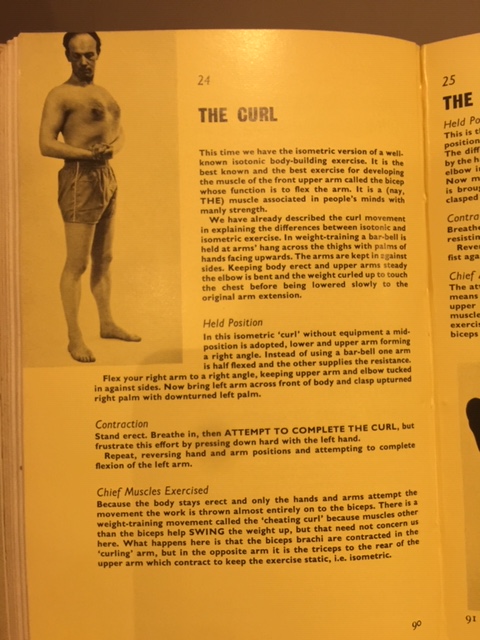
Put simply, isometrics are a system of physical exercises in which muscles are caused to act against each other or against a fixed object. It’s a form of exercise involving the static contraction of a muscle without any visible movement in the angle of the joint.

The popular regimes focused on basic body building type exercises and suggested a 6  second static contraction  with a maximum, or comfortable maximum contraction. This bicep curl picture gives you a good idea.

bicepcurl

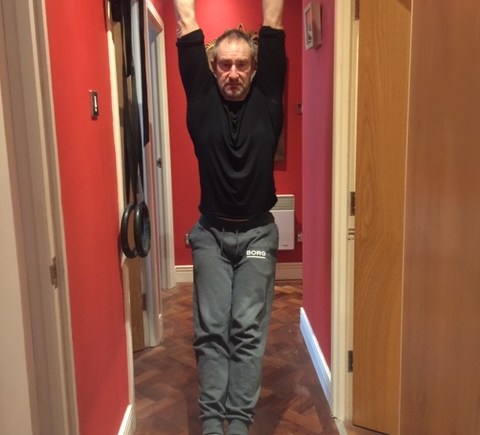
Whilst this had some value, the use of the extended static hold in functional fitness is probably in developing the capacity to simply hold postures which contribute to actual exercises. The reality is that if you want to kick up to a rock solid free standing handstand, or do 20 plus pull ups, you better be able to hold a static ( albeit “leaning” ) handstand against the wall, and hang for 60, 90, 120, 180 seconds. Extra grip strength is always useful!

Btw you could find yourself struggling at 10 seconds when you start. Just do what you can and build up

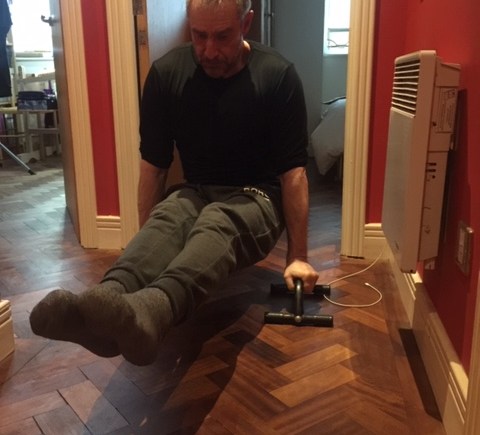
So think about your regime and hunt out obvious postures to practice: the side planks, lunging pushes against a wall and deadlift holds spring to mind. Adding the L sit, a horse stance ( the old martial arts favourite) and a “hip up” hold can , when combined,  make a really useful home exercise regime.

No more, “I cannot get to the gym”!!

The gymnastic dish shape or hollow hold

To have a fantastic core you need to strengthen and engage your core muscles in a move called the dish shape, or the hollow hold.

This video starts you on the road to the perfect dish

I like this move because you can learn it at home!

The value of this move is that it starts you on the road of learning the handstand. You take the shape you have been learning, make the pelvic tilt more obvious,  build it into a plank then walk the plank up the wall!

All at home!

Home pull up bar and gymnastic rings

When working through my home training courses, the chances are you will need a pull up bar. Many landlords won’t let you screw them into a wall, so get one that slides in and out of a door way. I’ve liked the JML one because, like me, its been around for ages,

JML Awesome Gym Door Frame Workout/Pull-Up Bar Home Gym for Upper Body Exercises

but there are lots of cheaper ones around too

I have to say that I own my own home so, Ive screwed mine into the wall.

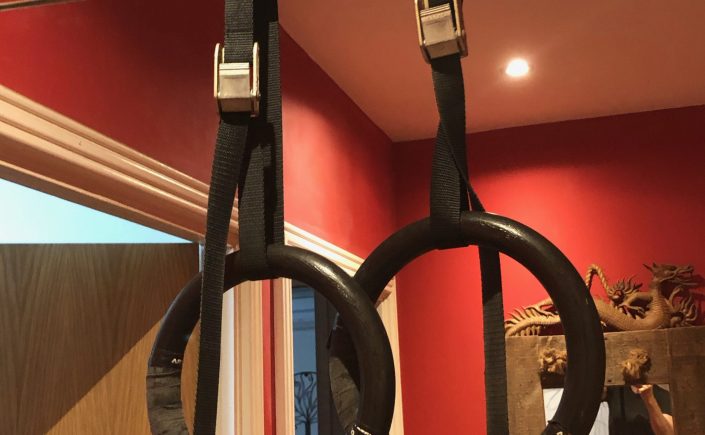
Once you have a pull up bar, you can get a set of gymnastic rings. I started importing them in 2005 in tiny batches, and I think they cost £50 plus.

Today £20 gets you a nice wooden pair. Here is a good example, opt for wood if you can.

Sundried Wooden Gymnastic Rings with Straps Exercise Gym Rings Crossfit Gymnastics Athletic Dip Rings

If you want to start using your Gymnastic rings, anf you can afford  99p  ( or £1 less 1p) you can get a copy of my old ring training guide, thats rudely been scored as a 1 star!! Try and be more generous

Ring Training: Using gymnastic rings in the fitness Environment

The dish hold

The absolute foundation of gymnastic training is the dish hold, or hollow hold or handstand plank. It’s a super useful skill and a great core and abdominal muscle builder. If you want a L sit, a handstand or a muscle up, you need this!


You need to tumble if you want to be a stunt performer

There are many requirements to becoming a member of the British Stunt Register. You can check them out here 
Its clear that for some, tumbling is an essential component: they really need  to learn how to handstand to forward rolls, back roll to handstand, cartwheel, round off
front tuck, back handspring, front hand spring.
The chances are, if you are an adult learner, that fear of going backwards will be a major stumbling block in your future career. At Crossfit london in Bethnal green, we have been running and adult gymnastics programme since 2008 . We have been teaching adult beginners how to do these skills for years.
Im privileged to be part of the tumbling teaching team, even though Im not one of the best ever tumblers.  Im now 58 so some of my demos are a bit wobbly, and at my age, I do like a bit of a comforting spot.
In short I know all about fear and what it does  to your form if you want to jump up in the air go backwards and land on your hands. I leave it to my younger colleagues to optimise your technique and string things together. For me, I know how great it it to nail that 1st handspring, that tuck, that flag. I got those, not when i was 6 or 8 or 16: i got those skills when I was in my 50’s

to be honest, may flag is still work in progress

here is my 1st ever unspotted  back handspring

We have spent our long teaching history building up drill to build your skills. We work almost exclusively with frightened adults !

If you want to check out my lessons in Bethnal Green E2 you can  look at our class schedule and book here.

At the moment, my classes are on Friday evening and Sunday afternoon at Crossfit London  If you want a better gymnast to lead your classes,  look for Matthias ( wed) and Tugs (sunday) . You should really check out our fantastic gymnastic strength classes: handstands, levers, muscle up, planches, the flag.

Loads of stuff for you to learn.