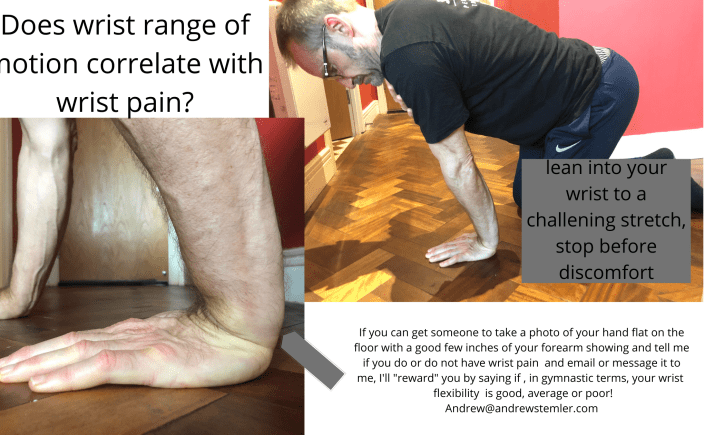
Does wrist flexibility, or range of motion, correlate with things like wrist pain. If it does, it means I can fairly easily sort it the same way I fix Plantar Fasciitis
To help out in this research, get into this position and lean on your wrists until you feel a stretch ( but not discomfort!)
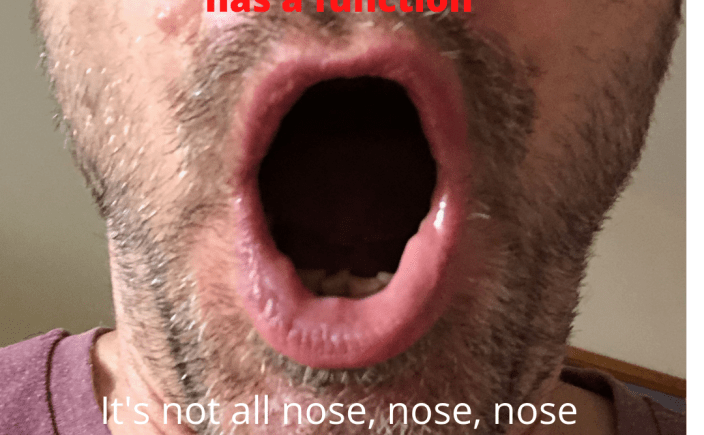
I now publish regular breathing drills and give the occassional zoom seminar . However, breathing has been one of those ongoing issues where people have been able to misrepresent, twist and ignore the science.
This goes for exercise professionals, miracle healers and straight up loonies.
Whilst everyone likes a rippling physique, there are exercises that are simply good for you, sometimes, for reasons that are not immediately obvious.
The L sit can have an impact on your stress levels. It was recently established that there is a connection between your core, your brain, your adrenal glands and thus the release of the stress hormone cortisol. It’s only been tested on Monkeys, but it’s very interesting.
Classically it was thought that most of the body systems worked top down. You think it, and the brain sends out the memo.
Basically, the primary cortex portion of your brain (or M1 for short) contains a map of your entire body including regions like your legs, arms, face, and your core.
To everybody’s surprise, boffins have discovered a large number of neurons in the M1 that controlled the adrenal medulla. Plus, most of these neurons were located in the axial muscle region of the M1. Stated plainly: “Well, lo and behold, core muscles have an impact on stress,” says Peter Strick, PhD, a professor and chair of the department of neurobiology at the University of Pittsburgh Brain Institute.
“One clear implication of this organization is that the sympathetic responses which occur during activities such as exercise, the performance of demanding cognitive tasks, and the experience of emotions are generated by neural activity from the same cortical areas that are responsible for these behaviors.” (The mind–body problem: Circuits that link the cerebral cortex to the adrenal medulla)
This isn’t that much of a surprise although as the mind body connection has been fairly known, or boringly worked to death, depending on your perspective. What we are beginning to see is the pathways for a body mind connection.
How you treat your body has a direct impact on your emotions .
The psychologists, hippies and new age weirdos had always talked about this connection. I went to a charity fire walk in Liverpool Street, London several years ago, and we were made to power pose (stand there, legs astride, “being powerful”) o prepare us for the rigours of the fire walk. to come Without such preparations, we would clearly have died
Whilst power posing per se isn’t at all guaranteed (other studies found it to be utter tosh), its enough to understand that:
“specific multisynaptic circuits exist to link movement, cognition, and affect to the function of the adrenal medulla. This circuitry may mediate the effects of internal states like chronic stress and depression on organ function and, thus, provide a concrete neural substrate for some psychosomatic illness”.
All of which is a long winded rambling way of saying, do the L sit! ‘Cause your core sort of chats to your stress bits. Like”.
It’s OK. I hang around with some really trashy people and have picked up some filthy phrasing habits.
To own the L sit, here are the stages! It’s vaguely abusive in places
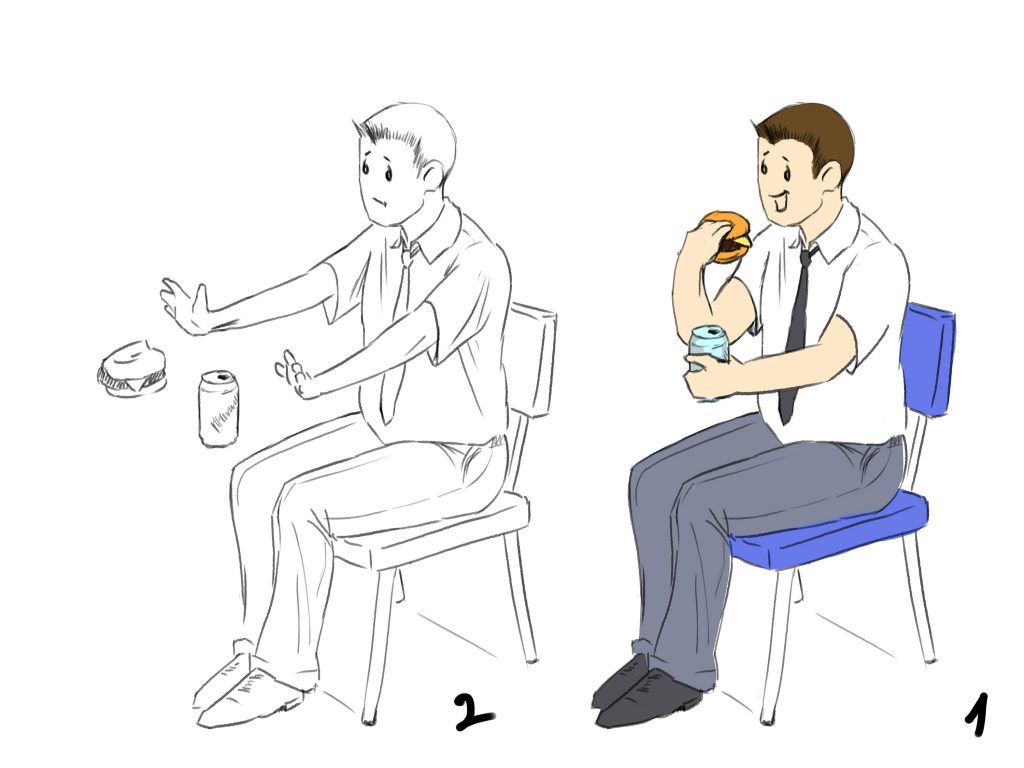
Stage 1. Notice the burger you are scoffing
Stage 2 put the burger down
The abusive thought behind stage 1 & 2 really is unnecessary. You can get good strong abs and still eat crap, you probably won’t be able to see them though. Although eating crap per se is bad for you.
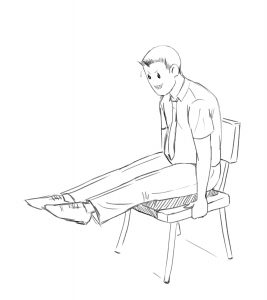
Stage 3 grab the edge of the health and safety checked chair and push your ass off the seat, Notice how your bum is behind your hands. Find a balance. Practice for a few weeks (less if its easy)
Stage 4 Build on stage 3 , then stick one of your legs in front of you.Yikes. It’s hard for some, not so for others. You are lucky or you are not. Practice this and stage 5 together. One leg, then the other. Feel free to cry. Everyone likes people who can express emotional weakness
Stage 5, is the other leg!
Stage 6. Hurrah, both legs out “purleez”
Stage 1-6 can be almost instant or its 6 weeks worth of work.
Then you can do it on the floor with paralletts
Then you start your disgusting journey to 2 minutes!
You’ll love the abs you get, the core control, and of course you’ll be calm and stress free!
Get L sitting, like you were born to it. It will soon become easy ( this is a lie: it will always suck. If you have Abs of steel,I can always put weight on your feet)
Whilst I talk about the various therapies and stretches for Plantar Fasciitis here, its worth tuning into the “length of stretch” debate.
If you look at Porter D, Barrill E, Oneacre K, May BD. The effects of duration and frequency of Achilles tendon stretching on dorsiflexion and outcome in painful heel syndrome: a randomized, blinded, control study. Foot Ankle Int 2002;23(7):619-624.
You’ll find two protocols coming neck and neck:
3 minutes of stretching 3 x a day (ie hold the stretch for 3 minutes) , or five sets, 20 seconds each, two times daily.
Either way, the take-home message that a quick reluctant 10-second stretch when you can be bothered, isn’t enough. The study also determined that both sustained and intermittent Achilles tendon stretching exercises increase Achilles tendon flexibility. This increase in flexibility correlated with a decrease in pain!
This is an idea that features heavily in my fix your plantar fasciitis course. It’s only £27 and has the most effective science-backed drills. Never waste money on physical therapy again!!
if you’d like other stuff sent to you free of charge, do join the mailing list
A big welcome to your Plantar Fascia. An unknown part of your foot, that, so it seems, you don’t have to worry about.
It will do whatever the hell it does for years, then one morning, in some unlucky people, it creates almost crippling heel pain.
First thing in the morning, upon getting out of bed, you’ll be in so much pain that even hopping across your bedroom floor is something you’ll dread. Even contemplating allowing your heel to touch the floor makes many want to throw up in their own mouths.
It’s not all bad. Just give it 5 or 10 minutes of hobbling around and you can begin to limp with a bit of dignity. Welcome to the party you now have plantar fasciitis. It often self cures, in anything from 6 weeks to TWO YEARS.
There are two positive sides to the condition:
1) You’ll meet lots of people online searching for a cure. So it’s like an agony based Tinder.
2) you’ll meet lots of dodgy therapists trying to part you from your money for quack cures. If you spot them, it’s fun to watch. If you cannot see a quack coming, its a bit expensive.
So some back ground, according to the BMJ plantar Fasciitis copy has the reputation of being “a trivial condition”. Clinically “benign and self limiting”. So, if you are limping around your bedroom, screaming with pain, wondering how you can get to the loo, don’t worry, its “benign and self limiting”.
Pull yourself together. Its not cancer
So who gets it?
Middle aged and older people. In some research I undertook, the age spread was thus
Athletes and active people
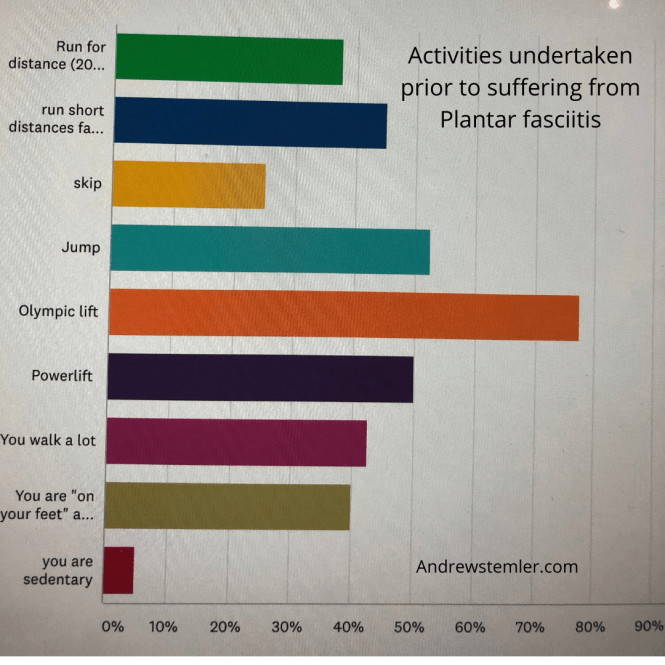
In my research, these were the activities being undertaken prior to Plantar fasciitis developing
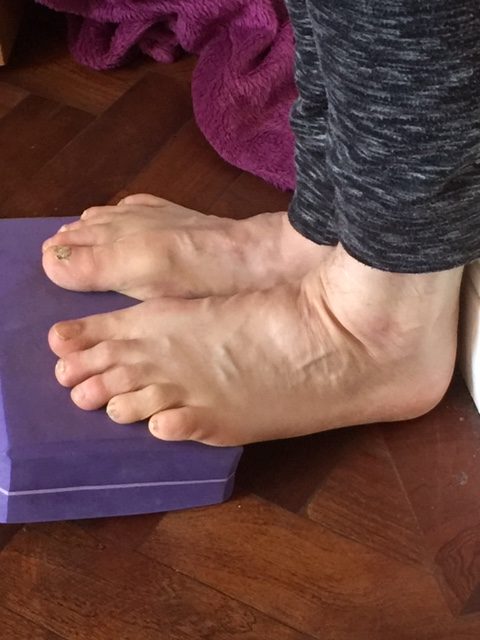
Those with a reduced range of ankle dorsiflexion. Its all about Equinus
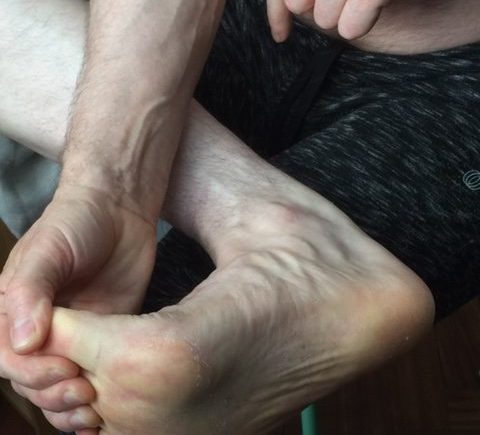
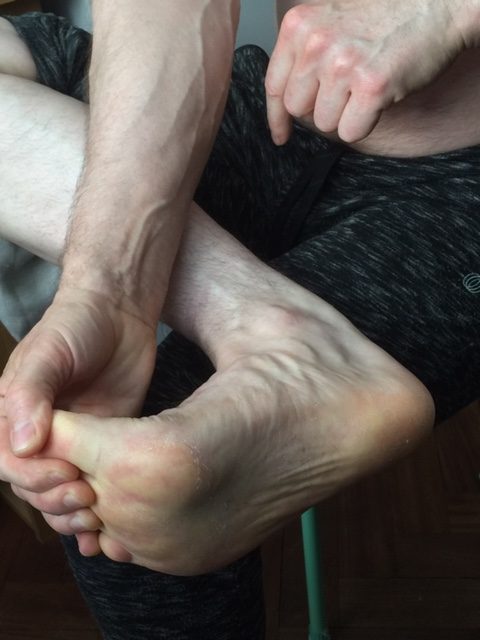
“sit with one leg crossed over the other, and stretch the arch of the foot by taking one hand and pulling the toes back toward the shin for a count of 10. The exercise must be repeated 10 times, and performed at least three times a day, including before taking the first step in the morning and before standing after a prolonged period of sitting”. Thanks to Benedict DiGiovanni and Nawoczenski,
Most foot issues (not only plantar fasciitis, but the nasty achilles tendonitis) benefit from a better range of ankle flexion and pliable calf muscles. This daily stretch is also a must!
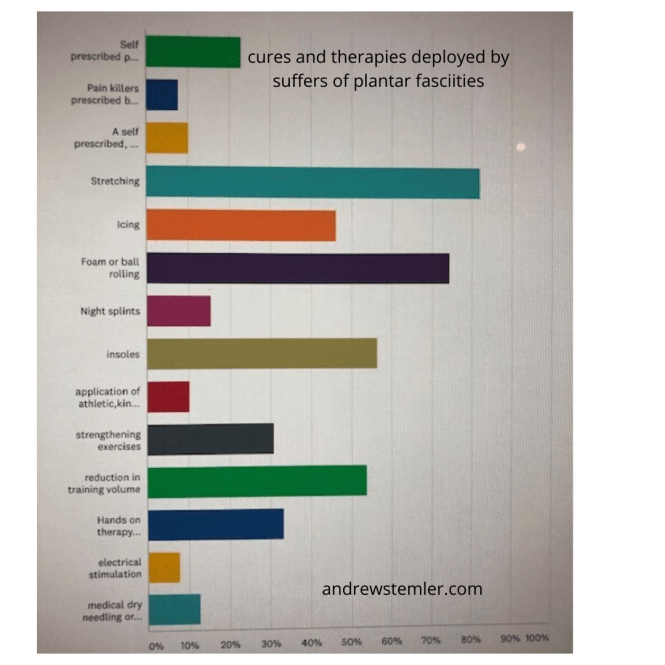
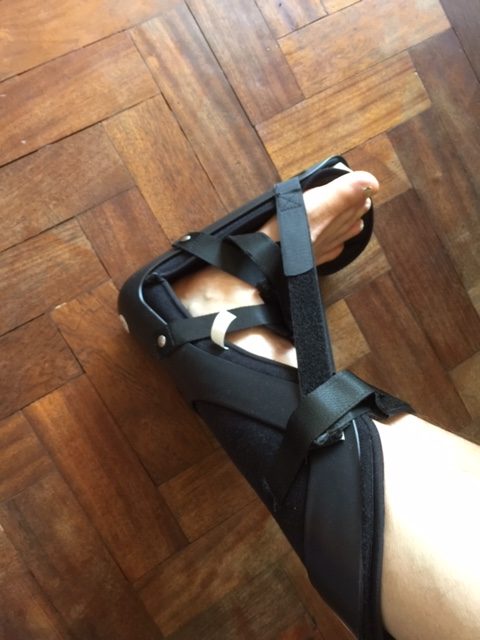
However, Crawford F, Thomson C. Interventions for treating plantar heel pain. Cochrane Database Syst Rev 2003; (3) found limited evidence to support the use of night splints to treat plantar fasciitis sufferers who had experienced pain for greater than 6 months. They found that patients treated with custom made splints improved but those with premade or ‘off the shelf’ splints did not.
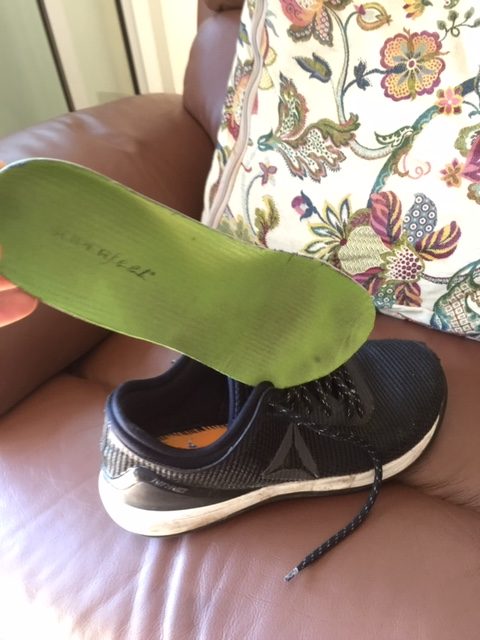
INSOLES: In my humble opinion, buying and wearing flatter shoes often causes Plantar fasciitis . This is often combined with the whole “go barefoot” rebellion. It’s based on the “well, its more natural, innit” concept and totally, totally fails to take into account the fact that you have worn heeled, and supported shoes for the last 20-30 years!
To actually fix your plantar fasciitis you need my SSES system ( stretch it, smash it, educate it, strengthen it). If you simply stretch it, the trigger points get you, and a lack of strength drags you back into pain. Strength on its own, without educating your muscles and restoring an effective range of motion, is also a low return strategy.
In this course, I’ll teach you these skills with a mixture of video, photos, and written teaching resources to help you learn. You’ll get my email address so any issues I’ll be there to help you. However, I’ll soon set up a free but private Facebook group to support you that way.
No modern discussion of flexibility, trigger points or pain is complete without talking about fascia.
I was introduced to fascia by Julian Baker of the Bowen technique during some guided dissection sessions back in 2012 ( which means I have dissected corpses as part of my studies).
Its the “sort of fatty stuff directly under your skin See here
Years ago this “stuff was simply cut away by laboratory assistants so you could see the actual muscles.
It’s only now that people see this as a new communication highway for our endocrine, circulatory, or nervous systems.
Today much “tightness” is attributed to dysfunction in the fascia. Although this is far from proven it’s useful working hypothesis that makes us focus on trigger points. They are “a hyper irritable locus with a taut band of skeletal muscle, located in the muscular tissue and/or its associated fascia.”
Sometimes called knots, trigger points can be quite painful, will cause stiffness and weakness of the affected muscle, and restrict the muscle’s full range of motion.
Fascia can also stick to muscles in what Gill calls “fuzz” ( if you cannot pick the skin off your muscle, its arguably adhered and interrupting muscle function, reducing range of motion
When poking around your body, you can often find what needs attention if 1. You press on the skin, and its super painful with pressure 2. you cannot pick the skin away from the muscle. This should glide, not stick 3. You feel special tension in an area when you stretch
This is sorted by, being bothered enough to do something about it. Practically that means a mix, but consistent mix , of gentle (and not so gentle) massage, skin rolling and pressure applied by your fingers, objects, cupping, or better still someone else.
This stuff goes under the heading of Myofascial Release.
It’s uncomfortable which is why few people use it or do it. Sort of like flexibility. You have to get used to that weird discomfort.
The problem is that medically, no one wants to be a muscle doctor. So it’s the orphan organ.
If you have enough flexibility to squat, why do you need more. Crucially, if you cannot squat well because of flexibility who cares. Most lift the weight anyway, and if they screw their back who cares!
Stretching is uncomfortable, boring, the evidence is very conflicted and many charlatans insist that flexibility is a “star gate” to spiritual well being and enlightenment. This obviously puts any right mind individual off stretching.
I refer to this “genius” so often, that I thought I should post up this reference here.
Alfredson H Pietila T Jonsson P Lorentzon R. Heavy‐load eccentric calf muscle training for the treatment of chronic achilles tendinosis. Am J Sports Med. 1998;26(3):360‐366. [PubMed] [Google Scholar]
This is a report that has changed the lives of so many people, it’s ridiculous. It’s basically stretching a tendon through its eccentric phase, under load.
Here is a much younger me trying it out, back in the days when I was sufferer!
For those who want to dig further into this issue, check out this useful review.
Misrepresenting Crossfit injuries is simple click theft!
Obese reporters, lazy bloggers out to “steal clicks”, and those seeking to curry favour with critics throw their hands up in horror at the thought that any sporting activity could result in any type of injury.
“Surely”, they ooze, “If we could rid ourselves of rugby, MMA, boxing, indeed all martial arts (except that nice Tai Chi, that’s ok) and Crossfit, no one would be injured again.”
I reflected on this and thought about my Crossfit injuries, then I thought about my pre-Crossfit injuries as a “fit” person, then I thought about my injuries as a normal member of the public.
I’m proving nothing, other than saying injury, biffs, cuts and stuff are probably part of life unless you are very unfit and sedentary. In which case, it’s just the bed sores.
An overview of my injuries
As a sedentary 100 day a smoker who avoided physical activity till I was 37.
I got run over by a car.
I fell of a ladder while painting,
I burnt my chest in a garden fire.
I had back pain from slouching.
I had back pain from moving stuff badly.
I had numerous hangovers from drinking too much.
A disastrous smokers’ cough with the associated high blood pressure.
I skipped down a low corridor and bounced so high that I smashed my head on the ceiling and landed on my elbow.
I stood up too fast while filing and smashed my head against the bottom of a draw that was pulled out above me.
I cut my lip by trying to lick the top of a soup tin, which I had opened with an opener .
I nearly mandolin-ed the top of my finger off.
I’ve caught my fingers in the car door,
I’ve banged my fingers with hammers, sliced my skin open with knives so many times that I should have therapy for self harming.
I’ve electrocuted my self, twice.
I’ve burned myself on the iron, on the oven, and by seeing what would happen if I poked a straw into the 2 bar fire in the lounge.
Cigarette burns galore.
I’ve walked into too many doors.
Tripped down stairs, and slipped on slippery things .
I have left shoulder pain as I sleep on it… (for 54 years!!)
I got several bouts of carpet burn knees after having sex on the floor
I’ve caught my foreskin in my zip, unbelievably, 3 times.
I fell off a wall while having a cigarette and dislocated my finger.
Why do I continue to stub my toe?
As a child learning to ride my bike, I scraped both knees, badly, and my mum screwed up the bandage so the scab meshed into the material, so that had to be ripped off. I often slammed the breaks on and often went sailing over the handlebars.
Often.
From when I started to get fit at age 37
I tumbled off the treadmill,
Dropped a dumbbell on my foot,
Caught my finger on the safety catch on the leg extension machine
At martial arts, 5 years of black eyes, numerous with kicks to my poor testicles.
Learning to swim at the age of 40 (God knows how much pool water I drank).
While wrestling, I caught my big toe between two mats and twisted it.
As a doorman and on security contracts, I got slashed with a bottle on my arm, then split a knuckle punching someone in the mouth. And I had someone try and scoop my eye out with their finger (I’m sure I got a knee in the groin too).
From running I developed severe knee pain and shin splints, and Achillies tendonitis. I compounded my shoulder damage by dropping that bench press
Since I started Crossfit:
Callus tears
4 bouts of deadlift- induced bad back pain (1 during a wod, the other 3 during strength sessions)
A nasty psoas injury, which I got demonstrating an unweighted split jerk.
My Achilles and shoulder continue to bother me.
I got a nasty dose of plantar fasciitis
My wrists don’t like high rep bar push presses.
There are injuries in Crossfit, but bearing in mind it taught me sooo much, I think, on balance, for me, it was safer than normal living. Certainly I’ve not zipped up my foreskin since I became a bit more co-ordinated.
Get me to the safety of 30 power snatches for time.








 .
.


 Andrew Stemler
