Ive had a chat with some of my followers, all of whom have said they would prefer to get the DWF’s in their 4 days blocks, so people can see in advance whats coming next.
so I’ll publish this series on the rest day. In each post you’ll get 3 workouts, and a food hint.
We don’t assume that you have access to a pull up bar! But today we stayed in the flat because we have a pull up bar there (with rings on). We wanted to do a version of Cindy. The Crossfit workout of 5 pull ups, 10 push ups, 15 squats. AMRAP in 15 minutes (it should b 20 minutes, but Im 59, so I cut myself some slack now and then.)
Maybe you like the idea of being a reality TV star, or you want to meet Ant Middleton, but lots of people want to get onto programmes like SAS: Who Dares Wins and Special forces Ultimate Hell Week. Some , even want to join the military!
Interest in military fitness regimes has also been stoked up by books such as “Can’t Hurt Me” by David Goggins and our relentless diet of war films.
Having been involved in the training of a few wannabe participants, chatted to a contestant who got a good way through the process, and having analysed the challenges, I thought it would be helpful to offer some general training and preparation advice.
I have a motto, stolen from an ancient greek warrior. In a crisis, you do not rise to the challenge, you sink to the level of your training. Success in these types of programs , and indeed success in applying for a position in the army, and their elite corps, requires you to be properly trained for the challenges you can anticipate.
Lower down in this article you find details of how military fitness testing goes, and the standards they expect. However, here is your take home message. To successfully survive one of these regimes, I say you need a good back ground in being “outdoors”. Do you love going for hikes in the rain and getting soaked. Do you know how to manage wet clothing. Are you ok with sleeping outside, and essentially are you ok with operating on limited sleep and getting up at 2, 3am and going for a run. Do you love camping. Would you turn down some super sex for a 10k run?
If your preparation only involves going to the gym, at sociable times, the chances are you’ll be screwed.
Let me rephrase this. You need to be able to put up with crap they don’t even have names for. Are you used to insect bites, going for a pooh in a bush, stinking and running in boots. Have you had blisters on your blisters, and can you work through the discomfort of a wet pant band working their way into your crotch.
Do you like the cold? Well you better like those morning cold showers and going out in all sorts of weather. On the plus side, getting used to the cold has benefits. A few years ago, “Thermal loading” was all the rage!
There is another type of training you should consider. It’s mindset. Doing a lot of mindset work would probably help; learning how to break big tasks into little task: it may be 4 am in the morning, you may have run 8 miles, you may be at the end of your tether but, maybe you can get to that tree thats 50m away. Ok, now let’s try that house 40m away. Not letting the enormity of the task overwhelm you is important.
This involves dealing with fear The science fiction fans amoung you will recall this monologue from Dune
“I must not fear. Fear is the mind-killer. Fear is the little-death that brings total obliteration. I will face my fear. I will permit it to pass over me and through me. And when it has gone past I will turn the inner eye to see its path. Where the fear has gone there will be nothing. Only I will remain.”
To be successful you probably need to distinguish the difference between fear and recognising danger. Fear is often described as False Evidence Appearing Real. Fear is an impractical emotion. Recognising danger and taking appropriate action is good. Being paralysed by fear isn’t.
Lord Moran, ( Winston Churchill’s physician, and a trench doctor in WW1) said “Courage is a moral quality; it is not a chance gift of nature like an aptitude for games. It is a cold choice between two alternatives, the fixed resolve not to quit; an act of renunciation which must be made not once but many times by the power of the will. Courage is willpower.” (The Anatomy of Courage).
This is part of working out how you think . Are you already looking for your excuse, or are you thinking, “I’m going to give this 100%”. Having a victim mentality can quickly bring your performance to an end. Combating a perfectionist mindset is also part of the magic. You’ll be slower and feel like you cannot succeed. Ignore that and just continue.
It’s worth remembering that 90% fail (the real) SAS selection, and most of these simply give up. The instructors rarely have to fail people.
The last thing you need to prepare for is lack of sleep. This is truly awful. Here are the consequences of not sleeping (Ref):
Humans can bear several days of continuous sleeplessness, but it screws everything. It may lead to deteriorated functioning, impaired perception, reducing concentration, vision disturbances, slower reactions, as well as lower capabilities and efficiency of task performance and to an increased number of errors.
It screws with your thinking which means wrong decisions, and emotional disturbances such as deteriorated interpersonal responses and increased aggressiveness.
Being woken up at 2 am to do a run or burpees is really, really awful. It is however a reality that soldiers at times need to operate in a sleep deprived state. There are some interesting tips and hints here but, it seems that you’ll need to set yourself some middle of the night exercise sessions. “Exposing soldiers to fatigue in a training environment teaches them how it affects them and their performance. Learning the consequences in a protected environment will help them identify the issues caused by sleep deprivation, so that they can know how deal with them before reaching combat. Likewise, understanding why you’re tired can help you power through the day”(National Sleep Foundation)
If you are from a farming background, you probably have some experience of sleep disturbing work like lambing, milking and chasing poachers. I knew a financial broker who got up to trade at 3am. I think after a few years he went a bit mad: but that could have been the drugs and the booze.
David Goggins, the navy seal, suggested an interesting task. It’s called a 4x4x48. In other words you go for a 4 mile run every 4 hours for 48 hours. That will give you a very good idea of what sleep deprivation feels like, although, I’d start at something like 2 x 4 x 12, and build up!
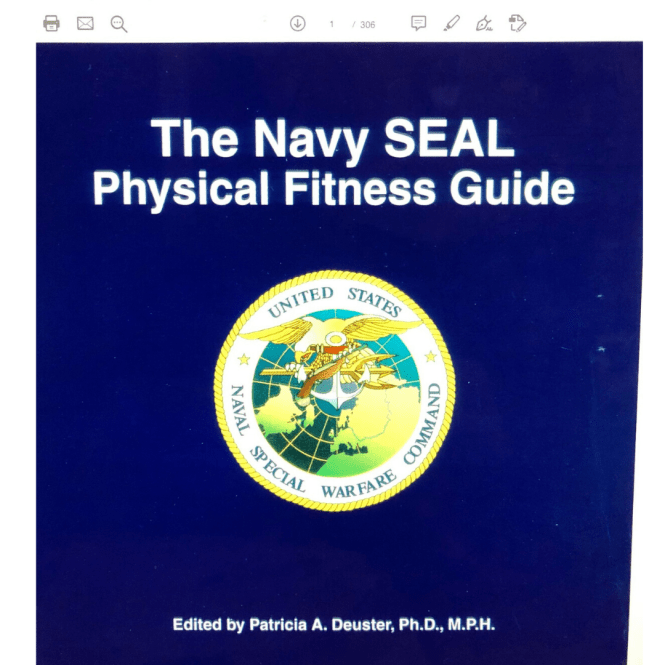
So, thats the background . What follows are the physical tests along with some official guidance from the military like this US Navy Seal training guide. Download and read it. Its free and useful
With these points in mind, you need to prepare for the actual standards. Either you have the knowledge to develop an effective training regime to master these, or you need a PT /or a coach
4km loaded march with 40kg within 50mins followed by 2km with 25kg in 15 mins (Infantry/RAC). The times allowed for 16 AAB/Paras are shortened to 35mins and 12.30mins respectively.
Fire and movement tactical bounds, followed by crawl and sprint ( 20 x 7.5 m bounds , or mini sprints. Then crawl 15m, sprint 15 m in 55 seconds
Casualty drag (110kg bag) dragged 20m in 55 seconds
Water can carry (simulates stretcher carry with 2 x 22kg cans) over 240 meters in 2 mins.
Vehicle casevac (70kg lift with 3-second hold)
Repeated lift & carry (20kg bags over distance) 20 x 30m in 14 minutes
I say you should not only be familiar with these challenges. You should do them, often, as part of your training. I think you should see these as the absolute minimum standards. Whilst I’m not sure, I’d prepare to do these tests with boots on.
The Royal Marines’ Pre-Joining Fitness Test allegedly involves completing two 2.4km runs on a treadmill that is set to a 2% incline. The first run must be completed in less than 12 minutes 30 seconds. You will then have a one-minute break before completing the second run in under 10 minutes and 30 seconds. This time is the absolute minimum requirement, and the expectation is that you will record the best time possible. You can use this chart to assess where you are
There are 4 body weight challenges. You should aim to ace them all. Why would you humiliate yourself on TV if you can only do 10 push ups if you know that 60 is the standard.
The VO2 Max bleep test (also known as the ‘bleep test’.) Minimum pass score is level 10.5. Shoot for the max!
Press ups are carried out immediately after the bleep test. A maximum score is achieved for 60 press-ups are conducted to an audible bleep (listen to the video below). Arms should be locked into side, shoulder width apart. The partner puts his fist on the floor facing away and counts one repetition for every time the chest touches his fist. If you put your knees onto the floor you will be told to stop.
Sit-ups come straight after the press-ups. 85 are needed for maximum points. Sit ups are conducted to an audible bleep. A partner holds the feet, elbows must touch top of knees and then the shoulders and elbows must touch the floor on the way down for a repetition to count. Knees must remain together or else reps will be deducted.
Pullups follow situps. A minimum of 3 are required to stay on the course but any less than 5 will be looked at critically and 16 will gain the maximum score. The over-grasp grip is used, the candidate is required to pull and hold the position until told to extend the arms; pull-ups are performed to the “bend” and “stretch” commands. The candidates chin must pass over the top of the bar to count and on the way down our body must be straight hanging down from the bar. Your legs must not cross. If the chin does not satisfactorily pass above the bar, or candidates cannot keep up with the commands, the candidate will be told to “drop off”.
The pool assessments include jumping off a high diving board (3m) in normal swimming kit and swimming a maximum of 4 lengths (approx 100m) of breast stroke followed by retrieving a brick from the bottom of the pool which is 3m deep. Train these skills. That brick retrival can be tricky. Learn to swim outdoors, in the cold, in clothes. For God sake have a life guard nearby. I think there are some outdoor swimming places like this one in the Royal docks in East London.
Other testing includes
The “Tarzan Assault Course” conducted up to 30 foot off the ground. Deal with your vertigo issues, or don’t apply!
The bottom field assault course which involves team games and other arduous physical activities.
An endurance course lasting 90 minutes and covering 2.5 miles undertaken on Woodbury Common
An over-night exercise which is intended to promote team building.
To train these, you’d better be a regular at your local Tough Mudder or Spartan Race. You need a t-shirt that says “I do love an obstacle race”. As I have said else where, if you don’t like getting wet, feeling cold, being woken up in the middle of the night, you really don’t want to apply for one of these programs, or the actual army for that matter. Familiarity with rope climbing and ab-sailing can probably be obtained at your local climbing centre. In the East End we have the Mile End Climbing wall
If you want to apply to be on SAS Who Dares Wins click here
If you are insane enough to want to do this, feel free to ask me for some in real life (if you are in the East End of London) or Online PT sessions.Click here
Where ever I go I find people abandoned by the fitness industry!
My evidence for this is the failure of so many people to be able to do a pull up.
I’ve written about this phenomenon in the past. Often in slightly rude, slightly risque, terms.
But let me, again, emphasise how to get your first pull up.
Obviously, any arm strength helps. If you’ve been bicep curling, doing push-ups, tricep extensions, some other weird bodybuilding isolation exercise you got off the internet, you must be better of than someone who hasn’t used their arms since birth, but as my article “Pull ups and girls” proved, generic exercises do not give you pull-ups.
in the 60’s to 70’s you would have been hard pressed to ignore the isometrics movement. Vic O’beck published “How to Exercise without moving a muscle” in 1964 and it became very popular.
Like many fitness fades, the interest faded from main stream use, due in part to silly claims. A regime that promises to get you fit and trim in 90 seconds a day is bound to sell you the book or course, but fail to deliver much , if any, fitness.
This is a shame, as given the right objectives, the static hold has a really useful role to play. According to James Hewitt who wrote Isometrics for you: Get fit and trim in 90 seconds a day in 1966 “without special apparatus and without moving a muscle you can grow stronger and build, or reshape your body to nearer your hearts’ desire. The static contraction has been part of physical culture systems for a very long time. Hatha yoga contains postures held without movement”.
Put simply, isometrics are a system of physical exercises in which muscles are caused to act against each other or against a fixed object. It’s a form of exercise involving the static contraction of a muscle without any visible movement in the angle of the joint.
The popular regimes focused on basic body building type exercises and suggested a 6 second static contraction with a maximum, or comfortable maximum contraction. This bicep curl picture gives you a good idea.
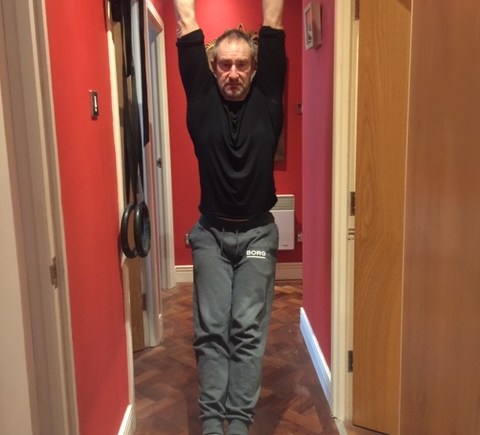
Whilst this had some value, the use of the extended static hold in functional fitness is probably in developing the capacity to simply hold postures which contribute to actual exercises. The reality is that if you want to kick up to a rock solid free standing handstand, or do 20 plus pull ups, you better be able to hold a static ( albeit “leaning” ) handstand against the wall, and hang for 60, 90, 120, 180 seconds. Extra grip strength is always useful!
Btw you could find yourself struggling at 10 seconds when you start. Just do what you can and build up
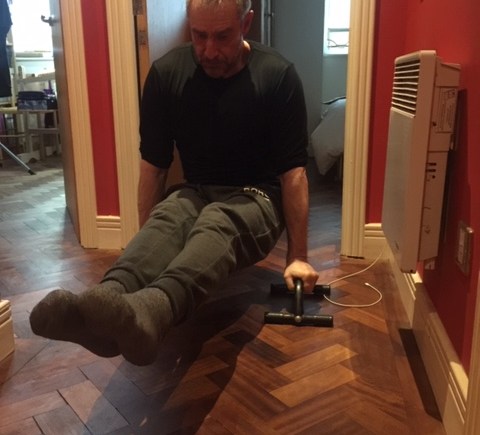
So think about your regime and hunt out obvious postures to practice: the side planks, lunging pushes against a wall and deadlift holds spring to mind. Adding the L sit, a horse stance ( the old martial arts favourite) and a “hip up” hold can , when combined, make a really useful home exercise regime.
When working through my home training courses, the chances are you will need a pull up bar. Many landlords won’t let you screw them into a wall, so get one that slides in and out of a door way. I’ve liked the JML one because, like me, its been around for ages,
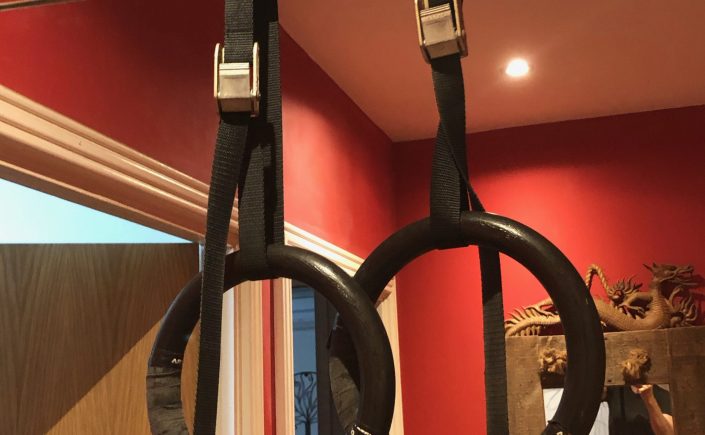
If you want to start using your Gymnastic rings, anf you can afford 99p ( or £1 less 1p) you can get a copy of my old ring training guide, thats rudely been scored as a 1 star!! Try and be more generous Ring Training: Using gymnastic rings in the fitness Environment
It is seen by many as a useful test for measuring the strength and endurance of the arm and shoulder girdle, and useful for those occupations where you need to manipulate your body weight: fire fighters, climbing into lovers’ bedrooms, showing off in front of kids, and getting out of holes when the zombie apocalypse strikes.
In Dec (2012) The media (papers and blogs) were all a-thither with the scientific proof that women cannot do pull ups. Even the Marines (“hoo-rah”) expect men to do 3, but women don’t have to do even one.
Zilch.
If you boil down the current research on women and pull ups, you will find two physiological reasons why most women cannot pull up.
They are fat and weak. (Don’t hate me, it’s science! )
It is generally accepted that women have a higher % of body fat (Heyward and Stolarczyk 1996) and according to an average of the research, women have upper body strength ½ of that of a man. (ranges from 35-79%: Laubach 1976).
But, as Kate said “It may be true, but God help you if you say that out loud to a girl!”
To be diplomatic and soften this up, it can easily be spun into the standard gym nonsense that women don’t have to do pull ups. Woo hoo, here comes your next Yoga class….after all strength is for smelly noisy boys.
We must accept that (Western) women have been sold a pernicious type of cultural weakness that blurs fitness with the spa. It palms off competence in Zumba as a substitute for the fitness that most women in the developing world need purely to survive the day. Elsewhere in the world women have to be tough, they have to plant food, haul goods, build stuff. A heroin-chic stick insect clinging to a partner’s arm isn’t available as a job option.
In fact, to be slightly political, the only reason Western women can prance around an aerobic studio and claim to be fit, is because their ancestors had the decency and foresight to be pirates, drug dealers and slavers who not only stole wealth, but saved it.
The poorest of us lives in comparative luxury based on this accumulated wealth, and it doesn’t matter if you have no physical competence
But what did this science experiment have to do, to validate the proposition that women don’t have to pull up?
“Three days a week for three months, the women focused on exercises that would strengthen the biceps and the latissimus dorsi — the large back muscle that is activated during the exercise. They lifted weights and used an incline to practice a modified pull-up, raising themselves up to a bar, over and over, in hopes of strengthening the muscles they would use to perform the real thing. They also focused on aerobic training to lower body fat”
And the result of this exciting “lat” challenging, bicep-strengthening routine was: “By the end of the training program, the women had increased their upper-body strength by 36 per cent and lowered their body fat by 2 per cent”
Wowee!
“But on test day, the researchers were stunned when only 4 of the 17 women succeeded in performing a single pull-up.”
“We honestly thought we could get everyone to do one,” said Paul Vanderburgh, a professor of exercise physiology”
A few interesting points.
1) This “hot news” (New York times dated 2012) was based on a report published in 2003 (“Training college-age women to perform the pull-up exercise.”) Shows how behind the times fitness media is.
2) It has been presented by much of the blogging world as justification for women having no pull ups, with the implication that they ought not to bother.
3) It shows that no one reads the small print. The researchers did not set out to produce a pull up specific routine
“We designed our training program with certain delimitations ..a whole body workout and not just a workout to improve pull ups”
4) It shows the impatience of “fitness regimes”. Why should the ability to achieve a certain goal in an arbitrary 12 weeks hold any sway? What’s wrong with spending 6 (+) months learning a skill?
5) The ineffectiveness of looking at movement in the simple terms of the strength of individual muscles.
All worthwhile “exercise” movements are analogues of human movement: they need to be learned, and they all, all combine numerous components of fitness: co-ordination, accuracy , agility, flexibility, strength, strength endurance, and to be frank some mental toughness and determination.
6) If you will permit me to sling a cat in among the pigeons, my final point is this : are pull ups a proper marker of fitness, or is “fit” a guesstimate of VO2 max.
If the girls we train can haul weight, including themselves, we begin to think “ tough chick” ( yes I know that’s a bit demeaning, but its meant nicely), but when flexible stick insects swoon into our gym with chocolate denial etched into their dulled eyes and the whiff of bulimia induced vomit around them, but a “really low resting heart rate”, we don’t think , “wow you’re fit”, we think “ Eat something and man up” .
Or to be more specific, get some steak and a pull up bar!
Once you have a few pull ups, its ‘easy’ to keep adding to them. The real hard one is getting that 1st pull up. I’ve struggled for 3 months to post a genuine article about getting your first pull up. This is my first public draft.
I hope it helps.
If you have no pull ups, here are some essential things you must do:
Get a pull up bar at home. I’d say this won’t guarantee success, but not having one at home will guarantee failure. Do not rely on getting to the gym, or to us for that matter. Also it’s a private matter between you and the bar: basically you have bar “issues” and sometimes its best to deal with “issues” in private. This pull up bar is often recommended JML Iron Total Gym Upper Body Workout Bar
Understand that a pull up is not a rubbishy exercise like all those silly piltates wiggles and squirms that you do. Pull-ups are a predictive happiness test. If you have no pulls ups (and this is especially true of ladies) no-one of quality will want to marry you. If you refuse to get that first pull up, stop reading this and go and get some cats. That’s all you will be good for.
. Look honestly at your weight. Pull-ups will be harder to get if you are over-weight. That does not mean you wait until you are the “right weight”. Get going now. It will be harder, but as I often say: “you ate it, now hump it”.
(If you are overweight don’t set yourself the task of losing a few pounds before you do anything; start living your life now. If you are overweight, and are miserable because you are lonely and boyfriendless/ girlfriendless/ loverless, put your details up on the raunchiest BBW site that your morality can stand, and hold on to your hat! Big girls and boys are always in demand. You can only lose weight if you are happy. Fending off would-be lovers with a stick is a very practical and measurable marker of happiness. Sitting at home feeling fat and ugly, makes you fat and ugly. Sorry, that not really about pull ups is it.)
Let us begin…
Objective 1: can you hang from the bar with your palms facing towards you (for those in the know, this is the ‘chin-up’ grip that’s a bit easier to begin with)?
Objective 2: can you hang a bit longer?
Objective 3: can you hang a bit longer than objective 2? (can you see where this is going?)
To save a lot of time, can you get to hang on your bar for 10 seconds? When you can, shout “woohoo” (loudly so as to annoy your neighbours) and start on working out how to do your first negative.
Your first what?
Well in highly technical terms, right, there’s the pulling up bit (right?) and then there’s the lowering bit.
Innit?
At the moment you are not strong enough to do the pulling up bit, like, but if you were kind of already up there, maybe you could, er, lower yourself down a bit?
Alright!
Does sort of rather beg the question of “how do i get up there?”…
Well here is the Andrew Stemler “Getting it up guide” (apparently this is a good title that always sells):
Jumping. Grab the pull up bar but instead of trying to pull yourself up, jump up so that your chin is above the bar. This can be easier said than done
By standing on something. Just stand on something that is high enough for you to start out in that already-pulled-up position. A bench, a chair, whatever. Anything you can use as a mini-ladder would be perfect. Perhaps even a mini-ladder?
Stand on something “version 2”. Grab the bar and make your loser boy- or girlfriend (perhaps the one you got from the BBW site) grab your ass and push you up
Now, once you’re in that top position, you’re ready to do the negative part of the pull-up. So, lower yourself down as slow and controlled as you possibly can. Focus on keeping really tight. I don’t mean “refuse to lend people money or get drunk”, I mean “have lots of tension in your body”. Squeeze (your own) bottom together. Brace your abs, squeeze your legs together.
Your first lower (we will call it negatives from now on) will either be agonisingly slow and hurt like hell, or you will fall straight through as you discover you have no strength at all.
Once you have lowered yourself, pop off the bar and reflect. Negatives are very taxing. You need rest between each one and you should never do more than 6 to 8 in a session.
So here is you beginner “CHIN-UPS FOR HAPPINESS” programme
Day 1: neg, neg, neg, neg, neg ( 120 secs rest between each negative)
Rest a day ( drink, eat cake, take all sorts of drugs. Smoking is especially good for you these days as it gets you out in the fresh air
Day 2: neg, neg, neg, neg, neg (90secs rest between each negative) It’s the same but with less rest!
Rest a day (put your own joke in!)
Day 3: neg, neg, neg, neg, neg (120 secs between each negative)
Rest one day
Day 4: The next workout needs you to get that loser boyfriend/girlfriend again. Basically they are going to try and help you pull yourself up and down. They get behind you, grab you…somewhere….(experiment) then they assist you to do….three sets of as many reps as you can with 120 seconds between. So they grab you, and haul you up and down as many times as you can. Could be 1, you could do 2 or 6. The set is over when they cannot push you anymore, not when you feel like it. You will want to stop early as it feels as it you are not doing the work: in fact it’s mainly you.
Rest 120 seconds. Do it again 2 more times.
It’s my way of getting your body to see what the actual task is. No, a lat pull down machine is not a good substitution.
But, what if you cannot get anyone to help you? Well thats beyond this article: but ideas could be to go next door and bug your neighbour, call up your ex-wife. Perhaps the guy selling the Big Issue fancies a couple of quid extra. Get creative, and find someone. Join a religious group and offer to host a scripture reading and slip your set in before you start as “movement prayer”
Rest 2 days.
Day 5: neg, neg, neg,neg, neg (90 secs rest)
Rest 2 days.
Now it’s the big test. Get someone to help you do 1-2 easy, supported reps. Rest for 2 minutes. Then do your 1 chin-up (woohoo!) or hang there trying for a full 7 seconds. Then with 120 seconds rest neg, neg, neg.
If you get that pull up come and talk to us about getting more. If not return to the beginning and start again. If you are very weak it could take many passes through to get your first pull up. But this regime works.
Feel free to suggest improvements or funnier/ruder quips to comments.
My Name is Andrew Stemler and I’m a personal trainer in London



 .
. in 1966 “without special apparatus and without moving a muscle you can grow stronger and build, or reshape your body to nearer your hearts’ desire. The static contraction has been part of physical culture systems for a very long time. Hatha yoga contains postures held without movement”.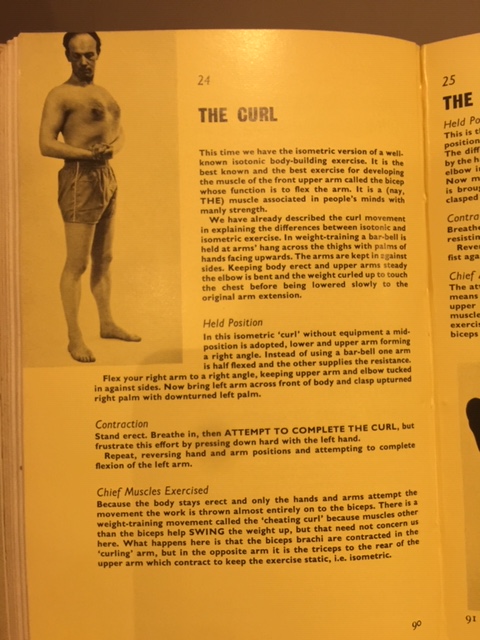




 Andrew Stemler