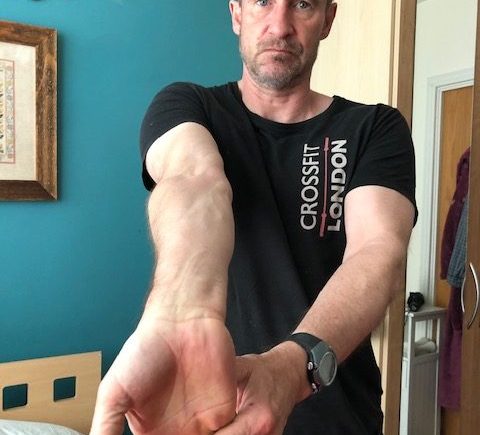
its actually quite a tricky muscle to stretch. Interestingly it inserts into the shoulder and then skips over to the forearm. Speaking with my therapist hat on, I’d say 85 % of shoulder problems have a “poor relationship” with the bicep. Getting some sort of stretch in, is therefore, good.
Stretch No 1
The “just straighten your arm” stretch. Do what it says on the tin. It’s better than nothing
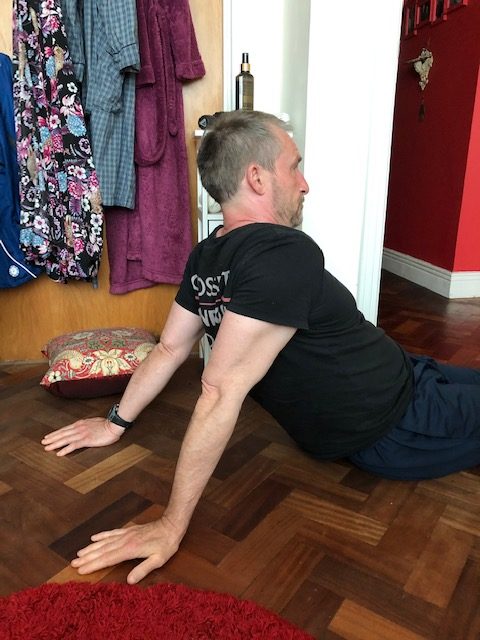
Stretch 2 is more fun. Sit down with your arms behind you and start sliding your bum forward. You’ll either feel the stretch in the elbow, the shoulder or in the belly of the muscle. Over the weeks, focus on getting your hips further forward to increase the stretch. Build to 2-3 minutes
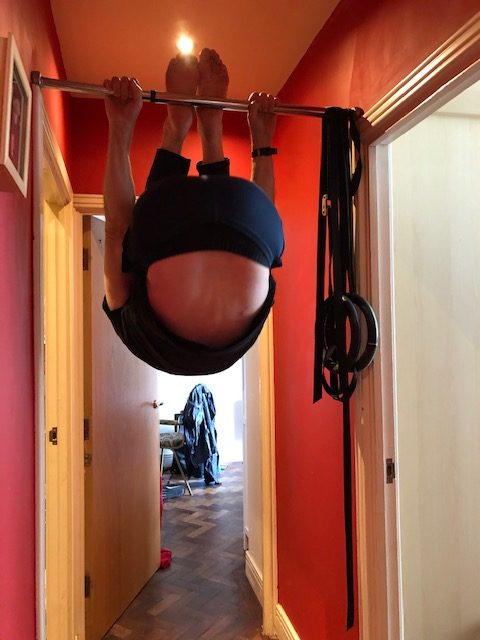
Number 3 is a disgusting stretch, so make sure you have built some stretch capacity by pushing Stretch 2 along for a few weeks. This hanging stretch is stolen from gymnastics and is called the German Hang. Find a low bar, hang off it. Pull your knees through your arms then keep on turning. Lower your legs to the floor and hang in your shoulders. Do start this with a low bar, as you may need to drop straight off even as you get into something resembling the position. Its very intense!
It also helps you understand the meaning of the word “intense”
If you can run 1 mile in sub 8 minutes: run 1 mile (1.6k) to equal or beat your last 1 mile time. Rest that amount of time, then run 1 mile (1.6k) . Attempt to keep the same pace ( or faster). ( this amounts to 2 miles (3.2k) in total.
If it takes you longer than 8 minutes to run a mile, run 1K as fast as you can; rest the amount of time it took you to do the 1st 1k. Then run 1 k again. ( 2k in total, not miles)
If your 1 mile (1.6k) time is between 8 and 9 minutes you can choose which task you feel will benefit you more. But we are looking at pace and speed if possible.
(new runners feel free to pick 400, 600, 800m as your distance)
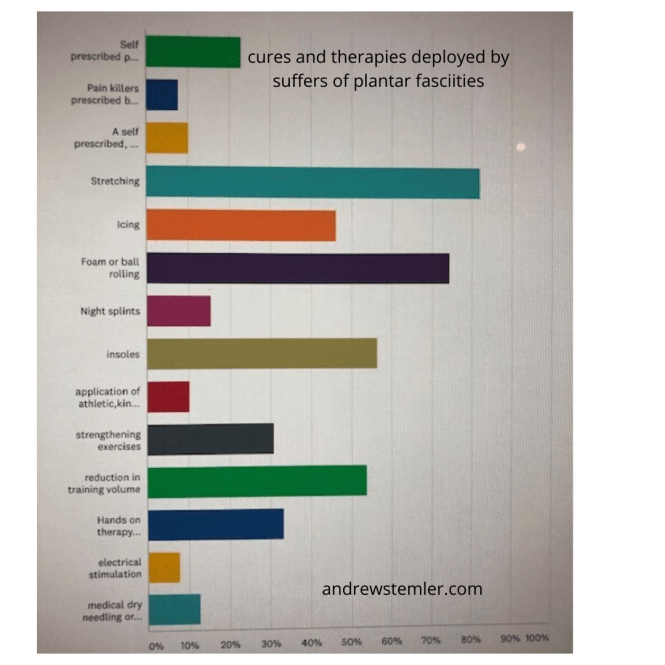
Whilst I talk about the various therapies and stretches for Plantar Fasciitis here, its worth tuning into the “length of stretch” debate.
If you look at Porter D, Barrill E, Oneacre K, May BD. The effects of duration and frequency of Achilles tendon stretching on dorsiflexion and outcome in painful heel syndrome: a randomized, blinded, control study. Foot Ankle Int 2002;23(7):619-624.
You’ll find two protocols coming neck and neck:
3 minutes of stretching 3 x a day (ie hold the stretch for 3 minutes) , or five sets, 20 seconds each, two times daily.
Either way, the take-home message that a quick reluctant 10-second stretch when you can be bothered, isn’t enough. The study also determined that both sustained and intermittent Achilles tendon stretching exercises increase Achilles tendon flexibility. This increase in flexibility correlated with a decrease in pain!
This is an idea that features heavily in my fix your plantar fasciitis course. It’s only £27 and has the most effective science-backed drills. Never waste money on physical therapy again!!
if you’d like other stuff sent to you free of charge, do join the mailing list
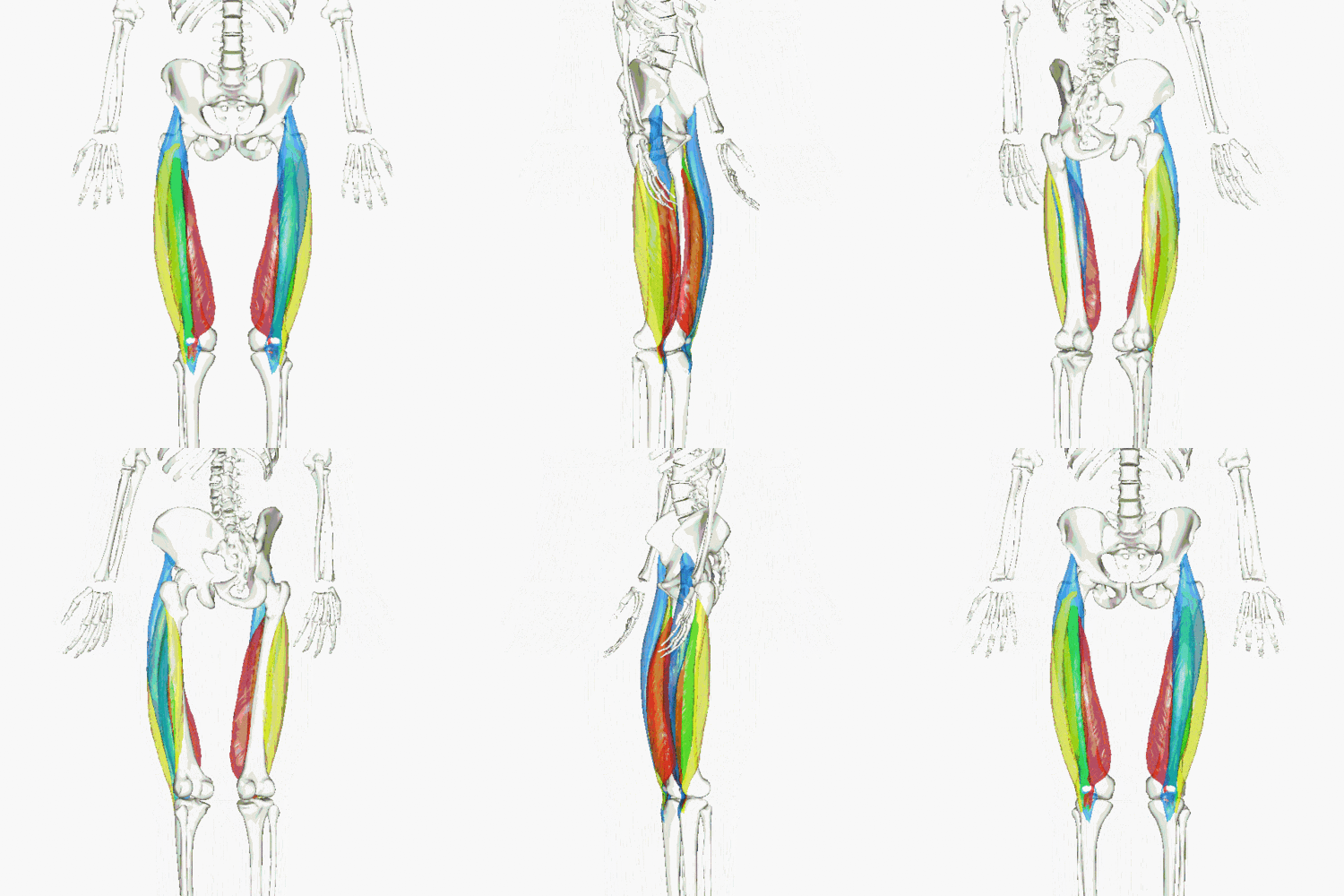
It’s impossible to get fit without someone reminding you to “stretch your quads”. The quads, or quadriceps ( quad for four) run up the top of the front of your leg. Three of them go from the knee cap to below your hip. One goes across the knee and then across the hip. Here is a useful graphic from wikipedia
Stretching these muscles is important as they are the ones most likely to become short if you sit too much. We all sit too much.
Here is the standing quad stretch that I think everyone must have seen at some stage
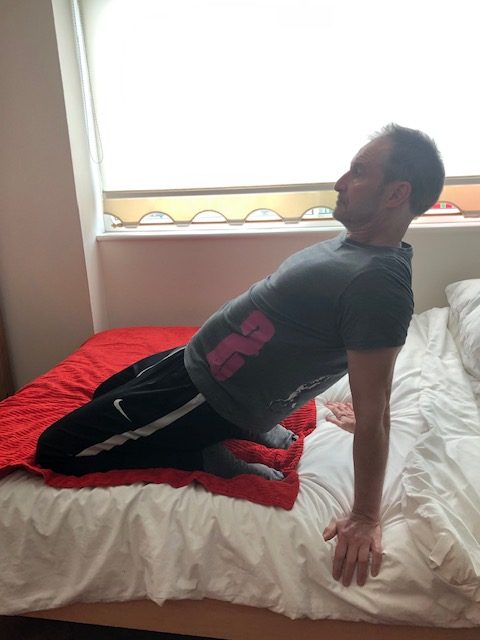
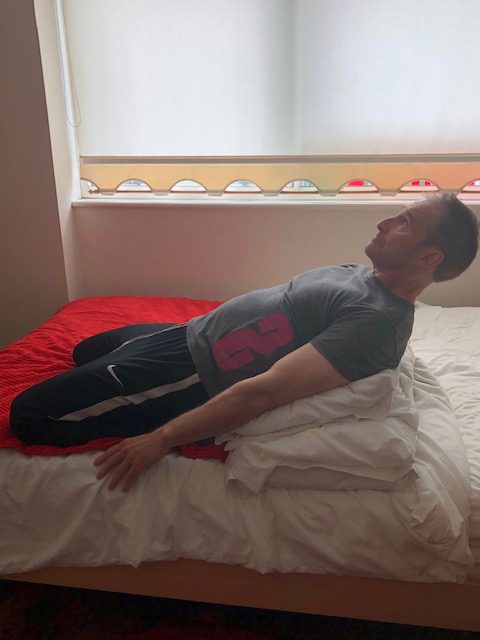
But this is just the start of your quad journey. Get on a bed (or anything comfy) and kneel down
Put your hands behind you and lean back. Some may find this hard. Don’t worry, just keep on getting used to it. Just incase you get stuck, it maybe as well to have someone around to pull you back up again if you cannot get back up again.
Once you build your confidence, get a cushion pile and slowly take a cushion away each time you try
Eventually you’ll simply lie down. you’ll notice my hips are fairly high, so to be a quad stretching master, eventually you need to pull your hips down.
Unfortunately, you probably need to build this up to 3 minutes. If your ankles are very tight you may need a small roll (a towel) under them, as the initial stretch can be quite intense! Enjoy. Slowly build up your time and tolerance. In the early stages,it’s just about getting used to it.
No matter how badly or poorly you have run, jogged, or staggered 20 meters plus, there will always be a fitness motivator screaming “good job, you lapped the guy on the couch”
Its sort of true, but at the same time they lapped everyone doing a static exercise: they lapped the person doing pull ups, deadlifts, the olympic lifts, bicep curls and hundreds of other stationary exercises: they lapped the guy doing burpees and tuck jumps, they lapped everyone on a concept 2 rower or an assault bike.
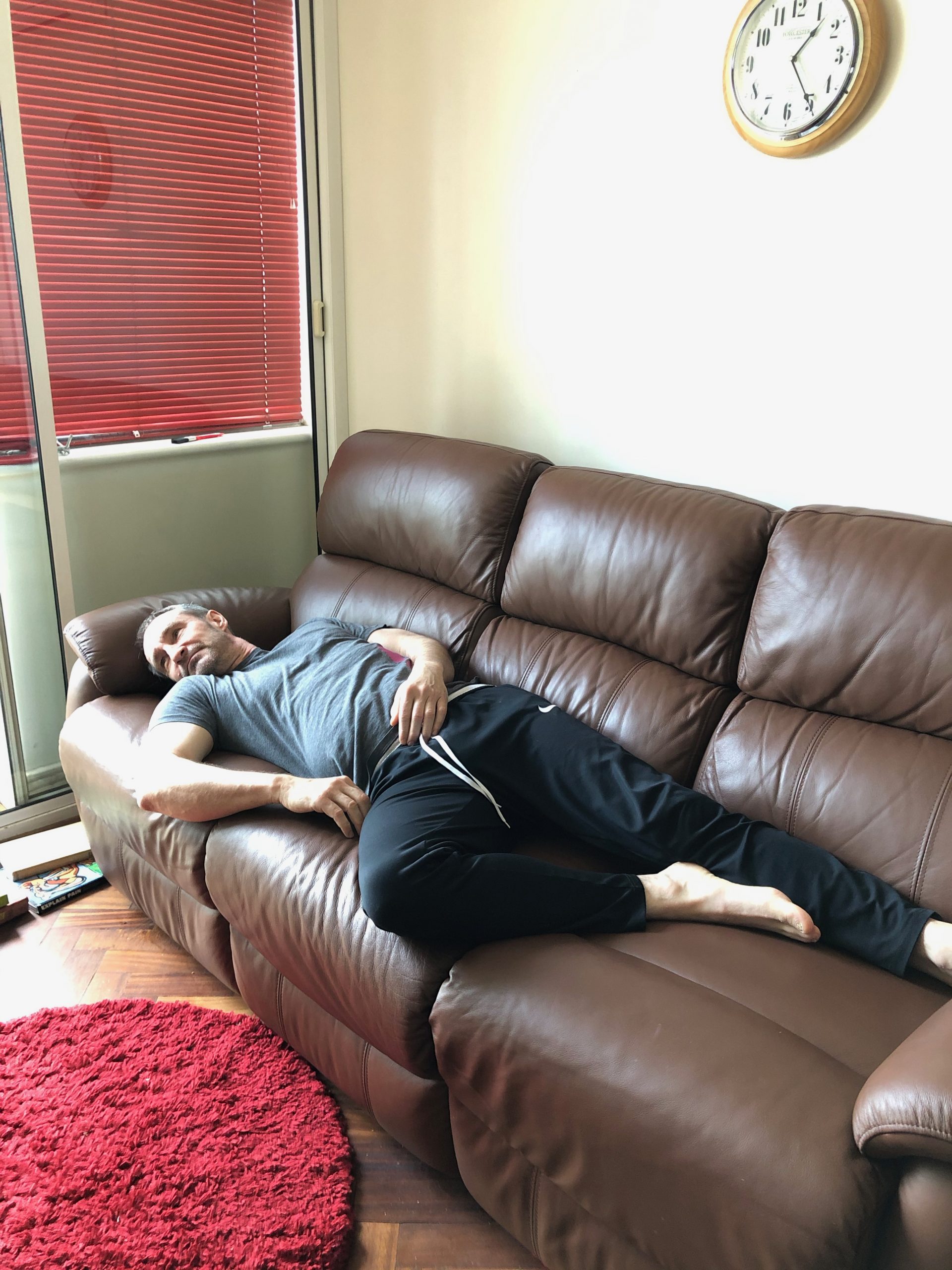
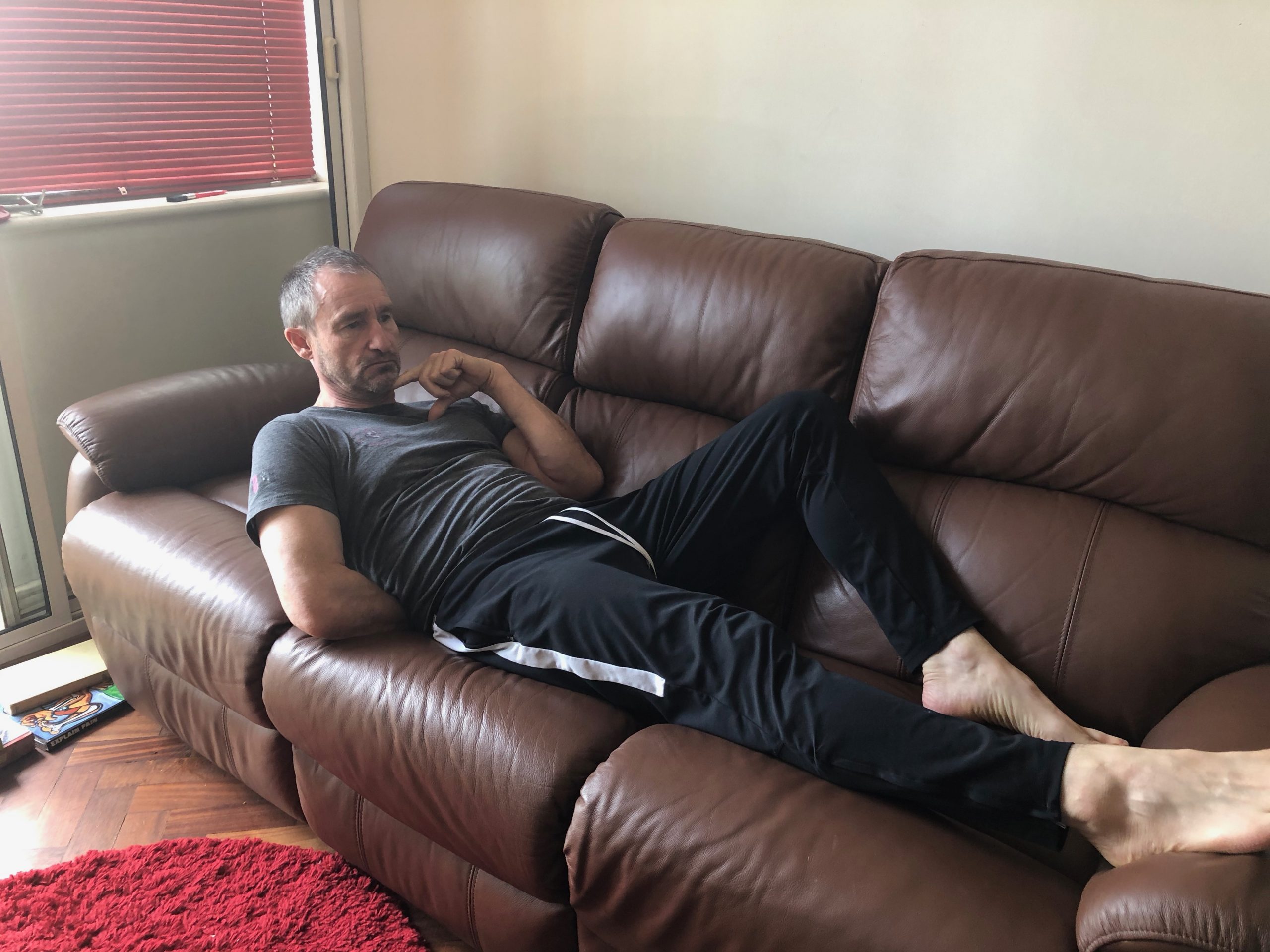
During fits of depression, or good old fashioned laziness, it super easy to crawl onto a couch and crash out. This means that deciding to get up, change, walk out the door and start jogging can be a super barrier.
I remember lying on the couch staring at the floor being unable to roll off and do one push up.
To build new habits and behaviours, they really need to be modelled on existing habits and behaviours. It’s very difficult to abandon bad behaviours, so its best to use them if you can.
If it’s a racing certainty that you will throw yourself onto the couch in the next few hours, connecting the couch with exercise could be the most effective exercise improvement you can make. This is crucial if you find yourself locked down.
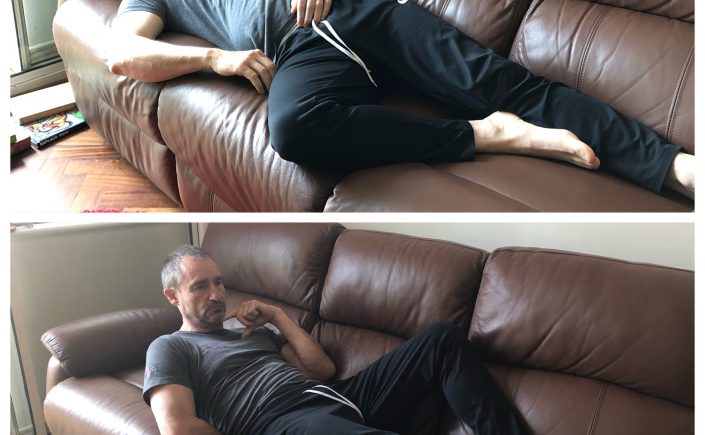
As a quick example I’ll use the curl up abdominal exercise. Its fairly easy to change from a couch slump
into something fairly near a therapeutic curl up!
Over the next few months, I’ll be showing you how you can get fit on your couch. moving from a slump into an effective exercise.
Obviously this is a great stand alone (lie alone) exercise. You don’t have to get on the couch to do it!
A big welcome to your Plantar Fascia. An unknown part of your foot, that, so it seems, you don’t have to worry about.
It will do whatever the hell it does for years, then one morning, in some unlucky people, it creates almost crippling heel pain.
First thing in the morning, upon getting out of bed, you’ll be in so much pain that even hopping across your bedroom floor is something you’ll dread. Even contemplating allowing your heel to touch the floor makes many want to throw up in their own mouths.
It’s not all bad. Just give it 5 or 10 minutes of hobbling around and you can begin to limp with a bit of dignity. Welcome to the party you now have plantar fasciitis. It often self cures, in anything from 6 weeks to TWO YEARS.
There are two positive sides to the condition:
1) You’ll meet lots of people online searching for a cure. So it’s like an agony based Tinder.
2) you’ll meet lots of dodgy therapists trying to part you from your money for quack cures. If you spot them, it’s fun to watch. If you cannot see a quack coming, its a bit expensive.
So some back ground, according to the BMJ plantar Fasciitis copy has the reputation of being “a trivial condition”. Clinically “benign and self limiting”. So, if you are limping around your bedroom, screaming with pain, wondering how you can get to the loo, don’t worry, its “benign and self limiting”.
Pull yourself together. Its not cancer
So who gets it?
Middle aged and older people. In some research I undertook, the age spread was thus
Athletes and active people
In my research, these were the activities being undertaken prior to Plantar fasciitis developing
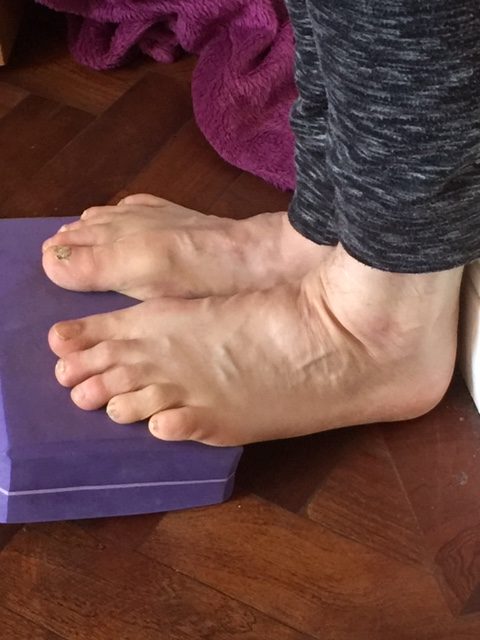
Those with a reduced range of ankle dorsiflexion. Its all about Equinus
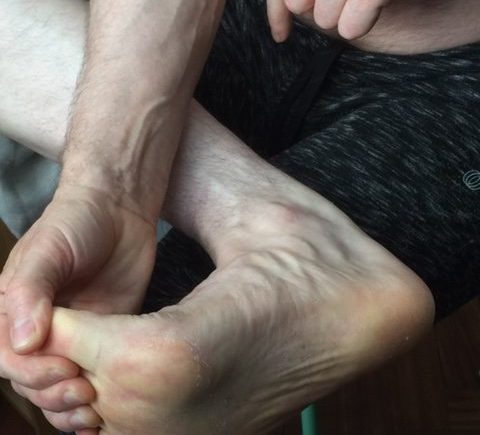
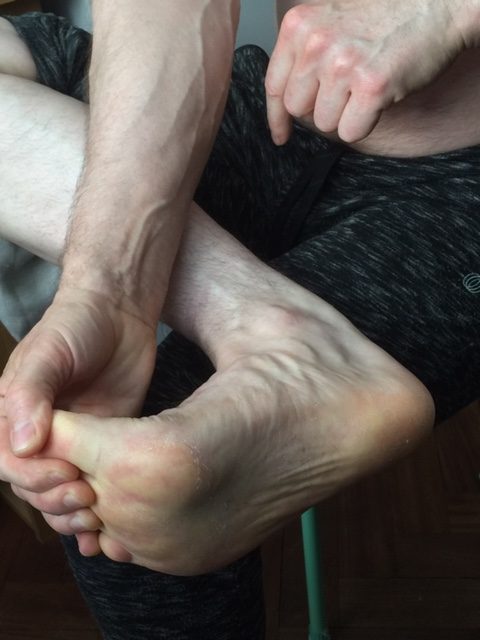
“sit with one leg crossed over the other, and stretch the arch of the foot by taking one hand and pulling the toes back toward the shin for a count of 10. The exercise must be repeated 10 times, and performed at least three times a day, including before taking the first step in the morning and before standing after a prolonged period of sitting”. Thanks to Benedict DiGiovanni and Nawoczenski,
Most foot issues (not only plantar fasciitis, but the nasty achilles tendonitis) benefit from a better range of ankle flexion and pliable calf muscles. This daily stretch is also a must!
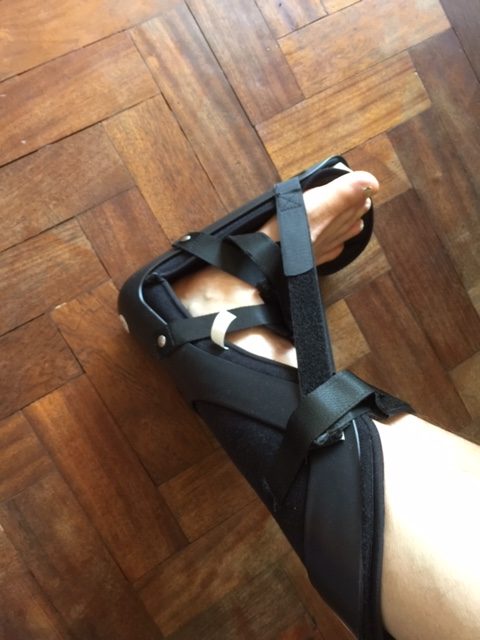
However, Crawford F, Thomson C. Interventions for treating plantar heel pain. Cochrane Database Syst Rev 2003; (3) found limited evidence to support the use of night splints to treat plantar fasciitis sufferers who had experienced pain for greater than 6 months. They found that patients treated with custom made splints improved but those with premade or ‘off the shelf’ splints did not.
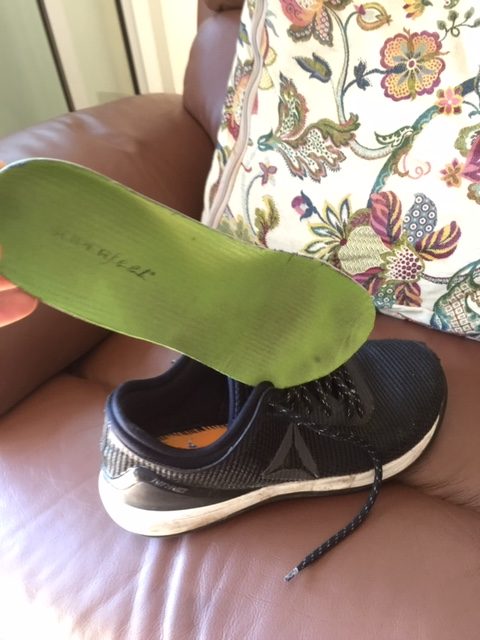
INSOLES: In my humble opinion, buying and wearing flatter shoes often causes Plantar fasciitis . This is often combined with the whole “go barefoot” rebellion. It’s based on the “well, its more natural, innit” concept and totally, totally fails to take into account the fact that you have worn heeled, and supported shoes for the last 20-30 years!
To actually fix your plantar fasciitis you need my SSES system ( stretch it, smash it, educate it, strengthen it). If you simply stretch it, the trigger points get you, and a lack of strength drags you back into pain. Strength on its own, without educating your muscles and restoring an effective range of motion, is also a low return strategy.
In this course, I’ll teach you these skills with a mixture of video, photos, and written teaching resources to help you learn. You’ll get my email address so any issues I’ll be there to help you. However, I’ll soon set up a free but private Facebook group to support you that way.
Maybe the strongmen of old didn’t have access to weights. I say that as, many of the old fashioned “get fit at home” manuals and pamphlets, put push ups and push up variations at the core of their regimes. Maybe they assumed that their home based clients didn’t have a “bench”.
Not a totally insane assumption.
So, push ups or “dips” as Charles Atlas called them, belong in any home regime. I think they are often overlooked.
Charles Atlas does his “dip”between two chairs in order to get a bigger range of motion. according to his pamphlet its great for “Chest, Shoulders and Back. Excellent for preventing Lung and Chest troubles. Do the dipping exercise at least 100 times every day. Aim to do it 200 times daily if you are keen on getting a very big and powerful chest development. Do this by dipping 25 or more times, rest and relax a few moments and do them again. Rest and do them again.” Charles Atlas said he did 200 daily.
However, it isn’t as simple as just doing any type of push up. Notice from this video that you are aiming for a planche push up. Your shoulders go forward and your hands end up as near the hips as possible
Of course, this is achievable if you already have push ups. If you don’t work your progressions like mad
In the time before the lockdown, I used to coach Olympic weightlifting at Crossfit London on a Saturday morning.
I mean, I was in the same room, at the same time as other people
Seems weird now.
Now that everyone has moved online, it’s easy to forget that that building explosiveness into fitness regimes, without weights can be tricky. The Olympic lifting drills are especially difficult to think up as , ideally, you want to the end up in a squat.
There are loads of fantastic stretches for your glutes ( your bottom muscles) . These are seen as the biggest, strongest muscle the body has, and is the one that really powers most human movement.
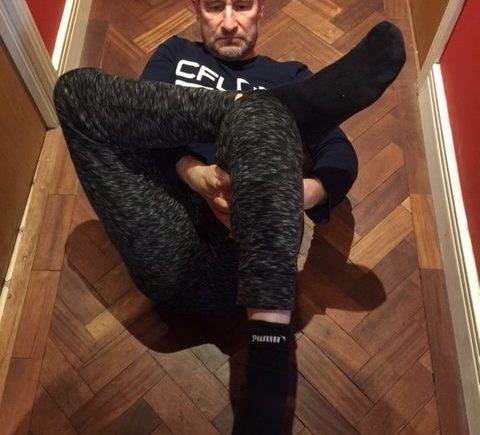
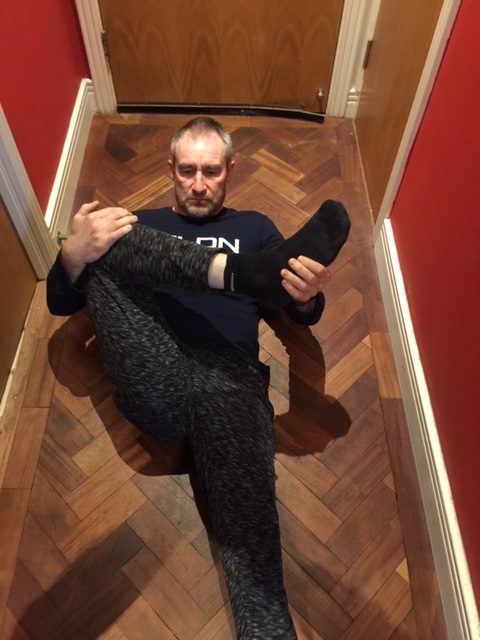
It’s crucial to build a supple muscle . Today, I’m just getting you used to this”easy” lie on your back stretch. Simply cross one leg over the over in a figure of 4 shape and pull the “4” towards you (see above). You’ll feel a great stretch.
If that doesn’t work for you, isolate the core of this moves by grabbing your leg and ankle so you can see what you have to do to get the stretch to work. Focus on pulling the knee up towards your chest, with a pull across your body (see below).
Having great flexible shoulders can make your day to day life much easier and improve your posture, as well as your gymnastics!
Basically, can you make you hands meet behind your back? If so, you are well on the way to some really useful shoulders, if not, this is your first port of call. Develop your shoulders individually, both the reaching down and the stretching up parts.
Work on these sub-stretches, with some other drills we will show you, and your shoulders, too, will become lovely.










 .
.




 Andrew Stemler